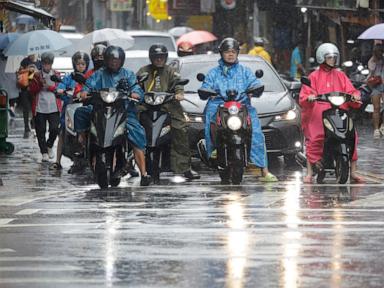
Taiwan suspended classes and halted flights when Typhoon Champi grazed the island, turning a seemingly glancing blow into a sweeping test of public safety rules, aviation margins, and economic stamina. On paper, a storm brushing past a coastline sounds minor. In practice, wind shear, heavy rain bands, and strict legal triggers forced immediate closures before the worst gusts even arrived.
Having covered Pacific weather disruptions for decades, I have learned that the headline rarely captures the real friction. A storm does not need to make a direct hit to paralyze a tightly scheduled island economy. When Typhoon Champi swept past offshore waters, authorities and airlines were reacting to barometric pressure, forecast uncertainty, and hard numerical thresholds rather than waiting to see which neighborhoods flooded first.
Why a Glancing Blow Still Shuts Down Daily Life
Most people assume closures happen only when the eye of a storm aims straight for a major city. That assumption misses how meteorological risk works in the western Pacific. Tropical cyclones are sprawling engines of moisture and spin, and their outer rain bands and gust fronts often reach hundreds of kilometers from the center.
Even when Typhoon Champi stays offshore, shifting steering currents can pull heavy squalls onto coastal plains and mountain slopes on short notice. Local officials rely on quantitative wind and rainfall projections to decide whether children can safely travel to school or whether municipal workers should stay off the roads. Once those forecast thresholds are crossed, the machinery of caution kicks in automatically.
There is a practical reason officials move early rather than waiting for confirmation on the ground. Evacuations, utility staging, and school notices take hours to ripple through dense cities and rural counties alike. Waiting until winds peak turns a controlled pause into a scramble.
Yet early caution carries its own cost. When a storm brushes by without delivering catastrophic damage, critics inevitably ask whether the shutdown went too far. That tension is permanent in disaster management because safety decisions are made under uncertainty, while judgments are passed in hindsight.
The Aviation Math Behind Grounded Flights
Flight cancellations during a near-miss often puzzle travelers looking up at patchy clouds or light drizzle. Commercial aviation does not operate on ground conditions alone. Pilots and dispatchers care deeply about wind speed and direction at altitude, crosswind limits on runways, and rapid shifts in wind shear during takeoff and landing.
A storm brushing past an island can bend upper-level airflow in ways that exceed aircraft certification limits long before surface gusts look dramatic. Crosswinds push planes laterally toward the edge of the pavement, while sudden shear can alter airspeed in seconds. No airline wants to test those tolerances when an alternate diversion airport is also dealing with weather.
Airspace Bottlenecks and Aircraft Positioning
Groundings also stem from logistics that have nothing to do with the runway outside a traveler's window. Aircraft are part of a tight rotation across regional hubs. When Typhoon Champi disrupts schedules along key corridors, planes and crews get stranded out of position.
Canceling flights proactively prevents cascading delays that can clog terminals for days. Still, aviation is an imperfect science. Forecasting exact storm tracks and wind fields hours ahead involves ranges of error, which means one carrier might trim its schedule aggressively while another holds out hope until the last update.
Schools on Pause and the Hidden Strain on Families
Closing schools is one of the clearest signals that authorities take a weather threat seriously. Students avoid risky commutes on slick roads, falling branches, and swollen creeks, and school buildings sometimes double as emergency shelters or staging points.
For working parents, however, a weather day is rarely a simple break. Caregivers with inflexible shifts, healthcare workers, retail staff, and factory operators must piece together last-minute childcare on zero notice. A hypothetical example illustrates the squeeze: a parent working a hospital shift in a coastal city might have to choose between leaving a young child with a neighbor or taking unpaid leave when classes are called off overnight.
Schools are indispensable safety buffers, yet they also anchor daily routines across the island. Every weather closure exposes how fragile household schedules can be when institutional support pauses suddenly.
Policy Triggers Versus Real-World Nuance
Automatic or semi-automatic shutdown rules give the public clarity. Families and businesses know what numbers matter instead of guessing behind closed doors. Transparency builds trust when conditions are tense.
At the same time, rigid cutoffs have blind spots. Coastal fishing ports, highland agricultural valleys, and flat urban basins experience the same weather system very differently. A broad threshold can over-restrict calm pockets while still feeling stretched in exposed spots.
Local leaders face a constant balancing act between uniform rules and tailored exemptions. Move too slowly, and someone gets hurt on a flooded underpass. Move too broadly too often, and public fatigue sets in, making people less likely to take future warnings seriously.
Economic Ripple Effects Beyond the Storm Track
When Typhoon Champi brushes past, the economic tally extends well beyond fallen trees or canceled tickets. Supply chains depend on predictable handoffs at ports, airports, warehouses, and offices. A one-day pause ripples through just-in-time inventory, perishable cargo, and service-sector payrolls.
Smaller businesses feel that squeeze most sharply. A neighborhood cafe or independent shop loses daily revenue it cannot easily recover once the week moves on, even if physical damage to the storefront is zero. Larger firms can often shift work remotely or absorb a short dip, whereas hourly workers shoulder the immediate loss of shifts.
Over decades of watching storms skirt major population centers, one pattern stands out above all others. Near-misses rarely make history books the way direct hits do, yet they shape public habits, airline playbooks, and crisis readiness every single season. Treat every close call as a live rehearsal for the direct hit that is never guaranteed to miss next time.


