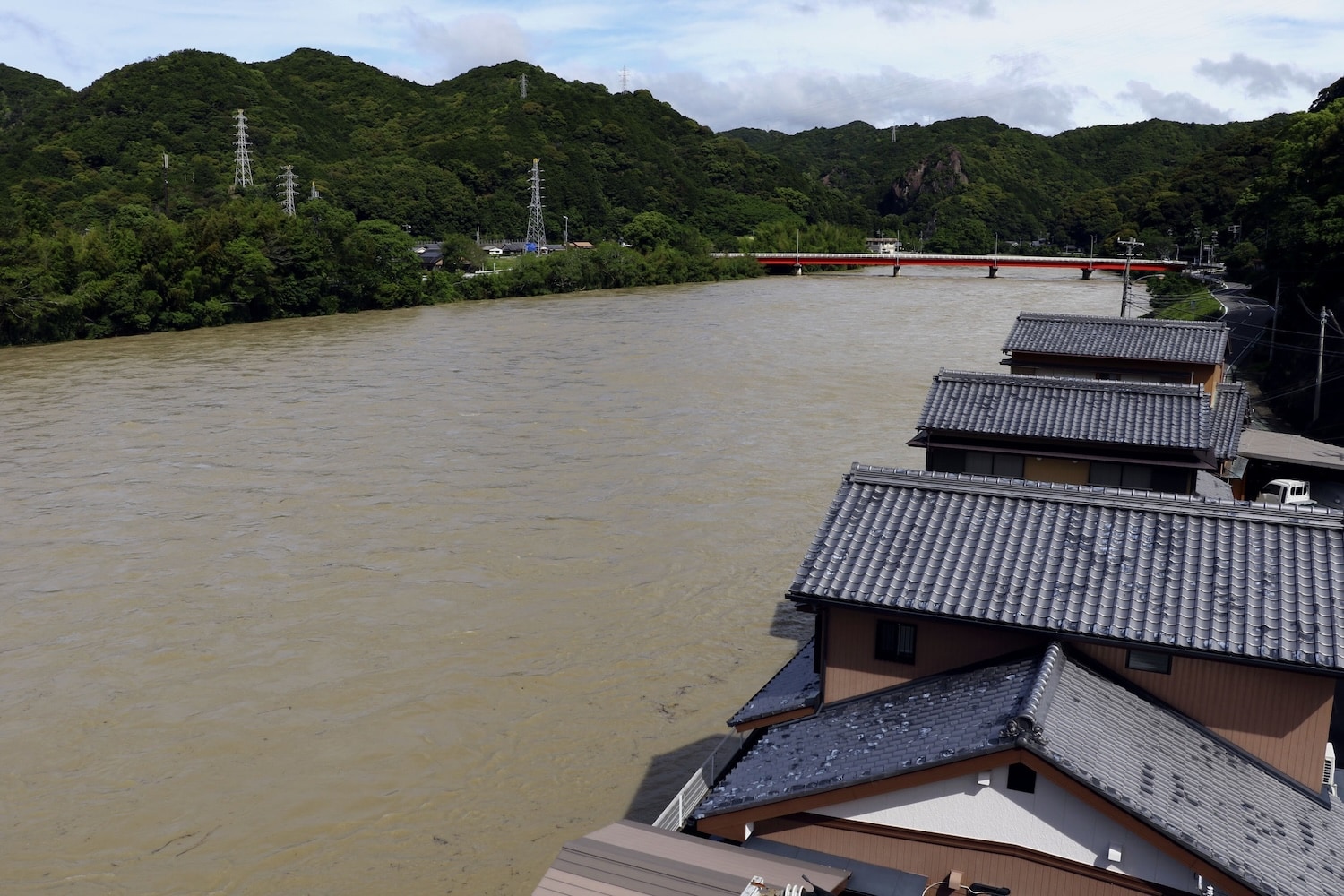
Severe Tropical Storm Jangmi tore through mainland Japan on Wednesday, cutting electricity to nearly 60,000 households, grounding 900 flights, and triggering highest-level evacuation orders for hundreds of thousands of residents across the greater Tokyo region. The immediate devastation follows a predictable pattern of seasonal extreme weather. Beneath the sensational headlines of darkened living rooms and grounded Boeing 777s at Haneda Airport lies a much harsher structural reality. Tokyo’s globally renowned, multi-billion-dollar flood defense network is running out of headroom.
For decades, the Japanese capital has relied on an engineering marvel to keep its streets dry. The Metropolitan Area Outer Underground Discharge Channel, often referred to as the G-Cans project, acts as a massive subterranean safety valve. When rivers like the Zenpukuji, Kanda, or Nogawa swell toward disaster levels, overflow channels divert billions of gallons into titanic underground silos before pumping the water safely out to the Tokyo Bay.
It is an incredibly complex system that worked perfectly for the climate realities of the late 20th century. Jangmi proved that those realities no longer exist.
The Linear Rainband Problem
The true danger of the storm did not stem from its raw wind velocity. After tracking over Okinawa and making landfall in Wakayama Prefecture with peak intensity, Jangmi was actually downgraded from a full typhoon down to a severe tropical storm. The real crisis developed when the system stalled and birthed what meteorologists call a linear rainband.
A linear rainband is a stationary conveyor belt of severe cumulonimbus clouds. It dumps immense volumes of water over a highly concentrated geographic area for hours on end. Owase in central Japan recorded a staggering 50 centimeters of rainfall in a 24-hour window. As that moisture-heavy system tracked northeast directly into the Kanto Plain, it overtaxed local river systems simultaneously.
When a single storm drops over 20 centimeters of water on a concrete metropolis like Tokyo, the ground cannot absorb it. Urban runoff spikes instantly. The Zenpukuji River neared the absolute brink of its banks on Wednesday morning, sending muddy torrents toward residential neighborhoods and forcing level 4 evacuation alerts across major hubs like Shinagawa Ward.
Major industrial operations recognized the systemic risk immediately. Toyota Motor halted production across 13 of its domestic assembly plants on Wednesday morning, choosing to absorb massive operational losses rather than risk stranded workers or flooded supply chains. Suzuki Motor followed suit, paralyzing five factories in neighboring Shizuoka Prefecture. These decisions are not made lightly. They represent an unspoken corporate acknowledgment that Tokyo’s transport grid can no longer guarantee safe passage during a modern atmospheric event.
The Grid Under Siege
While the underground vaults were working at absolute capacity, Tokyo Electric Power Co. (TEPCO) struggled to maintain the city's surface infrastructure. High winds hitting 25 meters per second whipped debris into overhead distribution lines, knocking out power to tens of thousands of homes across the Kanto-Koshin region.
Japan’s grid vulnerability remains a paradox. The nation boasts some of the most advanced grid-stabilization technology in the world, yet its metropolitan areas remain choked with a dense web of utility poles and overhead lines. Burying these cables underground is a slow, prohibitively expensive process that local governments have dragged their feet on for decades. During an event like Jangmi, these exposed lines act as low-hanging fruit for falling trees and airborne debris.
A short circuit in one neighborhood cascades. Substation redundancies can reroute power to a degree, but when dozens of local distribution nodes fail simultaneously under the weight of localized landslides and water logging, repair crews are left paralyzed by flooded roads.
Flight Cancellations and Rail Paralysis
The transport shutdown ripple effect was felt worldwide. Japan Airlines and All Nippon Airways were forced to scrap nearly 900 flights, including all departures out of Haneda Airport before noon on Wednesday. More than 90 international routes were severed, stranding business travelers and disrupting global air freight networks.
On the ground, East Japan Railway systematically shut down lines linking Tokyo to the surrounding prefectures. Standard express services to Chiba, Shizuoka, and Tochigi were entirely canceled. While the Tokaido Shinkansen bullet train limped along with major delays, the broader commuter network that feeds 40 million people into the metropolitan core ground to a complete halt.
The Myth of Absolute Engineering
The core premise of Tokyo's civil defense has always been control. Concrete embankments, massive sluice gates, and underground cathedrals were built to tame nature. Yet, civil engineers have quietly warned that these defenses possess an inherent breaking point.
The G-Cans system and related subterranean reservoirs are rated for historical rainfall maximums. They assume a statistical limit on how much water can fall within an hour. Linear rainbands throw those historical baselines out the window. If an atmospheric event dumps rain faster than the massive pumps can discharge water into Tokyo Bay, the underground vaults will fill to capacity. When that happens, the water has nowhere to go but up into the city streets.
We are seeing the early warning signs of this system failure. The emergency safety warnings issued for the Koza River in Wakayama, where waters actually breached the banks before receding, serve as a stark preview of what face-to-face failure looks like in a major metropolitan center.
Fixing this vulnerability requires a massive shift away from pure structural engineering toward aggressive urban adaptation. Tokyo cannot simply dig bigger holes. The city needs to embrace permeable architecture, convert public parks into temporary retention basins, and accelerate the undergrounding of its power grid to prevent a storm from cutting off communication and power when residents need it most.
Jangmi was a wake-up call wrapped in a downgraded storm. The 60,000 darkened homes and swelling rivers are symptoms of a deep structural deficit. Tokyo survived this specific round of torrential downpours, but the buffer zone between engineering triumph and systemic catastrophe has never been thinner.