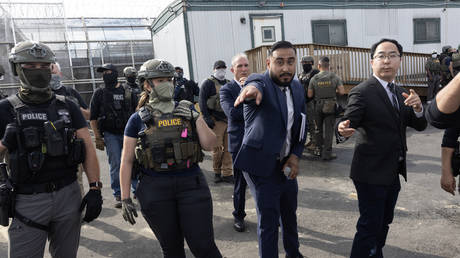
The Friction on the Front Lines
Federal immigration enforcement has crossed a visible threshold. Incidents involving the deployment of chemical agents like tear gas during standoffs between Immigration and Customs Enforcement (ICE) personnel and civilian demonstrators are no longer isolated anomalies. They represent a fundamental shift in tactical operations. When crowd control measures collide with community resistance, the result is an immediate escalation that extends far beyond the physical perimeter of a single protest. This flashpoint highlights a deeper structural evolution within domestic law enforcement agencies.
The immediate driver of these confrontations is a shift toward aggressive field tactics designed to bypass municipal non-cooperation policies. As cities restrict local police participation in federal immigration actions, ICE has adapted by deploying specialized, heavily equipped units to execute high-risk operations. This strategy inevitably increases the probability of direct, volatile engagements with organized protest networks.
The Evolution of Domestic Enforcement Tactics
To understand why chemical agents are now appearing in urban neighborhoods, one must examine the operational structure of modern federal enforcement. ICE utilizes specialized tactical groups, primarily the Homeland Security Investigations (HSI) Special Response Teams and Enforcement and Removal Operations (ERO) special tactical units. These teams train alongside military and high-level police SWAT units. Their equipment inventory includes less-lethal munitions, distraction devices, and various chemical irritants.
Originally, these assets were reserved for high-risk operations involving barricaded suspects, human trafficking rings, or transnational gang activity. Today, the operational boundaries have blurred. When field agents encounter unexpected civilian blockades or active interference during routine administrative arrests, the command structure frequently authorizes a rapid escalation in force to secure the perimeter and exit the area swiftly.
This tactical pivot stems directly from operational necessity. In jurisdictions with strict sanctuary laws, federal agents cannot rely on local police for crowd management or perimeter security. Left to secure their own operational zones, federal units treat civilian blockades not as political expressions, but as active tactical hazards.
The Logistics of Local Resistance
Protest movements have evolved with equal speed. Flash mobilization networks utilize encrypted messaging apps and real-time location tagging to deploy hundreds of demonstrators to enforcement sites within minutes. What begins as a standard vehicular stop or a targeted residential warrant quickly transforms into a high-intensity standoff.
For the field commander, time is the enemy. A prolonged confrontation increases the risk of injury to agents and detainees alike. When a crowd surrounds an enforcement vehicle, tactical doctrine favors the use of airborne irritants to create immediate physical separation. It is a mathematical calculation of space and compliance, executed with mechanical efficiency.
The Legal and Health Realities of Chemical Deployment
The use of tear gas and pepper spray in domestic civilian environments remains one of the most contentiously debated aspects of modern policing. While international treaties ban these substances in warfare, domestic law enforcement agencies face no such restrictions.
The primary agents utilized are CS gas (2-chlorobenzalmalononitrile) and OC spray (oleoresin capsicum). These compounds target the mucous membranes, causing involuntary blindness, intense burning sensations, and immediate respiratory distress.
+------------------+----------------------------------+------------------------------------+
| Agent Type       | Primary Physiological Effect     | Operational Objective              |
+------------------+----------------------------------+------------------------------------+
| CS Gas           | Severe respiratory irritation    | Area denial, rapid dispersal       |
|                  | and involuntary tearing          | of large crowds                    |
+------------------+----------------------------------+------------------------------------+
| OC Spray         | Intense burning, temporary       | Individual compliance, localized   |
|                  | blindness, skin inflammation     | perimeter defense                  |
+------------------+----------------------------------+------------------------------------+
In dense residential areas, the deployment of these agents carries significant collateral risks. Wind drift frequently carries chemical clouds into schools, private residences, and unrelated businesses. This creates a secondary layer of community trauma, affecting individuals who have no participation or investment in the ongoing political dispute.
The Strategy of Escalation
The broader implications of this tactical shift point toward an increasingly fractured domestic security environment. Federal agencies are doubling down on autonomy, while local municipalities continue to restrict cooperation. This leaves a vacuum that is increasingly filled by direct, physical conflict on American streets.
The current trajectory suggests that the use of specialized tactical gear and crowd dispersal agents will become standard components of urban immigration enforcement. As long as the underlying political gridlock prevents a cohesive legislative resolution on immigration, the burden of execution will remain on the shoulders of field operatives who view compliance through the narrow lens of tactical control.
This environment leaves no room for gray areas. Every enforcement action carries the potential to trigger a localized crisis, turning routine bureaucratic executions into battlegrounds for the soul of domestic policy.