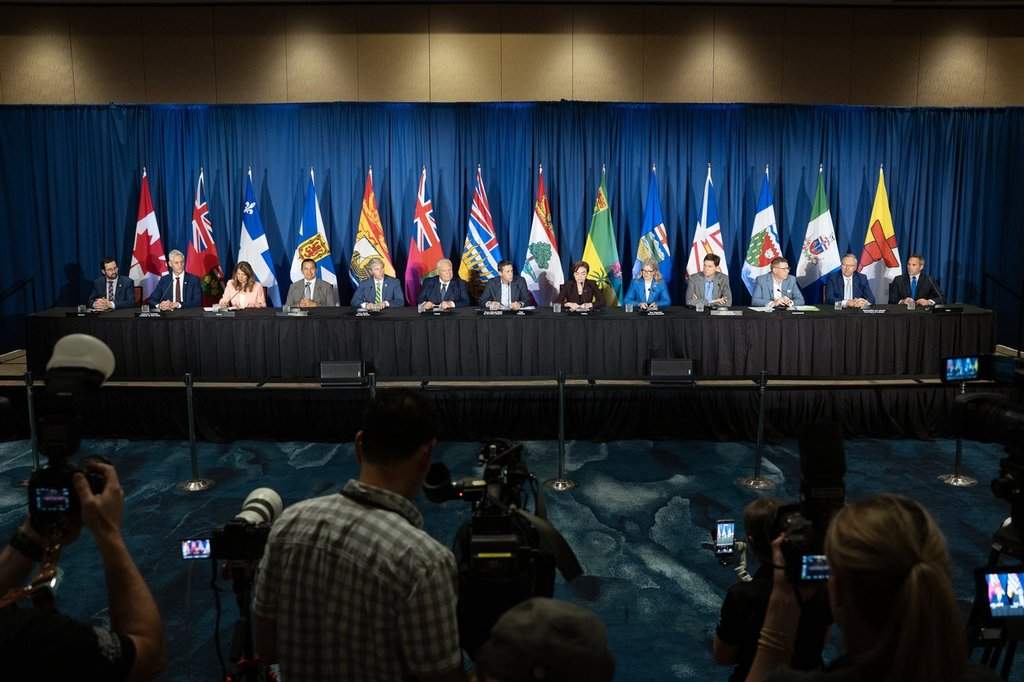
When Alberta Premier Danielle Smith placed sweeping constitutional changes and a potential separation pathway before voters, the rest of the provincial capitals responded with a deafening, calculated quiet. While political pundits in Central Canada treated the ballot questions as an existential crisis for Confederation, provincial counterparts from Victoria to St. John's offered little more than guarded observations.
This vacuum of commentary was not born of indifference. It was a masterclass in tactical containment. Provincial premiers understand the mechanics of Canadian federalism far better than temporary electoral strategists, and they recognized that engaging with Alberta's structural grievances would only validate a constitutional strategy designed to fracture national unity.
The Anatomy of Intergovernmental Silence
To understand why provincial leaders chose to look away, one must examine the high-stakes chess match of executive federalism. When a province attempts to rewrite the rules of judicial selection, Senate accountability, or fiscal autonomy through a localized referendum, it exerts centrifugal force on the entire federation.
Yet, answering back carries immediate political peril. If a premier from Atlantic Canada or Ontario condemns the push, they hand Edmonton a convenient rhetorical weapon, allowing local populist factions to frame the critique as eastern interference. If they endorse any part of the structural overhaul, they open Pandora's box for their own local negotiations with Ottawa.
Silence becomes the only defensive armor that works. By refusing to amplify the referendum debates, provincial leaders starved the initiative of the pan-Canadian friction it required to become a genuine national crisis.
Why Structural Demands Fall Flat Across Provincial Lines
The core of the disconnect lies in the asymmetry of Canadian provinces. What works as a grievance-fueled rallying cry in western town halls often registers as an administrative impossibility in provinces facing entirely different economic realities.
Take the proposals regarding regional priority or opting out of federal programs while retaining financial transfers. Provinces dependent on federal equalization payments cannot afford to cheer for a mechanism that threatens to dismantle the redistributive architecture of the country. At the same time, resource-have provinces guarding their own provincial jurisdiction are notoriously protective of their exclusive constitutional turf. They have zero appetite for a messy, open-ended constitutional renegotiation that could weaken their own standing vis-à-vis Ottawa.
When voters ultimately rejected the constitutional amendment questions on the ballot, it confirmed the intuition of neighboring premiers. Albertans signaled a clear desire to address economic friction without rewriting the foundational text of the nation. The expected domino effect across provincial legislatures simply did not materialize because the other premiers knew that constitutional reopening is a zero-sum game with no guaranteed survivors.
The Cost of Managing Ottawa Through Referendum Theater
Using provincial referendums as leverage against the federal government is a high-risk gamble that yields diminishing returns. Every time a premier forces a confrontation over constitutional architecture, institutional fatigue sets in among the electorate.
The strategy treats foundational law as a temporary bargaining chip. Real governance requires tedious, unglamorous negotiation behind closed doors—precisely the kind of work that does not fit neatly onto a polling card. While political theater can dominate the news cycle for a legislative session, it leaves behind structural scars that complicate future federal-provincial cooperation.
As the dust settles on the aftermath of the vote, provincial capitals have returned to their familiar posture of pragmatic, transactional federalism. They negotiate quietly on healthcare transfers, infrastructure matching, and resource corridors, ignoring the grand constitutional designs that briefly captured the headlines. The quiet from the premiers' offices was never an oversight. It was an intentional rejection of a distraction, signaling that the real work of the country happens far away from the referendum stage.