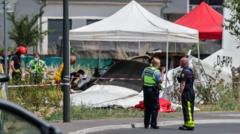
Eleven people boarded a single-engine aircraft at the Nancy-Essey aerodrome in eastern France, expecting an afternoon of standard recreational aviation. Within minutes, every individual on board was dead. The aircraft, a Pilatus PC-6 Turbo Porter carrying five skydiving students, five instructors, and a single pilot, plummeted almost vertically into a grassy field in the commune of Tomblaine. It missed a row of suburban homes by mere meters. The victims on board were not daredevils, but rather a group of independent local nurses trying to unwind during a punishing summer heatwave. They died in full view of their families who had gathered at the edge of the runway with cameras raised to capture what was supposed to be a joyous milestone.
The immediate coverage of the Tomblaine disaster followed a predictable script. Media outlets focused heavily on the heartbreak of the families, the sudden silence of the engine, and the shock of local officials. But this tragedy is not an isolated piece of bad luck. It exposes a systemic, structural vulnerability within the recreational aviation and skydiving sectors across Europe. For decades, the industry has relied on aging, single-engine utility aircraft pushed to their mechanical limits by the unique, high-cycle demands of jump operations. When an engine fails on a commercial airliner, redundant systems and multiple power plants give the crew options. When a single-engine turboprop suffers a catastrophic power loss during a steep skydiving ascent, gravity wins almost instantly.
The Fatal Minutes at Nancy Essey
Eyewitness accounts from the ground near the Salvador Allende street area describe a sudden, sickening alteration in the sound of the aircraft. One local resident noted that the distinctive hum of the turboprop simply stopped. This silence was followed immediately by a loud impact. Flight data indicates that the German-registered aircraft took off, began its initial climb, banked sharply to the left, and then lost all forward momentum.
Skydiving flights are fundamentally different from point-to-point transportation. They require rapid, high-angle climbs to maximize the number of rotations an airfield can manage in a single afternoon. This operational blueprint places immense thermal and mechanical strain on the engine. The Pilatus PC-6 is a legendary workhorse, renowned for its short take-off and landing capabilities. However, its single-engine configuration means that any severe drop in propulsion during the critical climb phase leaves the pilot with a zero-sum calculation. At low altitudes, there is insufficient time to glide, insufficient altitude to deploy parachutes, and zero room for error. The plane simply falls straight down.
The Illusion of Redundancy in Utility Turboprops
The aviation community frequently praises the reliability of modern turboprop engines. They are remarkably efficient machines. Yet, the absolute reliance on a single power plant in commercial skydiving operations represents a calculated risk that participants rarely understand. Most first-time jumpers assume that the safety margins of the aircraft match those of a commercial airline. They do not.
Commercial passenger transport under European Union regulations generally mandates twin-engine aircraft for specific high-risk profiles. Skydiving clubs, operating under recreational or specialized operation frameworks, frequently circumvent these stringent requirements. They utilize single-engine assets to keep operational costs low enough to attract casual consumers. A twin-engine jump plane costs significantly more to maintain, fuel, and insure. By choosing single-engine platforms, the industry prioritizes economic viability over mechanical redundancy.
When an engine failure occurs at three hundred feet, the laws of aerodynamics dictate the outcome. The pilot cannot restart the engine in time. The heavy load of eleven passengers shifts the center of gravity as the plane stalls. Without a second engine to provide asymmetric thrust or maintain airspeed, the aircraft enters an unrecoverable dive.
The Cross Border Registration Loophole
Investigators from the air transport gendarmerie and forensic identification services are currently examining the wreckage of the Tomblaine crash. A key focus of any deep-dive investigation into European light aviation must be the registry of the aircraft. The plane involved in the Nancy disaster was registered in Germany but operated by a French parachuting school.
This cross-border arrangement is common across the continent. It often allows operators to navigate differing national maintenance oversight regimes. While the European Union Aviation Safety Agency sets baseline rules, the day-to-day enforcement and inspection cycles fall on national authorities. Some operators prefer certain registries because the administrative burdens or specific maintenance timelines are perceived as less restrictive.
This regulatory fragmentation complicates oversight. A plane based in France but answerable to German maintenance logs can fall into an inspection grey zone. Local inspectors may lack immediate jurisdiction over the foreign registry, while home-country regulators rarely inspect assets permanently stationed hundreds of miles away. It is a system built on trust and paperwork rather than rigorous, hands-on spot checks.
When Skydiving Operations Push Mechanical Limits
A typical skydiving aircraft undergoes dozens of cycles a week. It starts, climbs aggressively to altitude, dumps its passengers, descends at a high rate of speed to minimize fuel consumption, and repeats the process. This cycle profile causes rapid temperature fluctuations within the engine components. Turbine blades expand and contract at extreme rates.
Compounding this mechanical stress is the seasonal nature of the business. The Tomblaine tragedy occurred during a severe heatwave. High ambient temperatures decrease air density, which simultaneously reduces engine performance and wing lift. To achieve the same climb rate in hot air, an engine must run hotter and harder. If maintenance schedules do not adjust for these extreme environmental variables, hidden flaws like fatigue cracks or fuel system blockages can manifest catastrophically during take-off.
The tragedy in eastern France should force a structural re-evaluation of how recreational aviation operates. Continuing to permit heavy passenger loads on single-engine aircraft during high-stress flight profiles is a gamble that the industry cannot justify. Until regulators mandate twin-engine redundancy or implement strict, universal oversight on cross-border club charters, the safety of every student jumper remains tethered to a single point of failure.