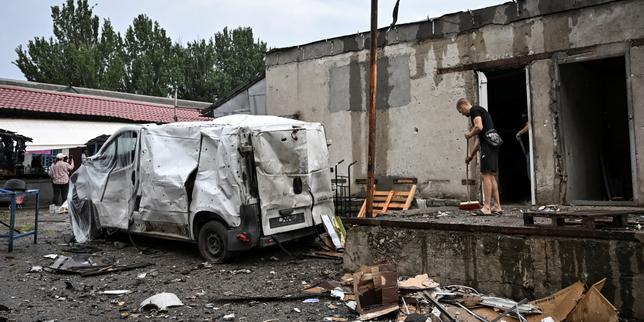
The sirens in Zaporizhzhia do not sound like warnings anymore. They sound like white noise, an ambient mechanical hum that weaves through the daily rhythm of a city caught in the crosshairs of an industrial-scale war of attrition. When local authorities log the daily tally of incoming munitions, numbers like five hundred strikes across forty settlements in a single twenty-four-hour cycle cease to shock. They become baseline data.
Behind the standard bulletins reporting residential casualties and shattered masonry lies a far more grueling reality. The airspace above southern Ukraine has transformed into a saturated laboratory for automated warfare. Building on this idea, you can find more in: The Anatomy of Gray Zone Attrition A Quantitative Deconstruction of Taiwan Strait Pressure Metrics.
The Arithmetic of Exhaustion
Look past the individual headlines of fallen roofs and localized blazes. The strategic weight of the campaign across the Zaporizhzhia region centers on persistent saturation. Russian forces rely less on high-value, pinpoint missile salvos here and more on an unyielding continuum of first-person view drones, heavy artillery, and guided aerial bombs.
Consider the mechanics on the ground. A typical daily log from regional military administration head Ivan Fedorov details hundreds of unmanned aerial vehicles buzzing across rural districts and urban peripheries. This volume creates an inescapable pressure cooker for civilian populations who remain anchored to homes they refuse to abandon. Analysts at TIME have also weighed in on this situation.
Municipal workers patch water mains and electrical grids within hours of an impact, only for the same coordinates to absorb another strike days later. It is an exhausting cycle of repair and ruin. Air defense units operate under impossible constraints, attempting to intercept swarms where every missed interceptor means a direct hit on a civilian structure or a secondary road.
The Drone Saturation Economy
The tactical evolution driving casualties in places like Zaporizhzhia is the democratization of loitering munitions. Cheap, mass-produced quadcopters and fixed-wing drones have compressed front-line lethality deep into residential sectors.
In past decades, reaching targets miles behind the immediate contact line required sophisticated artillery spotting or expensive aviation assets. Today, an operator sitting in a reinforced basement miles away can pilot a video-feed drone directly into a passenger vehicle or a residential courtyard. This shift alters the psychology of the region. There is no rear echelon left in the Zaporizhzhia oblast. Every secondary highway, agricultural field, and village grocery store functions as a potential zone of exposure.
Logistical arteries suffer constant harassment. When transport links face continuous interdiction from the air, local economies grind down to a crawl. Heavy industrial facilities, once the economic spine of the region, either suspend operations or operate under constant threat of structural collapse.
Beyond the Immediate Toll
Reporting on conflict often stalls at the immediate aftermath of an explosion. Two dead, fifteen wounded, a burned-out facade. Yet the wider systemic collapse extends far beyond the physical footprint of the blast.
Soil contamination from heavy metals, unexploded ordnance buried in agricultural plots, and the psychological fracturing of communities form a compounding crisis. Farmers risk their lives entering fields lined with debris or targeted by overhead drones during harvest windows. The long-term habitability of these frontier zones degrades incrementally with every passing week of bombardment.
International attention tends to drift toward sudden escalations or major capital-city strikes. Meanwhile, the grinding pressure applied to regional hubs like Zaporizhzhia establishes a grim baseline for how modern territorial pressure is maintained.
Emergency crews pull survivors from rubble while preparing for the next wave, knowing the trajectory of the airspace will not shift until the underlying military balance undergoes a structural fracture. The sirens will sound again before the smoke clears.