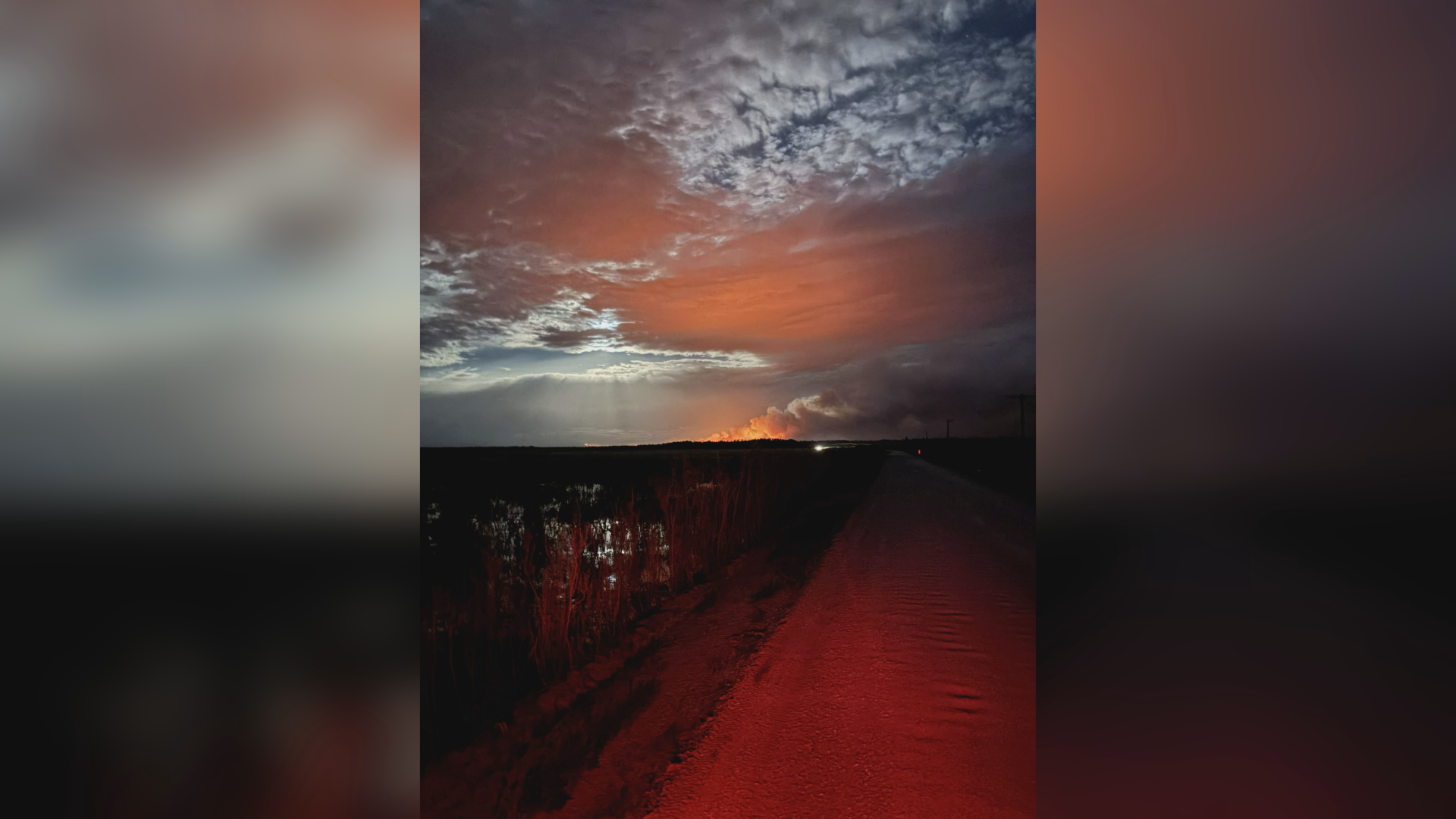
More than 1,400 residents from the Red Earth Cree Nation and Shoal Lake Cree Nation remain displaced this week as the uncontained Cayford wildfire sweeps through northeastern Saskatchewan. The blaze has scorched roughly 11,500 hectares of timberland. Concurrently, the massive Lobstick wildfire between Prince Albert and Duck Lake holds steady at 19,000 hectares. While provincial officials express cautious optimism that a temporary break in the weather has slowed the advance of both fronts, neither fire is considered contained. The crisis highlights a widening gap between official messaging and the ground reality faced by northern communities, infrastructure networks, and local evacuees.
A closer inspection of the response infrastructure reveals that the current stabilization is less about a definitive tactical victory and more about a fortunate atmospheric reprieve.
The Myth of Control on the Fire Line
The Saskatchewan Public Safety Agency (SPSA) recently adjusted its tone. Officials noted that weekend rainfall allowed crews to reinforce fire guards and protect vital values east of the North Saskatchewan River. Premier Scott Moe stated the province occupies a stronger position than it did days ago.
This rhetoric masks a more complex, volatile operational environment. The Lobstick fire is roughly the size of Regina. It remains classified as uncontained. Firefighting assets are deploying extensive measures. Type 1 and Type 2 crews are building dozer lines along the eastern flank near Macdowall. Helicopters are applying specialized fire gel to preserve a critical high-voltage transmission line.
To understand the scale of the threat, consider a hypothetical scenario where a major transmission line fails during an active blaze. The loss does not just disrupt local household power. It cuts the electricity required to run the municipal water pumps and communication repeaters that emergency crews rely on to coordinate their operations.
In the hamlet of Holbein, located 11 kilometers northeast of the fire perimeter, workers have set up large irrigation lines to feed perimeter sprinkler systems. This defense mechanism shows how close the flames remain to residential zones. Despite the deployment of a federally supplied heavy helicopter and land-based air tankers, the head of the Lobstick fire was only halted because aircraft managed to anchor it into Callaghan Lake. Relying on natural water bodies to serve as fire breaks underscores the limits of manual containment lines when dealing with a 19,000-hectare inferno.
Local Frustrations and the Evacuation Bottleneck
While provincial communications focus on inter-agency cooperation, residents living near the perimeters tell a different story. Some local property owners report that emergency agencies spent too much time assessing the initial sparks instead of deploying immediate water bomber strikes and dozer lines near the riverbanks. This perceived delay forced several rural inhabitants to fight spot fires on their driveways and acreages using private trucks, trailers, and personal equipment to prevent their homes from burning.
The logistical strain is even more visible in the evacuation process. The mandatory displacement of over a thousand individuals from the Red Earth Cree Nation revealed significant flaws in regional emergency logistics.
Evacuees faced severe delays before they could even leave the threat zone. Local leadership reported that a line of 13 buses and 117 private vehicles had to queue at a single operational gas pump in Red Earth to secure fuel for the journey. Once on the road, displaced families faced long wait times at registration centers handled by the Canadian Red Cross in Prince Albert and Saskatoon.
As local hotel capacities filled to maximum levels, the emergency response system had to redirect families hundreds of kilometers south to Regina and Moose Jaw. This scattered distribution complicates the delivery of catered meals and health services. It also isolates vulnerable people from their traditional community networks during a time of extreme stress.
Deep Roots in Old Burns
The behavior of the Cayford fire introduces another challenging variable for long-term provincial management. SPSA officials confirmed the Cayford blaze originally ignited within the footprint of the 2021 Bell fire.
Forestry experts know that re-burning old fire scars presents unique hazards. While young regrowing vegetation sometimes lacks the dense canopy needed for a fast-moving crown fire, the abundance of dead, fallen timber from previous burns creates a heavy fuel load on the forest floor. These fuels burn deep into the soil. They create persistent hot spots that resist surface drops from water bombers. SPSA crews are currently prioritizing a dozer line aimed at restricting northward growth to prevent the fire from jumping Highway 55. This route serves as the primary transportation artery for the entire northeastern corridor.
A shifting storm system adds further unpredictability to the region. Stratiform rain forecast for the central and northeastern zones offers a brief window for crews to dig deeper trenches. However, the system also brings a distinct risk of dry lightning. A single lightning strike landing in dry brush outside the current perimeter can immediately trigger a new fast-moving front, splitting already overextended provincial resources.
The Financial Calculation of Wildfire Budgets
The proximity of the Lobstick fire to the rural municipality of Shellbrook hits close to home for Premier Scott Moe, as it sits within his own riding. Critics have used this geographic overlap to renew debates regarding the province’s wildfire preparedness funding.
The provincial government allocated a $140-million budget to the SPSA earlier this year. This figure drew sharp criticism from opposition leaders who deemed it insufficient given the historical trend of increasing wildfire intensity. Government officials defend the allocation by calling it a baseline estimate. They claim that emergency funds will always flow to protect communities regardless of the initial fiscal blueprint.
Yet, relying on emergency overages rather than investing heavily in proactive, year-round mitigation leaves northern communities vulnerable to tactical delays. The structural realities of northern geography mean that when a fire breaches initial lines, the cost of reactive suppression rises exponentially. The expenses of operating heavy aircraft like the newly deployed Q400 tankers, mobilizing hundreds of Type 1 personnel, and funding long-distance hotel stays across multiple southern cities quickly drain temporary emergency funds.
The immediate threat to homes in the Shellbrook municipality has eased enough for officials to lift certain local evacuation orders. However, the broader crisis remains unresolved. The smoke plume continues to degrade air quality across central Saskatchewan. This environment presents ongoing respiratory risks for elderly residents and children who stayed behind. The current stability is a fragile pause dependent entirely on weather patterns. The uncontained status of both the Cayford and Lobstick fronts proves that Saskatchewan’s wildfire management infrastructure is operating at its absolute limit.