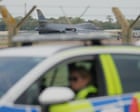
Two men stand formally charged under the United Kingdom's National Security Act 2023 following a serious security breach at Royal Air Force Fairford in Gloucestershire. Prosecutors allege the suspects engaged in conduct intended to assist a foreign intelligence service—specifically linked to Iran—at a military installation that serves as the United States Air Force's primary forward-operating location for heavy bombers in Europe. The charges mark one of the most consequential applications of Britain's updated counter-espionage laws, exposing critical vulnerabilities around high-value Western defense infrastructure during a period of acute geopolitical friction.
For decades, intelligence watchers have treated perimeter breaches at British airbases as the domain of anti-war protesters cutting through chain-link fences with bolt cutters. That era is dead. When Counter Terrorism Policing South East and the Crown Prosecution Service bring charges alleging state-backed assistance to Tehran at an airfield built to launch B-52 Stratofortresses and B-1B Lancers, the threat profile shifts entirely.
What Happened at RAF Fairford
RAF Fairford is not an ordinary provincial airfield. Located in the quiet Cotswolds countryside, the base possesses a 10,000-foot runway specifically reinforced to handle the heaviest aircraft in the American arsenal. While formally a Royal Air Force station, it operates under the control of the United States Air Force's 501st Combat Support Wing. Whenever Washington needs to project strategic bomber power into Europe, the Middle East, or the Arctic, Fairford is the staging ground.
The incident that triggered the arrests involved unauthorized activity connected to the installation, prompting an immediate joint response from Ministry of Defence Police, local constabularies, and specialized counter-terrorism detectives. Unlike routine trespassing cases that end up in local magistrates' courts with minor fines, investigators quickly identified indicators of structured intelligence collection and foreign state direction.
Prosecutors brought charges under the National Security Act 2023, legislation enacted specifically to modernize Britain's antiquated Official Secrets Acts. Under Section 3 of the Act, assisting a foreign intelligence service carries severe penalties, including life imprisonment. Crucially, the law lowers the evidentiary burden for prosecutors in certain respects; the Crown does not always need to prove that classified secrets were successfully transmitted to a hostile capital, only that the defendants engaged in conduct likely to materially assist a foreign intelligence agency.
Why Tehran Targets British Soil
To understand why two individuals would allegedly risk life sentences to gather intelligence or conduct operations around a Gloucestershire airfield, you have to look at the broader operational map of Iranian intelligence. The Ministry of Intelligence and Security (MOIS) and the Islamic Revolutionary Guard Corps (IRGC) Quds Force have steadily expanded their covert footprint across Europe over the past decade.
Iran lacks the conventional air power and global satellite surveillance networks enjoyed by the United States and its NATO allies. To compensate for this asymmetry, Tehran relies heavily on human intelligence, proxy networks, and low-cost reconnaissance on the ground. Knowing when strategic bombers rotate into Fairford, tracking flight schedules, observing maintenance cycles, and mapping physical security blind spots give Iranian military planners early warning of potential strikes or regional deployments.
Consider a hypothetical scenario illustrating how low-tech observation yields high-value strategic intelligence. If an asset positioned near a perimeter road logs the tail numbers of incoming transport aircraft, notes the arrival of specialized munitions trucks, and photographs temporary communications arrays being erected on the tarmac, an analyst in Tehran can deduce a pending Bomber Task Force deployment days before any official Pentagon press release. That lead time allows air defense units and proxy forces in the Middle East to disperse assets and harden targets.
The Proxy Recruitment Playbook
Modern espionage rarely looks like the Cold War thrillers of John le Carré. Foreign intelligence services increasingly avoid sending accredited diplomats or trained case officers to conduct risky physical reconnaissance around heavily guarded military bases. Instead, they outsource the risk.
Intelligence agencies in Tehran and Moscow have repeatedly turned to criminal networks, ideologically motivated sympathizers, and financially desperate recruits living in Western nations. Recruits are frequently contacted through encrypted messaging platforms, tasked with seemingly mundane jobs—taking photographs of specific gates, testing response times of perimeter patrols, or leaving dead drops—and paid in cryptocurrency or untraceable cash transfers.
This deniable proxy model offers massive advantages to the sponsoring state:
- Operational Insulation: If the operatives on the ground are caught by British counter-terrorism police, the trail frequently ends at an anonymous encrypted account rather than an embassy official.
- Cost Efficiency: Recruiting local assets requires minimal logistical overhead compared to maintaining deep-cover illegals abroad.
- Volume and Persistence: A handler can task multiple low-level recruits simultaneously across different installations, overwhelming traditional counter-intelligence surveillance.
However, the model carries a fatal flaw for the recruits themselves. Because handlers prioritize deniability over the safety of their assets, they rarely provide genuine tradecraft training. Operatives use personal mobile phones, leave digital breadcrumbs on commercial networks, and trigger standard physical security alarms that alert local police long before any intelligence reaches its destination.
The Legal Teeth of the National Security Act 2023
Before 2023, British prosecutors attempting to charge suspected spies faced a frustrating legal bottleneck. The Official Secrets Act 1911 was drafted to catch German agents sketching dockyards before the First World War. It required proving that an individual acted for a "purpose prejudicial to the safety or interests of the State" and focused heavily on traditional espionage inside prohibited places.
The National Security Act 2023 rewrote the rules of engagement for MI5 and Counter Terrorism Policing. By introducing specific offenses for obtaining or disclosing protected information, assisting a foreign intelligence service, and sabotage, the legislation closed loopholes that foreign actors had exploited for years.
In the context of the RAF Fairford case, the statutory language surrounding "prohibited places" is particularly relevant. Military bases fall squarely under this definition. Under the updated law, approaching, inspecting, or even flying an unmanned aerial vehicle over a prohibited place for a purpose prejudicial to UK safety or interests is an explicit offense. Furthermore, the police now possess expanded powers to arrest suspects without a warrant if they reasonably suspect involvement in foreign power threat activity, alongside strict restrictions on bail and extended detention periods modeled on counter-terrorism legislation.
Chronic Vulnerabilities at Forward Operating Bases
The charging of two suspects does not erase the uncomfortable reality facing defense planners in London and Washington. Rural airbases like RAF Fairford are inherently difficult to secure against persistent, low-signature reconnaissance.
Unlike urban intelligence headquarters surrounded by blast walls and restricted airspace, Fairford sits amid public roads, agricultural fields, and public footpaths. Aviation enthusiasts—known locally as plane spotters—routinely gather along the perimeter fences with high-powered telephoto lenses and radio scanners whenever American bombers deploy to Gloucestershire. Separating benign hobbyists from hostile intelligence collectors requires immense manpower and sophisticated counter-surveillance technology.
The Drone and Sensor Dilemma
Commercial drone technology has further complicated perimeter defense. A off-the-shelf quadcopter costing less than a thousand dollars can capture high-resolution imagery of flight lines, fuel depots, and security checkpoints from outside the physical fence line. While military installations deploy electronic warfare systems and radar to detect unauthorized unmanned aircraft, rural terrain, tree lines, and civilian air traffic create constant false positives and blind spots.
Jurisdictional Friction
Security at bases like Fairford also involves a complex patchwork of authority. Perimeter security and local law enforcement fall under the jurisdiction of the Ministry of Defence Police and local British constabularies, while internal flight-line security is handled by United States Air Force Security Forces. When an incident occurs outside the wire—on a public road or neighboring farm—British civilian police hold primary jurisdiction, requiring seamless coordination with American military intelligence and MI5 to piece together the broader threat picture. Any friction in information sharing between allied agencies slows down threat detection.
What Defense Planners Get Wrong About Base Security
A recurring blind spot in Western defense posture is the assumption that physical deterrence equals comprehensive security. Erecting double-layered fencing, installing infrared cameras, and increasing armed patrols deter impulsive intruders, yet they do little to stop patient, methodical observation from public vantage points.
Furthermore, over-reliance on technical surveillance often comes at the expense of basic counter-intelligence awareness within surrounding communities. Local landowners, pub staff, and delivery drivers are frequently the first to notice unfamiliar vehicles parked repeatedly on narrow country lanes or individuals asking unusual questions about base shift changes. When military bases isolate themselves entirely from the surrounding civilian population, they sever their most effective early-warning network.
There is also the uncomfortable reality of over-classification and secrecy theater. Military officials routinely refuse to acknowledge bomber deployments that are already visible to anyone looking up at the Gloucestershire sky or tracking public flight transponders online. By treating publicly observable aircraft movements as top-secret while failing to harden the actual electronic and physical vulnerabilities on the ground, defense establishments misallocate security resources.
The Broader Geopolitical Reckoning
The arrests connected to RAF Fairford cannot be viewed in isolation. They fit into a documented pattern of escalating covert confrontation between Iran and Western powers. Over the past several years, British intelligence officials have publicly warned of a dramatic surge in Iranian state-backed threats on UK soil, ranging from surveillance of dissidents and journalists to plots targeting strategic infrastructure.
As tensions in the Middle East fluctuate, bases like Fairford become prime targets not merely for passive intelligence gathering, but potentially for sabotage. A single well-placed explosive device, an incendiary attack on fuel storage, or a coordinated drone swarm targeting parked bombers on the tarmac could cripple American power projection capabilities at a critical moment without Tehran ever firing a ballistic missile.
The prosecution of the two suspects sends an unmistakable signal that British authorities will deploy the full weight of their counter-terrorism and national security apparatus to protect allied installations. Yet prosecutions happen after the perimeter has already been tested. As long as strategic bombers continue to launch from the English countryside toward global flashpoints, the quiet lanes surrounding RAF Fairford will remain an active front line in an undeclared shadow war.