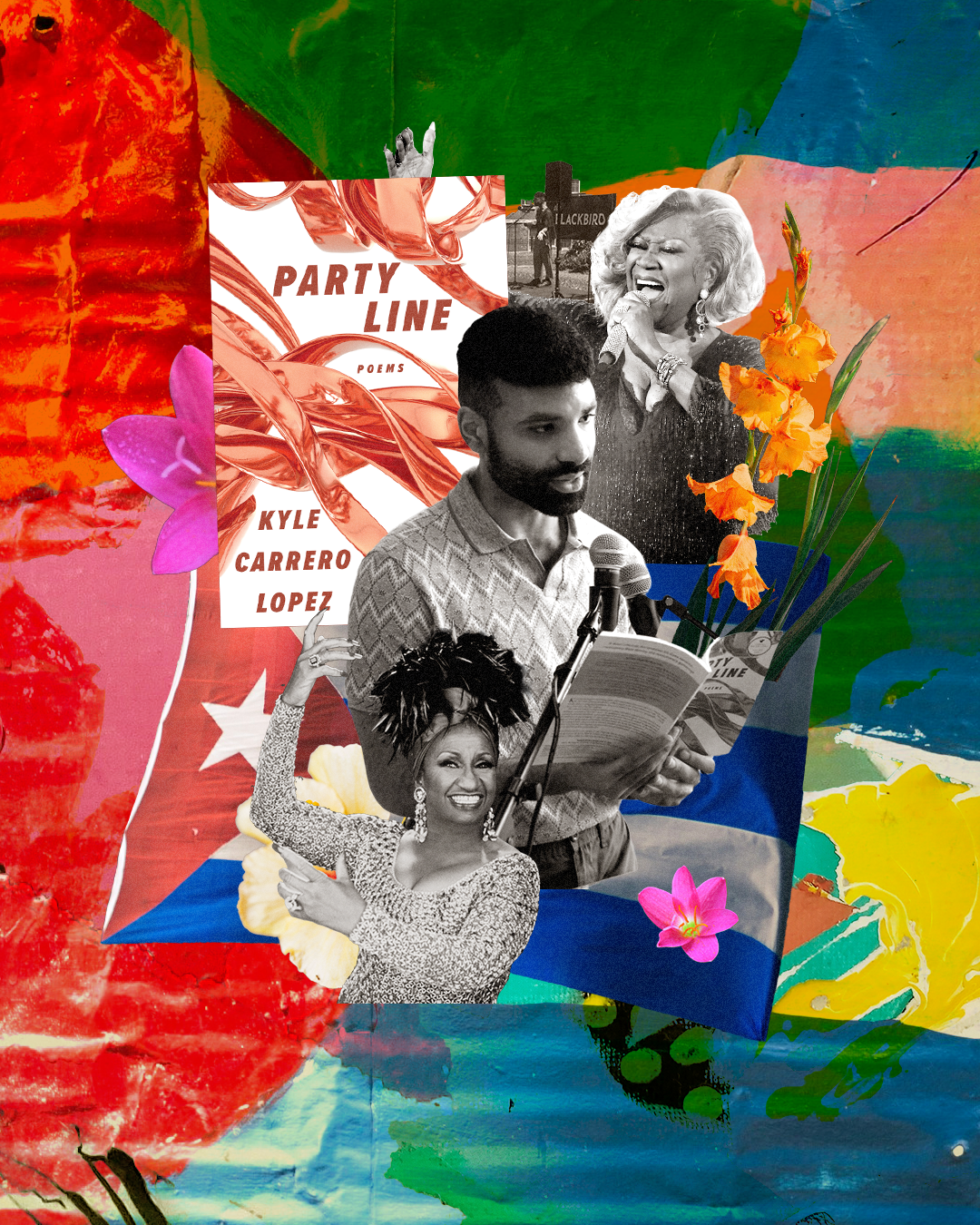
In his July 2026 debut collection Party Line, published by Graywolf Press, Cuban American poet Kyle Carrero Lopez takes a sharp, unapologetic stand against the rigid ideological scripts imposed on exile communities and nightlife spaces alike. By welding the mechanics of political party orthodoxy to the heat, surveillance, and rhythm of club culture, the book exposes how Black Cubanidad, queer survival, and U.S. sanctions policy collide inside everyday rituals.
Anyone who has covered cultural politics over the past three decades knows the familiar script. When a writer of Cuban descent enters the public square, editors, pundits, and community gatekeepers immediately reach for a binary that has governed South Florida and Washington talk shows since the Cold War. You are either mourning the lost island in hardened exile or reciting revolutionary catechisms from a safe distance. Carrero Lopez refuses that trap from page one. His debut does not ask for permission from either side of the strait, nor does it pretend that pleasure on a dance floor happens outside geopolitics.
Why Exile Orthodoxy Erases Black Cubanidad
The most persistent distortion in American commentary about Cuban Americans is demographic amnesia. When national outlets talk about the diaspora, they routinely default to a narrow portrait of white, affluent anti-communist exiles concentrated in Miami. That shorthand is not just lazy; it is a political instrument that flattens decades of migration, class stratification, and anti-Blackness on both sides of the Florida Straits.
Carrero Lopez approaches that erasure through family memory and sharp lyric economy. His father arrived in the United States as a Black Cuban refugee in the late 1960s and worked as a DJ, while his maternal grandfather ran a social club and games parlor in New Jersey. Growing up in that lineage meant encountering racism in multiple directions at once. His father walked home from school with his two sisters facing racial slurs in the streets and severe corporal punishment at home, navigating a country where his Blackness and his Cuban origin collided without a clear map for assimilation.
A single-note exile narrative cannot survive once you account for who actually boarded the flights, who faced slurs on American sidewalks, and who was written out of respectable diaspora politics.
In poems like "Lessico Famigliare," which appeared in The Yale Review before the book's release, Carrero Lopez distills generational anti-Blackness into a biting family epigram about an ancestor who claimed to like only two things in black: tuxedos and Cadillacs. Humor here does not let anyone off the hook. It exposes how colorism and respectability function inside families just as surely as they do in state policy.
A purely hypothetical example illustrates how that erasure plays out in literary publishing. Imagine a mid-sized literary magazine commissioning a round-up on "the Cuban American voice" during an election cycle and selecting four contributors who share a single political line and class background while calling the package a complete survey of diaspora sentiment. The resulting coverage looks thorough on paper, yet it leaves out the very people whose bodies absorb both U.S. sanctions and domestic racial policing.
Sanctions Begin at the Kitchen Table
Most policy analysts treat sanctions as an abstraction measured in Treasury licenses, shipping tonnage, or diplomatic cables. Carrero Lopez flips the scale. In his poem "Sanctions," economic warfare and household policing share the same vocabulary of restriction and enforcement.
As a boy, he experienced sanctions first not in a State Department briefing, but in his father's rules governing how a young male body was allowed to move. No dance class, no "girl toys," strict instructions on how to walk, stand, sit, and look at men. What begins as domestic discipline echoes the broader architecture of embargo and blockade, where external pressure squeezes daily life and narrows what is permitted.
The Cost of Policing Desire
Policing queer expression inside a marginalized household creates a double bind. A young person learns early which desires must be censored to keep the peace, which memories are safer to bury, and how survival often requires performing an acceptable version of masculinity.
Carrero Lopez treats that tension without sentimentality. He is not writing nostalgic postcards from a mythical past. He is tracking how authority works at close range—how a father's "law" gets hammered into a child, and how that child later examines the political laws imposed on an entire island.
Questioning the Failed-State Alibi
When commentators argue that Cuba's struggles stem solely from internal misrule, Carrero Lopez presses a blunt counter-question. If the island is already doomed or incapable of functioning, why maintain an elaborate web of restrictions?
His stance is not a naive defense of any government. He explicitly states that his duty as an artist is to truth rather than any state apparatus, and that his focus as a Cuban American centers on his home country's role in the conflict alongside the real effects of U.S. policy on ordinary people. That distinction frustrates partisans who demand absolute loyalty to one camp or the other. Good. Poetry is not a party platform, and honest reporting never stops where slogans begin.
| Dimension | Conventional Exile Framing | Carrero Lopez's Party Line Lens |
|---|---|---|
| Primary Lens | Cold War geopolitical allegiance and regime critique | Lived intersection of Blackness, queerness, migration, and policy |
| Meaning of "Sanctions" | State-to-state economic and diplomatic measures | Household gender policing mirrored by geopolitical restrictions |
| Role of Nightlife | Escapism or apolitical entertainment | A contested space of joy, commodification, and power |
| Writer's Posture | Spokesperson for a unified political bloc | Critical witness rejecting flat diaspora stereotypes |
Nightlife Is Never Off the Record
Another lazy assumption in cultural criticism is that parties and politics occupy opposite corners of human life. Serious activists are supposed to look grim at rallies; clubgoers are supposed to check their politics at the door with their coats.
Carrero Lopez dismantles that divide because nightlife is part of his family's actual labor history. His mother was a club kid, his father spun records, and his grandfather ran a social club. In Party Line, the word "party" pulls double and triple duty—meaning political factions, house and ballroom gatherings, and the friction between solidarity and exclusion on the dance floor.
Guests, Hosts, and Unpaid Debts
A recurring flashpoint in queer and club spaces is what happens when people enjoy music and culture rooted in Black and brown traditions while bristling at any mention of race, history, or exploitation. Someone complains that a night out is getting "too political," as if basslines and history exist in separate rooms.
Carrero Lopez calls that bluff directly. When the soundtrack comes from Black artists and Black scenes, dismissing accountability as a buzzkill exposes a sense of entitlement. You do not get to treat Black cultural invention as free fuel for good vibes and then demand silence when basic decency or historical context comes up.
At the same time, he does not romanticize every corner of nightlife history. He points out how narratives around figures like 1990s New York club kid Michael Alig often glossed over white privilege and violence—including the killing of a man of color—while celebrating glamour. Nor does he let queer travel or party euphoria off the hook when pleasure is bankrolled inside racial capitalism or geopolitical tension.
Why Seriousness and Joy Do Not Cancel Out
One of the sharpest tensions running through Party Line is the pressure on Black and queer artists to use humor or charm as a cushion so audiences will tolerate hard truths. In the opening poem "The Rules," Carrero Lopez lays bare the calculation of being funny, charming, or "sassy"—and the quiet dread of what happens if the entertainer stops being entertaining.
That self-awareness gives the collection real teeth. Readers and critics often praise political art when it feels solemn and heavy, as if seriousness requires stripping away wit, rhythm, and warmth. Carrero Lopez shows how wit can sharpen critique rather than dull it, turning conversational cadences and Caribbean energy into instruments of precision.
He also resists turning historical figures into plaster saints. Writing about figures such as Amiri Baraka's early visit to Cuba or portraits of Black radicals like Assata Shakur, he looks for human scale and political seriousness rather than hagiography or distance. Ordinary people buy groceries, navigate contradictions, and still make choices that alter their lives and their art.
Where the Debate Hits Friction
No honest assessment of Party Line can pretend the book will earn universal applause across every political line. Hardliners in South Florida who view any engagement with Cuba or any critique of U.S. embargo policy as betrayal will push back hard. Conversely, rigid activists who want neat slogans rather than messy family contradictions or club-floor ironies may find his refusal to tidy up loose ends uncomfortable.
Even the book's own blend of playfulness and critique carries a subtle risk that sharp readers will notice. When a poet moves rapidly between camp, slang, lyric tenderness, and geopolitical argument, a reader skimming for a single thesis might miss how those registers test one another. Yet that friction is precisely the point. Real lives—especially Black, queer, diasporic lives—rarely sort themselves into clean files.
For editors, programmers, and readers tired of recycled talking points about Cuba and identity, Party Line offers a necessary reset. Stop treating diaspora politics as a closed two-party feud, start listening to the people living inside its contradictions, and read the full book rather than hunting for convenient soundbites.



