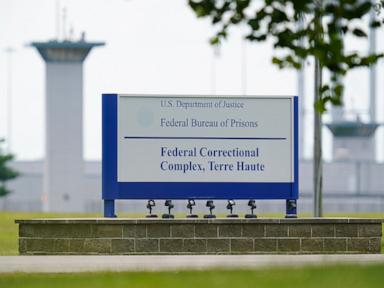
The United States Army is quietly refreshing its logistical playbook for carrying out military executions for the first time in over sixty years. Internal planning documents detailing "Operation Resolute Justice" reveal that the military branch has maintained an operational framework to transfer its four remaining death row inmates from the U.S. Disciplinary Barracks at Fort Leavenworth, Kansas, to the federal execution chamber in Terre Haute, Indiana, should President Donald Trump sign the warrants.
While an Army spokesperson downplayed the revelation as a standard continuity-of-planning exercise conducted routinely for two decades, the context surrounding these updates is anything but routine. The Pentagon finds itself caught between an aggressive executive branch eager to reactivate capital punishment and a highly idiosyncratic military justice system designed to delay executions indefinitely. This friction exposes a profound systemic crisis: the military death penalty is structurally dysfunctional, trapped in a decades-long loop of procedural limbo that satisfies neither the demands of retributive justice nor the constitutional guardrails of due process.
The Illusion of Readiness
The Army has not executed one of its own since 1961, when Private John A. Bennett was hanged for the rape and attempted murder of an 11-year-old girl. Since then, capital punishment under the Uniform Code of Military Justice (UCMJ) has existed primarily as a legal abstraction.
The existence of Operation Resolute Justice suggests a streamlined mechanism, mapping out a 150-day timeline from the moment a presidential signature hits the parchment to the final administration of lethal chemicals. The documents outline precise coordinates for prisoner transport, inter-agency communication between the Department of Defense and the Bureau of Prisons, and public messaging strategies.
The paperwork is pristine. The reality on the ground is completely fractured.
The four men currently residing in the Special Housing Unit at Fort Leavenworth represent some of the most heinous crimes in modern military history.
- Nidal Hasan: The former Army major who massacred 13 people and wounded more than 30 others at Fort Hood, Texas, in 2009.
- Hasan Akbar: An engineer who killed two officers and wounded 14 service members in a grenade and rifle attack in Kuwait during the 2003 invasion of Iraq.
- Ronald Gray: A former cook convicted in 1988 of a brutal spree involving multiple murders and rapes near Fort Bragg, North Carolina.
- Timothy Hennis: An Army master sergeant convicted in a military court in 2010 for the 1985 triple murder of a mother and her two daughters, a case that wound through state acquittals before advanced DNA evidence triggered a military court-martial.
Defense Secretary Pete Hegseth has signaled an appetite to break the dry spell, explicitly stating a commitment to see the ultimate punishment carried out against Hasan. Yet, the political will of an administration cannot easily override the labyrinthine architecture of martial law.
The Presidential Bottleneck and the UCMJ Labyrinth
In the civilian federal system, the Attorney General signs execution orders. In the military, the Constitution establishes a unique and heavy burden: no service member can be executed without the explicit, personal authorization of the President of the United States.
This requirement transforms every military death penalty case into a political third rail. For decades, commanders-in-chief from both parties have looked at the folders on their desks and chosen to do nothing. Presidential inaction is not merely a failure of nerve; it is a recognition that the military appeals process is a distinct mechanism designed to hunt for errors.
Consider the case of Ronald Gray. He is the closest to the chamber. In 2008, President George W. Bush took the rare step of signing Gray’s execution warrant, scheduling the event for December of that year. A federal judge intervened with a stay just days before the scheduled date. While that stay was eventually lifted in 2016, Gray remains alive today, frozen in a perpetual state of federal habeas corpus litigation.
+-------------------------------------------------------+
|              Military Court-Martial                   |
|         (Requires Unanimous Panel Verdict)            |
+-------------------------------------------------------+
                           |
                           v
+-------------------------------------------------------+
|         Service Court of Criminal Appeals             |
|          (Automatic Statutory Review)                 |
+-------------------------------------------------------+
                           |
                           v
+-------------------------------------------------------+
|     U.S. Court of Appeals for the Armed Forces        |
|             (Highest Military Court)                  |
+-------------------------------------------------------+
                           |
                           v
+-------------------------------------------------------+
|             Supreme Court of the United States        |
|               (Constitutional Review)                 |
+-------------------------------------------------------+
                           |
                           v
+-------------------------------------------------------+
|             Presidential Confirmation                 |
|          (Explicit Authorization Required)            |
+-------------------------------------------------------+
                           |
                           v
+-------------------------------------------------------+
|             Civilian Federal Courts                   |
|          (Habeas Corpus Writs & Stays)                |
+-------------------------------------------------------+
The system is structured so that a military capital conviction triggers an automatic, multi-tiered appellate review through the Service Court of Criminal Appeals, then the U.S. Court of Appeals for the Armed Forces (CAAF), and eventually the Supreme Court. Even after the president signs off, the inmate transitions into the civilian federal court system to file standard habeas corpus petitions.
This dual-track system means that military inmates enjoy more avenues of appeal than almost any civilian counterpart. It turns the process into an expensive, permanent holding pattern.
The Firing Squad and the Execution Protocol Crisis
Even if the legal hurdles vanished tomorrow, the executive branch faces an acute operational crisis regarding how it actually kills prisoners. The Department of Justice recently unveiled an expanded federal execution protocol, reverting to the single-drug pentobarbital method while simultaneously authorizing alternative methods like the firing squad.
The revival of the firing squad is pitched by proponents as a swift, infallible alternative to lethal injection, which has suffered from chronic drug shortages and botched administrations. The political rhetoric suggests a clean, decisive return to military tradition.
The historical and medical data tells a messy story. The physics of gunfire do not guarantee instant death. During the state execution of Mikal Mahdi via firing squad, observers noted that the condemned man survived the initial volley, groaning and breathing for nearly two minutes before succumbing. To consistently achieve a rapid loss of consciousness, the projectiles must completely disrupt the cardiovascular system. Human error, skeletal variance, and the psychological burden on the shooters frequently compromise this outcome.
For the military, adopting these expanded methods introduces a secondary layer of litigation. Defense attorneys for the Leavenworth four are already preparing challenges based on the Eighth Amendment’s prohibition against cruel and unusual punishment, arguing that the introduction of firing squads or untested drug protocols constitutes a form of state-sanctioned experimentation.
The Strategic Failure of Military Capital Punishment
The fundamental flaw of the military death penalty is that it fails to achieve its core objective: deterrence.
Martial discipline requires swift, certain consequences. When an active-duty soldier considers committing a capital crime, the threat of an execution that might occur forty years later—if at all—carries zero psychological weight. The system effectively guarantees a life sentence disguised as a death warrant, costing taxpayers millions in specialized maximum-security confinement and endless appellate litigation.
The Pentagon's insistence that Operation Resolute Justice is just standard paperwork is an admission of this gridlock. They are preparing for an event they know is legally and politically improbable. The executive branch may demand action and draft aggressive memos, but until Congress or the Supreme Court fundamentally strips away the unique procedural protections granted to American service members, the military death row will remain exactly what it is today: an expensive, permanent monument to judicial inertia.