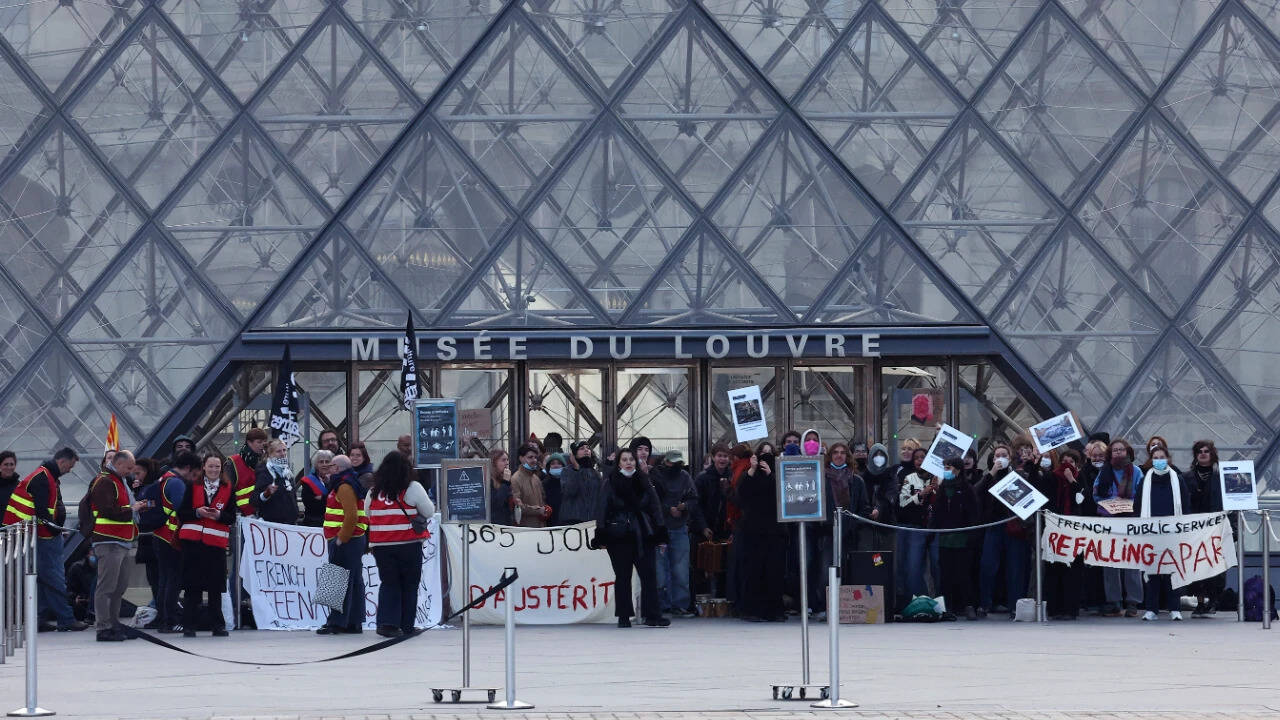
The shuttering of the Louvre Museum in Paris amid unrest one year after a $102m heist exposes a deeper structural breakdown than a single security breach or a sudden flare-up of street anger. A closure at this scale happens when overcrowding, understaffed galleries, deferred maintenance, and labor grievances collide inside a monument that tries to serve as both a royal palace and a high-throughput tourist machine.
Anyone who has covered cultural institutions for thirty years knows how institutions fail. They rarely collapse from one dramatic blow alone. They fray slowly through years of budget compromises, patchworked crowd-control rules, and frontline workers absorbing pressures that executives call unavoidable. When a high-profile theft is followed a year later by unrest that forces the doors shut, the headline focuses on spectacle while the real story sits in the operating ledger.
Why One Year After a $102m Heist Still Hurts
Anniversaries sharpen memory. They also strip away excuses.
A $102m heist at a flagship museum does more than empty a display case or trigger an insurance audit. It forces an uncomfortable reckoning over perimeter security, response times, curatorial supervision, and institutional pride. In the immediate aftermath of a major theft, leadership usually promises audits, new sensors, stricter bag checks, and tighter coordination with municipal police.
Twelve months later, those promises face a harder test. Did the money actually reach the floor where guards stand for eight hours at a time? Or did it go into committees, consulting decks, and glossy press releases?
Staff members watching the calendar turn one full year from a headline-grabbing robbery see the gap between public reassurance and daily reality. If gallery ratios remain thin, if alarm protocols feel improvised, or if visitor surges overwhelm already stretched teams, an anniversary stops being a quiet milestone. It becomes a flashpoint.
From an institutional standpoint, the security narrative and the labor narrative rarely stay separate for long. Guards, attendants, and conservation technicians are the first line of defense when something goes wrong, yet they are often the last to be consulted when crowd caps are raised or budgets are tightened. When unrest hits a flagship site like the Louvre Museum, grievances that have been simmering for months suddenly find a public stage.
The Myth of the Frictionless Megamuseum
For decades, major museums operated on a simple growth formula. More visitors meant more ticket revenue, bigger gift shop margins, stronger sponsorship leverage, and louder political applause.
That math has limits. Physical buildings do not stretch.
The Louvre Museum occupies historic structures layered across centuries, with corridors, staircases, and climate zones never engineered for modern daily crowds numbering in the tens of thousands. Funneling massive waves of visitors past a handful of iconic works creates predictable bottlenecks. Bottlenecks create tempers. Tempers turn volatile when lines stall, restrooms back up, or rooms feel suffocating.
Consider a hypothetical example to see how crowd pressure distorts operations. Suppose a museum raises daily admission caps by fifteen percent to recover post-pandemic or renovation costs, without adding a single new gallery attendant or expanding staggered entry windows. On paper, revenue rises cleanly. On the floor, guards spend half their shift managing angry queues and medical or heat complaints rather than monitoring artwork and exits.
That is not an abstract management flaw. It is a daily operational hazard.
When unrest breaks out outside or around the museum, the decision to close is rarely just about flying debris or blocked streets. Management also has to weigh whether remaining open puts staff, visitors, and priceless collections at risk when normal transit, police coverage, and emergency lanes are disrupted. Shutting the doors protects assets and people, yet every closure costs millions in lost ticket sales and damages Paris's image as a dependable cultural capital.
Unrest Meets Fragile Public Economics
Streets in Paris have a long history of turning political and economic friction into visible disruption. Cultural landmarks sit right at the crossroads of tourism, civic identity, and public frustration.
When protests erupt near major institutions, critics often frame the clash in simple binaries. One side blames disruptive demonstrators for harming workers and tourists; the other blames rigid authorities and austerity budgets for pushing people to the brink.
Both readings miss important nuance. Demonstrations around major public or semi-public institutions frequently draw together distinct groups with overlapping complaints. Some protesters focus on wages, staffing, and working conditions. Others bring broader grievances about cost of living, policing, or state priorities. Meanwhile, local shopkeepers, hoteliers, and tour operators lose income the moment a headline staple goes dark.
There is also a counter-argument worth taking seriously. Some cultural administrators contend that world-famous museums carry a unique public duty to stay open whenever safety permits, arguing that closing early signals weakness or hands leverage to whoever creates the most disruption.
That view sounds resolute in a boardroom. It looks far less convincing when a crowd surges toward an entrance, an evacuation route is contested, or overworked staff face verbal hostility without clear backup. Safety decisions in live environments require caution, even when caution looks expensive on a quarterly report.
Security After a High-Profile Theft
A $102m heist changes how every vulnerability inside a museum is judged. Before a major theft, a minor procedural lapse might be treated as routine friction. Afterward, every unlocked door, blind spot, or shift gap looks like an open invitation.
Yet tightening security at a massive public museum is notoriously tricky. High-security vaults belong in banks or military depots; museums are built to display objects to the public without turning every room into a cage. Striking a balance between openness, visitor flow, and asset protection requires constant calibration.
Physical Barriers vs. Human Vigilance
Technology helps, but cameras and sensors do not replace trained eyes and clear chains of command. A motion detector can ping a control room, yet someone still has to interpret the alert, verify whether it is a false trigger or a genuine breach, and coordinate a response across sprawling wings.
Understaffing undermines both layers. When positions go unfilled or shifts are stretched thin, fatigue sets in. Tired staff miss subtle cues, whether that means a suspicious bag left unattended or rising tension among visitors trapped in a gridlocked hall.
The Reputation Tax of Repeated Disruption
Museums trade on trust and permanence. Travelers plan trips months or years in advance around specific cities and landmarks.
When a single year brings a major robbery and then a shutdown tied to unrest, the damage compounds. Even if the museum reopens quickly, prospective visitors start asking harder questions. Will my timed ticket actually get me inside? Will half the rooms be closed? Will crowds and protests turn a bucket-list afternoon into an ordeal?
Rebuilding that confidence takes longer than unlocking the gates. It demands visible proof that leadership addresses root causes rather than waiting for the next crisis to blow over.
What This Moment Reveals About Cultural Leadership
Too many cultural institutions are run like trophy assets rather than complex industrial operations. Leaders love ribbon cuttings, record attendance numbers, and blockbuster loans. They spend far less energy on preventive maintenance, frontline morale, and contingency planning when civic unrest spills near the perimeter.
A shutdown of the Louvre Museum one year after a $102m heist should end that complacency. The theft showed that high-value targets face persistent, sophisticated threats. The unrest showed that internal strain and external friction can converge at any moment, halting operations cold.
True institutional resilience requires straightforward choices:
- Cap attendance to match staffing rather than treating peak capacity as a permanent floor.
- Fund frontline security and operations at levels that keep experienced staff in place and well-trained.
- Publish transparent metrics on security upgrades, maintenance backlogs, and closure triggers so workers and the public see real accountability.
- Build clear labor channels so workplace grievances are addressed before they erupt during public flashpoints.
None of those steps is cheap, and none makes for a flashy press release. Each one protects the collection, the people who care for it, and the credibility of the institution when the next storm hits.
Audit the staffing ratios, security protocols, and crowd caps in your own organization before external pressure forces the doors shut.