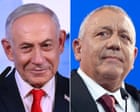
Coalition talks in Israel are heading straight into a mathematical brick wall because neither Benjamin Netanyahu's right-wing alliance nor Gadi Eisenkot's centrist opposition bloc can secure the mandatory 61 seats in the Knesset. While mainstream headlines frame this deadlock as a routine pre-election horse race, the underlying reality is far more destabilizing. Both camps are trapped by structural demographics, ideological red lines, and a proportional representation system that rewards uncompromising fringe factions while punishing broad consensus.
The numbers simply refuse to budge. For years, Israeli politics has operated on a binary axis defined largely by one question: whether Benjamin Netanyahu should remain prime minister. That single issue has fractured traditional party lines, turning natural ideological allies into bitter enemies and forcing unnatural marriages of convenience. When polling consistently shows both the Netanyahu bloc and the Eisenkot-led opposition hovering below the 61-seat threshold, the country is staring down the barrel of prolonged legislative paralysis, caretaker governments, and the very real prospect of yet another round of snap elections.
The Structural Trap of the 61-Seat Threshold
To understand why these coalition talks are doomed before they even begin, you have to look at the mechanics of the Knesset. Israel uses a pure proportional representation system with a single nationwide district. Voters do not cast ballots for individual representatives; they vote for party lists. Any party clearing the 3.25 percent electoral threshold enters parliament, and the 120 seats are divided accordingly.
In theory, this creates a hyper-democratic mirror of society. In practice, it manufactures chaos.
Because no single party in Israeli history has ever won an outright majority on its own, every government is a patchwork coalition. A prime minister needs at least 61 mandates to pass a state budget, appoint ministers, and survive no-confidence votes. Right now, the math is broken. Netanyahu’s traditional base—comprising his Likud party, ultra-Orthodox Haredi factions like Shas and United Torah Judaism, and far-right religious nationalists—faces a ceiling. Demographic growth among Haredi voters boosts their numbers, yet secular and moderate right-wing voters have steadily peeled away, exhausted by years of institutional friction and security failures.
On the other side, Gadi Eisenkot faces the exact opposite problem. As a former Chief of Staff of the Israel Defense Forces, Eisenkot carries immense security credibility that appeals to disillusioned center-right voters. He represents a pragmatic, institution-first approach that contrasts sharply with Netanyahu’s polarizing style. Yet having broad appeal is useless if you cannot cobble together 61 reliable hands in the Knesset plenum. The opposition bloc is an ideological soup stretching from hawkish secular nationalists to left-wing social democrats. They agree on replacing Netanyahu, and almost nothing else.
Why Eisenkot Cannot Easily Bridge the Divide
Mainstream commentary often treats Gadi Eisenkot as the ultimate unity candidate, a figure capable of drawing moderate Likudniks across the aisle while keeping the center-left intact. That assumption ignores how fiercely partisan discipline operates in Jerusalem.
Consider the sheer friction required to build a non-Netanyahu majority without relying on Arab parties. Historically, Zionist parties across the spectrum avoided including predominantly Arab factions in governing coalitions, keeping them in a permanent state of political quarantine. That taboo broke briefly during the short-lived Bennett-Lapid government in 2021, when the Islamist Ra'am party joined the coalition. The backlash from the right was ferocious, and the experiment collapsed within a year under the weight of internal contradictions.
If Eisenkot refuses to rely on Arab parties like Ra'am or Hadash-Ta'al to reach 61 seats, his only path to power requires peeling away significant chunks of Netanyahu’s current coalition. Who would make that jump?
The Haredi parties, Shas and United Torah Judaism, are transactional by nature. Historically, they cared less about foreign policy or judicial overhaul and more about securing state funding for religious institutions and protecting yeshiva students from mandatory military conscription. In past decades, they sat comfortably in Labor-led left-wing governments. Today, however, their grassroots voters have shifted sharply to the right, and the burning issue of military draft exemptions has created an unbridgeable chasm between Haredi leadership and secular centrists like Eisenkot, who built his entire career on universal military service and equal burden-sharing.
The Draft Exemption Flashpoint
You cannot overstate how toxic the military conscription debate has become in Israeli coalition math. Following prolonged multi-front military conflicts, the Israeli public's tolerance for blanket exemptions granted to ultra-Orthodox men has evaporated. Reservists who served hundreds of days away from their families and businesses are demanding systemic reform.
For Eisenkot, compromising on universal conscription would be political suicide. His entire brand rests on military integrity and state responsibility. Conversely, for the Haredi parties, conceding on draft quotas means losing control over their insular communities and facing rebellion from their own rabbinical councils. Without Haredi backing, Eisenkot cannot reach 61 seats from the right. Without compromising his core principles, he cannot bring the Haredim in.
Netanyahu's Diminishing Room to Maneuver
If Eisenkot is boxed in by ideological contradictions, Netanyahu is boxed in by survival instincts. A veteran operator who has outlasted nearly every rival over three decades, Netanyahu understands coalition leverage better than anyone in modern parliamentary history. Yet the tools he used to build previous governments have turned into liabilities.
To maintain his grip on power in recent years, Netanyahu empowered ultra-nationalist figures on the far right, handing them critical ministries overseeing national security and finance. That alliance kept him in the prime minister's office, but it exacted a heavy price. It alienated moderate conservatives at home, strained diplomatic ties with Washington and European allies, and locked Likud into hardline policy positions that leave zero room for diplomatic flexibility.
Now, as polls show his bloc falling short of 61 seats, Netanyahu faces an acute dilemma. He cannot expand his coalition to the center while keeping his far-right partners, because centrist leaders refuse to sit at the same cabinet table with them. At the same time, he cannot ditch his far-right partners without instantly losing his existing base and triggering a collapse of his own faction.
The Myth of the Likud Revolt
Political analysts frequently speculate that senior Likud lawmakers will eventually turn on Netanyahu to save the party from permanent opposition or electoral decline. If you look at the actual incentives inside Likud, that scenario falls apart quickly.
Likud’s candidate list is chosen through party primaries dominated by entrenched grassroots activists and local power brokers who remain fiercely loyal to Netanyahu. Any sitting Likud minister who publicly challenges the leader commits immediate career suicide. They will be purged in the next primary, stripped of their committee assignments, and branded a traitor by right-wing media outlets. Even ambitious politicians who quietly harbor hopes of succeeding Netanyahu recognize that moving too early guarantees destruction. They are waiting for him to exit the stage voluntarily or be removed by voters, not by an internal coup.
What Happens When Nobody Gets 61 Seats
When coalition talks stall and neither bloc crosses the 61-seat finish line, Israel enters a constitutional twilight zone. Under Basic Law: The Government, the President consults with all incoming party leaders and tasks the candidate with the best chance of forming a coalition—not necessarily the leader of the largest party—with a 28-day mandate, extendable by another 14 days.
If that candidate fails, the President can hand the mandate to a rival leader, or allow a majority of Knesset members to nominate someone themselves. When all of those avenues fail, the Knesset automatically dissolves, triggering new elections roughly 90 days later.
This is not a theoretical exercise. Between April 2019 and November 2022, Israel held five national elections in less than four years precisely because the blocs were locked in this exact mathematical stalemate.
During these prolonged deadlocks, the country is governed by a transitional caretaker cabinet. While a caretaker government retains legal authority, its political legitimacy is severely eroded. Passing a new national budget becomes nearly impossible, forcing the state to operate on a monthly pro-rated version of the previous year’s spending—a mechanism that starves new infrastructure projects, delays healthcare funding, and paralyzes long-term economic planning. Major strategic decisions, whether involving regional defense, judicial appointments, or civil service leadership, become bogged down in endless Supreme Court petitions questioning whether an unelected caretaker government has the mandate to bind its successor.
The Overlooked Variable of Voter Fatigue and Threshold Roulette
Beyond the headline numbers of the Netanyahu and Eisenkot blocs lies a critical factor that rarely gets enough scrutiny: the 3.25 percent electoral threshold.
In a deadlocked parliament, the fate of the entire government often hinges on whether a small party wins four seats or gets wiped out completely with 3.1 percent of the vote. When a party falls just short of the threshold, tens of thousands of ballots are effectively thrown into the trash, artificially inflating the seat counts of the remaining parties.
To grasp how this works, imagine a hypothetical scenario where two small left-wing parties run separately and each captures 3.0 percent of the total vote. Together, they represent 6 percent of the electorate—roughly seven Knesset seats. Because neither cleared the 3.25 percent bar individually, both receive zero seats. Those seven seats are redistributed proportionally among the surviving parties, potentially handing Netanyahu’s bloc a narrow 61-seat majority despite winning fewer total votes nationwide. Conversely, if a small far-right faction splits off from Netanyahu's camp and fails to clear the bar, those wasted votes could hand the keys of the prime minister's office directly to Eisenkot.
Coalition negotiations, therefore, begin long before election day. They start with brutal backroom pressure to force ideological micro-parties into technical mergers. Party leaders spend weeks arguing over which spot on the joint slate gets the fifth, seventh, or ninth slot, knowing full well that a single misplaced candidate could trigger a split that sinks the entire bloc.
The National Unity Mirage
Whenever polling shows a persistent deadlock, pundits inevitably call for a grand national unity government uniting Likud and Eisenkot's centrist camp, leaving the ideological extremes on both sides in the opposition. On paper, such a coalition would easily command 70 or 80 seats, projecting stability to financial markets and foreign allies while passing long-overdue domestic reforms.
In reality, trust between the two camps has been obliterated beyond repair.
Centrist leaders point to the short-lived unity government formed between Benjamin Netanyahu and Benny Gantz in 2020 as proof that power-sharing agreements with Netanyahu are worthless. Under that deal, the two men agreed to rotate the prime ministership, with Gantz taking over after 18 months. The agreement included explicit legal mechanisms designed to prevent Netanyahu from backing out. It did not matter. Netanyahu exploited a budget loophole to dissolve the Knesset before the rotation date arrived, sending the country back to the polls and leaving Gantz empty-handed.
Eisenkot watched that collapse up close. Entering a rotation agreement or serving as a junior partner in a Netanyahu-led government is viewed by the centrist base not as statesmanship, but as gullibility. Unless Netanyahu steps down from the leadership of Likud—a move he has repeatedly ruled out—a genuine unity government remains a fantasy.
The Economic and Security Toll of Perpetual Campaigning
Every month spent in coalition limbo carries tangible costs that extend far beyond the corridors of the Knesset. International credit rating agencies closely monitor institutional stability and fiscal discipline. When a government cannot pass a multi-year budget or relies on fragile, short-term political bribes to keep rogue backbenchers from bolting, borrowing costs rise and foreign direct investment cools.
The civil service suffers an equally quiet erosion. Senior positions across ministries, regulatory agencies, and diplomatic missions remain vacant or filled by temporary acting directors because coalition partners cannot agree on appointments. Career bureaucrats become risk-averse, unwilling to launch major policy initiatives when the minister sitting across the desk might be replaced in three months.
Meanwhile, the public grows increasingly cynical. Voter turnout among disillusioned moderates tends to dip during repetitive election cycles, whereas disciplined ideological minorities—particularly the Haredi and religious-nationalist sectors—turn out at rates exceeding 80 or 90 percent. That turnout differential steadily shifts the center of gravity in Israeli politics away from the secular mainstream, ensuring that the next coalition puzzle will be even harder to solve than the current one.
Where the Stalemate Actually Breaks
If neither Netanyahu nor Eisenkot can reach 61 seats through conventional partisan alignment, the deadlock will only break through an external shock or an unprecedented structural concession.
One path involves a dramatic realignment within the center-right. If new political figures emerge who can credibly appeal to soft Likud voters without carrying the baggage of past personal rivalries, they could siphon off enough mandates to break Netanyahu's blocking minority. Yet new parties in Israel have a notoriously short shelf life; they frequently surge in early polls only to cannibalize existing opposition votes rather than pulling voters across the bloc divide.
The alternative is far grimmer: a slow, grinding war of attrition where caretaker governments become the default mode of governance, punctuated by bitter election campaigns that rearrange the deck chairs without changing the arithmetic. Until either the electoral system itself is reformed to penalize micro-factions or one of the primary political architects exits the arena, every round of coalition talks in Jerusalem will end in the exact same place—staring at a tally board stuck at 59 or 60 seats, searching desperately for a single defector who refuses to jump.