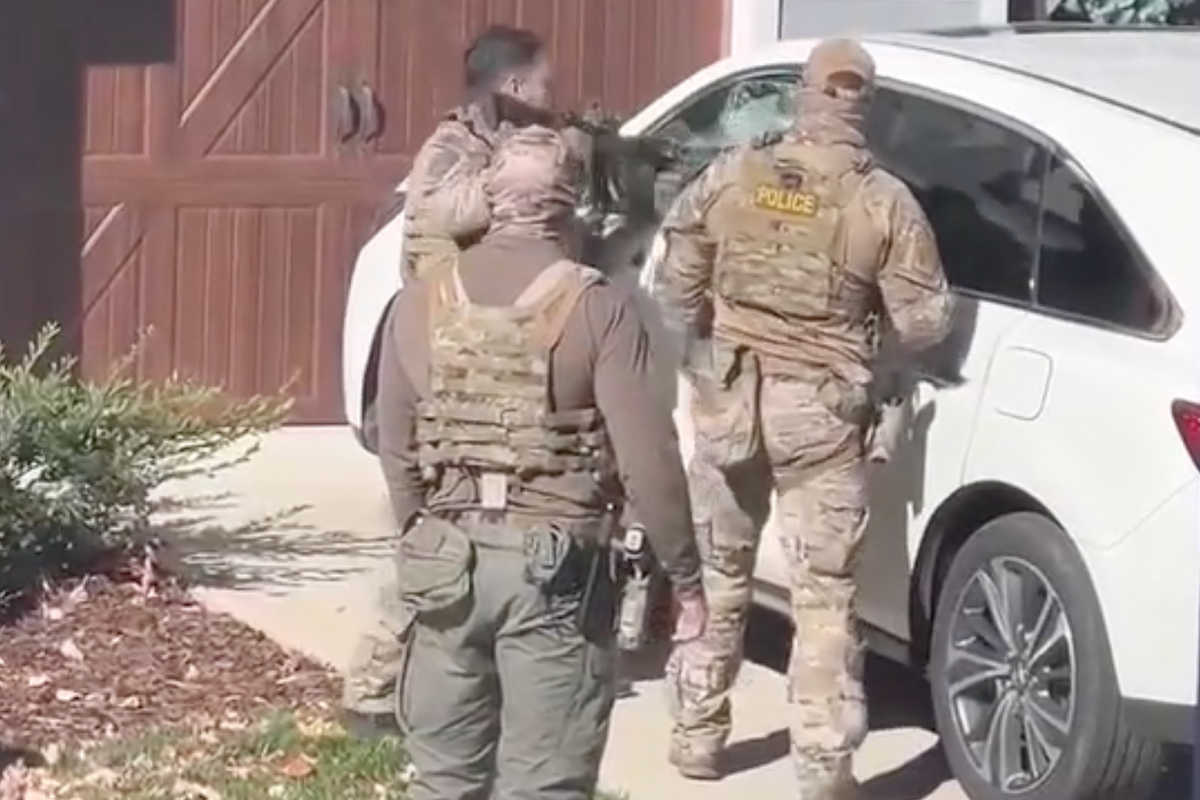
When two women were detained by federal immigration agents after honking their horn at an unmarked vehicle blocking traffic, legal observers saw more than a routine traffic dispute gone sideways. They saw a flashpoint in an ongoing struggle over federal law enforcement authority and First Amendment rights. The lawsuit filed against the federal government over this arrest cuts directly to a core constitutional tension: where does legitimate law enforcement end and retaliation against protected speech begin?
The incident unfolded with deceptive simplicity. Drivers honk every day to signal frustration or request that a blocked roadway be cleared. Yet in this instance, the individuals sitting inside the obstructing vehicle happened to be officers with Immigration and Customs Enforcement (ICE). What should have been a minor urban annoyance escalated within minutes into a full federal detention, handcuffs, and a fight in federal court. Read more on a related issue: this related article.
To understand how a car horn triggered a civil rights lawsuit, one must look closely at the expanding footprint of federal civil enforcement in municipal spaces.
The Constitutional Conflict in Plain Sight
Free speech protections under the First Amendment do not stop at the windshield. Courts have long recognized that expressive conduct—including using a horn to signal or protest—can fall under protected speech depending on context. When federal agents react to a simple horn honk by detaining the driver, they cross from traffic management into potentially unconstitutional retaliation. More journalism by NPR explores similar perspectives on the subject.
Federal law enforcement officers operating in local neighborhoods do not possess carte blanche authority to detain citizens for minor civil infractions or perceived disrespect. For an arrest to hold up under the Fourth Amendment, officers must demonstrate reasonable suspicion of criminal activity or probable cause. Honking at an idling car rarely meets that threshold.
When agents blur the line between federal administrative mandates and local traffic enforcement, constitutional protections begin to fray. The lawsuit challenges this precise overreach, asserting that federal agents used their badge to punish citizens for an act of speech that annoyed them.
Unmarked Vehicles and the Escalation Spiral
Unmarked government vehicles are a standard tool for field operations. However, when deployed in dense public areas, they frequently generate friction. Citizens have no immediate way of knowing whether an idling SUV blocking an alley or street belongs to a federal officer, a commercial delivery worker, or a distracted driver.
The dynamic unfolds predictably:
- A driver encounters an unmarked vehicle blocking a public lane.
- The driver honks to prompt movement, entirely unaware of who occupies the car.
- Officers inside interpret the honk as aggression or interference with an operation.
- Agents initiate a traffic stop or detention without establishing clear state law authority.
This escalation spiral highlights a structural blind spot in field protocol. Federal immigration officers are primarily trained for civil administrative enforcement, not local traffic control. When thrown into routine municipal interactions without clear bounds, the likelihood of constitutional friction multiplies exponentialy.
The Mechanics of Qualified Immunity
A central hurdle in any civil rights lawsuit against federal personnel is the doctrine of qualified immunity. This legal framework shields government officials from personal liability unless their conduct violates "clearly established" statutory or constitutional rights.
Plaintiffs must prove not only that their rights were violated, but that any reasonable officer would have known the conduct was illegal at the time. Proving that a federal agent should have known detaining a driver for honking violated established law is a steep hill to climb in federal court.
It creates an asymmetrical legal battle. Citizens face immediate loss of liberty on the street, while government actors benefit from broad legal shields after the fact.
The Broadening Scope of Pretextual Detentions
Legal scholars point to a troubling pattern in pre-textual stops involving federal agents. While local police officers must navigate strict state statutes regarding traffic stops, federal agents operating under administrative immigration warrants often operate in a legal gray zone regarding routine street stops.
If an agent uses a minor traffic irritation as a pretext to check the immigration status or identification of occupants, it subverts the legal limits placed on federal power. Federal courts have repeatedly warned against using administrative authority to conduct warrantless fishing expeditions against the general public.
The lawsuit serves as a test case for whether courts will tolerate administrative authority creeping into everyday public interactions. If honking at an unmarked car is enough to justify a federal detention, the boundary separating targeted federal enforcement from arbitrary public stops effectively ceases to exist.
Systemic Accountability and Policy Limits
The outcome of this litigation will carry implications far beyond a single legal settlement or payout. It directly challenges the internal oversight mechanisms within federal law enforcement agencies operating in domestic jurisdictions.
Real accountability requires clear operational limits:
- Strict protocols prohibiting agents in unmarked cars from conducting traffic detentions without clear criminal probable cause.
- Mandated body-worn camera deployment for all public-facing field operations.
- Clear public identification standards for federal vehicles operating in non-tactical settings.
- Internal discipline for officers who use enforcement powers in response to protected free speech.
Without structural reform, legal settlements merely become a cost of doing business for federal agencies, funded entirely by taxpayers.
When law enforcement treats ordinary public expression as an act of defiance warranting arrest, authority loses its legitimacy. The standard set in this case will dictate whether citizens can exercise basic constitutional rights in public without fear of federal retaliation.