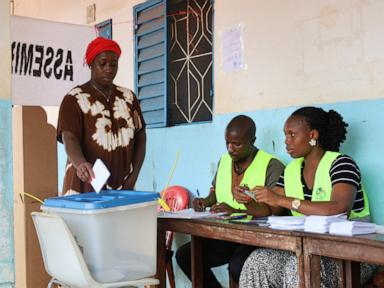
Decades of political dysfunction in Guinea-Bissau reached a structural breaking point when voters backed a constitutional referendum that fundamentally reshapes the nation's governance model. According to data released by the National Electoral Commission, roughly seventy percent of voters endorsed the sweeping changes, shifting the West African nation away from its historical semi-presidential framework and concentrating executive authority directly inside the office of the presidency. This pivotal constitutional overhaul, engineered during a military-led transition, alters the architecture of the state by shrinking the legislature from 102 seats down to 65, reducing electoral constituencies from 29 to 12, and stripping the prime minister of shared executive parity.
To understand why this happened, one has to look past the ballot boxes and examine the mechanics of chronic instability. Since gaining independence from Portugal in 1974, this coastal nation of roughly 2.2 million people has weathered five successful military coups and a revolving door of administrations. The root cause of the friction was never abstract. Under the old constitution, executive authority was split awkwardly between an elected president and a prime minister chosen by the parliamentary majority. That dual-executive model created a perpetual institutional cage match. When former President Umaro Sissoco Embaló clashed with an opposition-dominated parliament, he dissolved the assembly, ruled by decree, and eventually fell victim to yet another military takeover in November 2025 as a disputed election hung in the balance.
The military junta, led during the transition by General Horta N'Tam, argued that two captains cannot steer the same vessel. The newly approved charter resolves that friction by making the president the undisputed head of government. The head of state now commands the power to appoint and dismiss the prime minister at will, chair the Council of Ministers, and dissolve parliament entirely. Supporters of the shift, including armed forces chief General Tomás Djassi, maintained that clarity of command was the only antidote to decades of administrative paralysis.
Yet the transition from paper reform to institutional reality carries heavy baggage. The constitutional text itself was drafted under the auspices of the National Transitional Council, a body installed by the military following the November 2025 coup. Major opposition coalitions, spearheaded by the African Party for the Independence of Guinea and Cape Verde (PAIGC), viewed the process as an authoritarian blueprint disguised as institutional cleanup. Critics pointed out that a military government lacks the democratic mandate to rewrite the fundamental social contract of a country. Rather than participating in what they characterized as an engineered consolidation of authority, opposition leaders urged a complete boycott of the referendum.
Despite those calls for a stay-away, the electoral administration reported participation rates exceeding fifty-five percent, pushing the amendments across the finish line ahead of scheduled presidential and legislative elections. But lower turnout in urban centers like Bissau underscored an underlying current of public skepticism. Many citizens caught in the crossfire of recurring coups expressed exhaustion rather than enthusiasm. As local analysts pointed out during the campaign, the foundational question was never just about operational efficiency, but about who benefits when the rules of the game are rewritten from the top down.
Shrinking the National People's Assembly from 102 lawmakers to 65 is framed by state architects as a cost-saving measure that streamlines debate. Detractors view it as a deliberate neutering of legislative oversight. By compressing 29 electoral districts down to 12, the reform also alters the calculus of regional representation, centralizing political gravity away from the periphery and into the capital. Furthermore, the newly minted framework introduces stringent barriers for future aspirants, including a permanent residency requirement of five years prior to an election and a steep financial deposit equivalent to roughly $90,000, a staggering sum in a nation where over half the population lives below the poverty line.
International observers are watching closely as the country prepares for the December ballot boxes. Guinea-Bissau's strategic position along transnational cocaine trafficking corridors has historically intertwined its political instability with institutional vulnerability. A powerful presidency might insulate the state from legislative gridlock, or it could simply remove the remaining friction blocks that keep absolute authority in check. The referendum has closed one chapter of military-civilian transition, but the durability of this hyper-presidential model will face its true test the moment the next elected leader encounters political opposition.