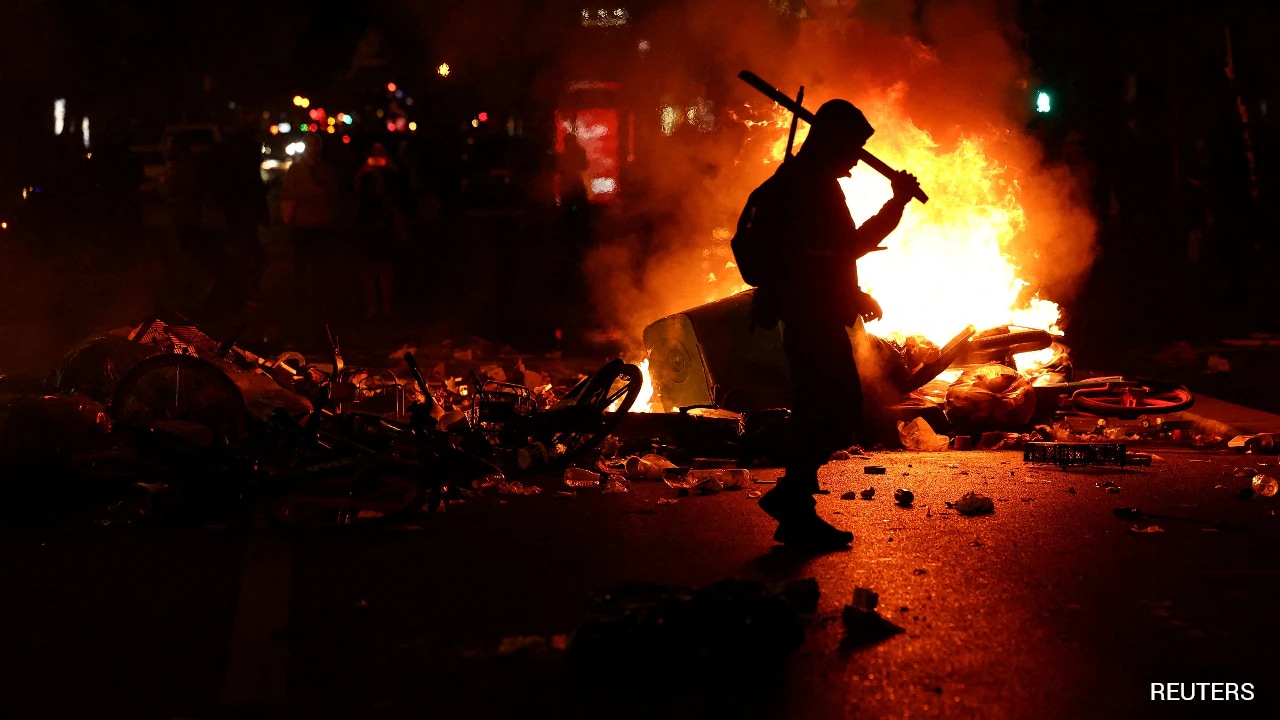
France is responding to waves of nationwide protests with overnight curfews, bans on gatherings and materials, and deployments of up to 70,000 security personnel—yet street unrest keeps returning because the state is treating a structural crisis like a routine public-order problem.
Watch enough French street clashes over the past thirty years and you start recognizing the choreography before the first tear-gas canister pops. A spark hits. High schoolers or union members hit the pavement. A smaller, harder-edged fraction uses the cover to smash storefronts, burn barricades, and hurl fireworks or petrol bombs at police. Then comes the familiar administrative reflex from Paris: prefectural bans on fuel containers and pyrotechnics, curfews in flashpoint neighborhoods, metro station closures, and tens of thousands of officers flooding the streets.
Competitor dispatches usually treat that checklist of curfews, bans, and security deployments as the story itself. It isn't. It is the symptom of a deeper failure. When a government leans this heavily on perimeter control and mass mobilization, it is usually compensating for an inability to settle the underlying disputes quickly or keep order cleanly without alienating peaceful crowds.
How High School Grievances Became Nationwide Unrest
To understand why curfews and bans keep piling up, look at how this wave started rather than how it looked on television once shop windows broke.
The mobilization did not spring out of nowhere as a pure riot. It began in September with concrete, unglamorous complaints: understaffed classrooms, missing teaching assistants and school nurses, overcrowded rooms, and strained public services. High school blockades in the Paris suburbs and overseas territories spread fast because students saw the same shortages in their own buildings and shared clips online.
Once those school blockades collided with anger over the high cost of living, rising fuel prices, and union grievances, the movement widened. Hundreds of thousands of people turned out across dozens of cities. Early polling showed majority public sympathy for the students' core complaints.
Then came the turning point on October 17. Peaceful marches and high school demonstrations overlapped with violent clashes, looting, fires, and thousands of arrests across multiple cities. Police suffered heavy injuries alongside demonstrators, and authorities openly acknowledged they had been caught off guard by the scale and intensity of the violence.
That shift changed the political math overnight. A movement about classrooms, schedules, and living costs got tangled up with images of burning barricades and ransacked shops.
Why Curfews and Bans Hit Peaceful Crowds First
When rioters move fast and anonymously, authorities reach for blunt instruments. Overnight curfews in targeted areas, bans on gatherings near sensitive landmarks or transit hubs, rules against carrying fuel or fireworks, and restrictions on protective gear near schools are all designed to shrink the room rioters have to maneuver.
On paper, those measures sound tidy. In practice, they carry a heavy catch.
Order decrees apply broadly across zones where most people are not throwing mortar fireworks. When police deploy tear gas in a crowded square to push back a violent group on a side street, the gas does not check who holds a union card or a sousaphone. Musicians warming up for a peaceful performance get choked out alongside bystanders, and lawful demonstrators end up feeling treated like suspects before a crime occurs.
There is an even sharper contradiction inside the ban strategy. You can prohibit petrol cans, fireworks, and unauthorized gatherings. You cannot ban economic squeeze or understaffed schools with a signature from a police prefecture.
Consider a hypothetical example of a mid-sized French city hit by two nights of looting. A mayor or prefect orders an overnight curfew and bans gatherings in the center. Rioters simply shift to another district, a ring road, or an earlier hour, while local shopkeepers and delivery riders lose more business and face daily friction getting home.
Security deployments also have a ceiling. Mobilizing 70,000 security personnel, including specialized units and ongoing military patrols at sensitive sites under Operation Sentinelle, projects maximum resolve. Yet officers are human. Stretching forces across dozens of cities, rail hubs, schools, and commercial districts over repeated weekends wears down stamina and leaves blind spots when crowds split.
| Measure | Stated Purpose | Practical Friction |
|---|---|---|
| Overnight Curfews | Curb late-night looting and street clashes | Disrupts residents, workers, and local commerce; can displace unrest elsewhere |
| Gathering & Route Bans | Keep crowds away from flashpoints and transit hubs | Can push protests into less predictable areas and spark disputes with unions |
| Material & Gear Bans | Reduce arson, fireworks attacks, and street brawls | Hard to enforce evenly across large crowds without blanket stops |
| Mass Force Deployments | Deter violence and protect public buildings | High fatigue and injury risk; cannot resolve political or wage grievances |
The Political Trap Behind the Crackdown
A veteran observer of French politics knows that street unrest here is never just about the immediate decree. It is a pressure test of state authority—and a gift to political extremes ahead of major elections.
With France's presidential contest looming in 2027, every clash on the streets feeds a fierce tug-of-war over blame. Officials point to violent actors, criminal looters, and radical fringes trying to break public order. Critics and many surveyed voters fault the government for letting frustration boil over in the first place.
Both sides of the political spectrum try to harvest the fallout. Hardline law-and-order figures argue that curfews, bans, and heavy policing did not go far enough soon enough. Firebrand left-wing leaders frame the turmoil as proof that working families and young people are being ignored until they scream.
Meanwhile, the moderate center gets squeezed. Late concessions—such as tweaks or replacements for university admissions like Parcoursup, education pledges, or moving up a minimum-wage bump—can cool one segment of anger without pacifying the rest. Once trust frays, promises that arrive after tear gas and broken glass rarely land as generous gestures.
What Actually Changes the Trajectory
No serious analyst pretends policing in France is easy when violent groups mix into large demonstrations. Officers face real danger, and small business owners bear real losses when shops are looted or burned. Interest-free loans help a bit, though shopkeepers rightly note they fall far short of full recovery when damage runs into hundreds of millions of euros.
Still, if the goal is fewer curfews and smaller deployments rather than an endless cycle of weekend standoffs, three shifts matter more than another round of bans.
- Separate crowd management from riot suppression. When peaceful marchers, students, and performers are swept into aggressive containment, legitimate grievances harden into anti-police fury.
- Negotiate routes and grievances early. Last-minute clashes over march routes and late policy walk-backs turn manageable disputes into nationwide flashpoints.
- Fix visible everyday bottlenecks. Staffing schools, smoothing transit and wage pressures, and giving workers clear safety rules during disruptions address why ordinary people show up alongside angry youths.
Curfews can clear a boulevard for the night. They cannot clear the resentment waiting for morning.


