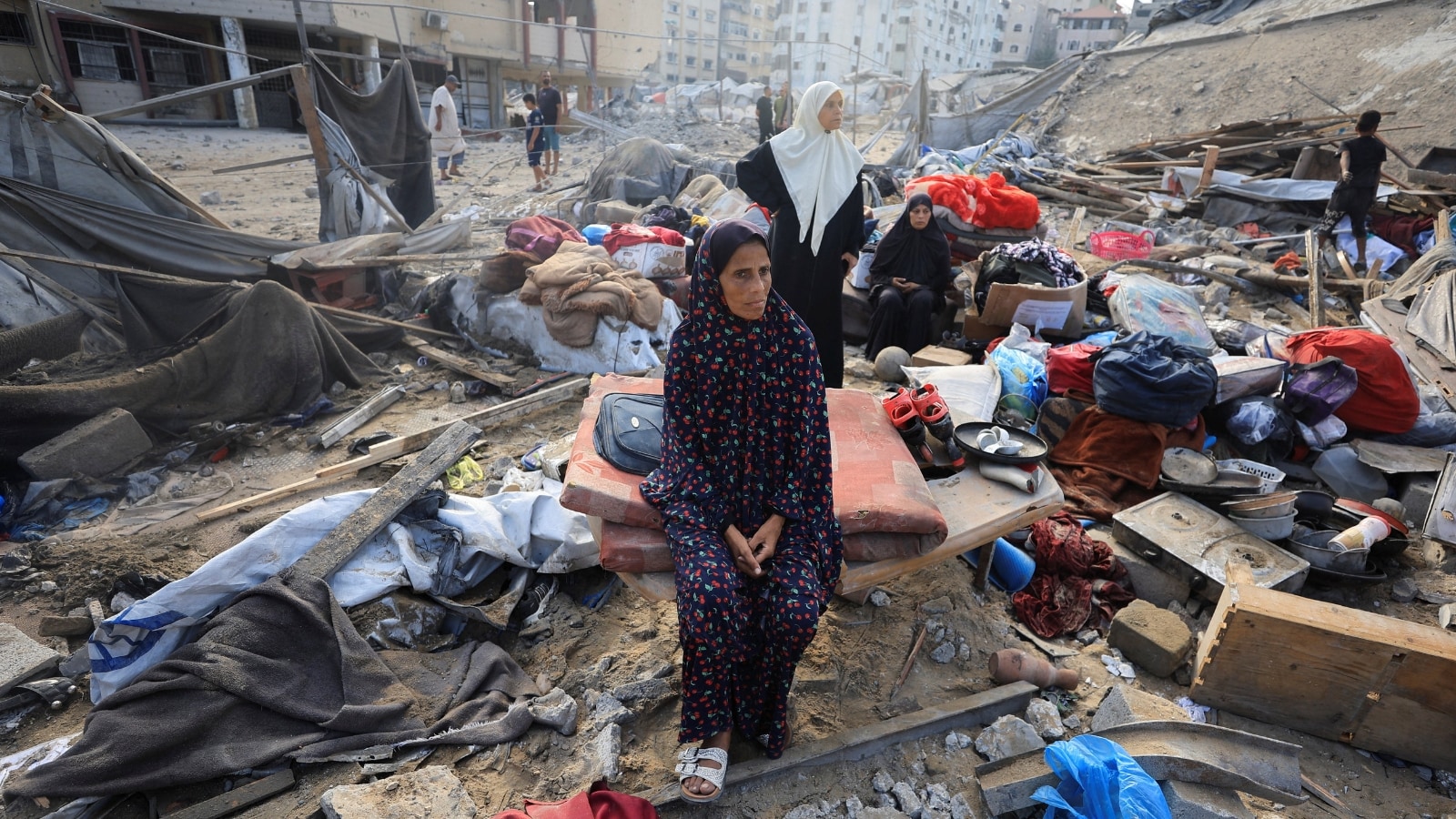
U.S. President Donald Trump announced that a structured, multi-phase agreement has been reached through international mediators to dismantle Hamas and disarm all militant factions in the Gaza Strip. This fragile framework, managed under the auspices of a newly formed international "Board of Peace", collides directly with entrenched Israeli skepticism and conflicting Hamas demands over the sequencing of troop withdrawals.
The announcement brings a high-stakes spotlight to the second phase of a stalled regional roadmap. Yet, the physical architecture of the deal reveals stark contradictions that could unravel the entire diplomatic effort before implementation even begins.
The Sequencing Trap
At the heart of the crisis lies a fundamental sequencing paradox. Washington and its international partners envision a step-by-step winding down of hostilities where Hamas gradually surrenders its heavy weaponry, dismantles its underground tunnel networks, and yields local authority to a newly minted technocratic administration. Only upon the completion of this disarmament would the Israel Defense Forces execute a total withdrawal from the Palestinian enclave.
Hamas negotiators, operating through regional intermediaries in Cairo, flatly reject this timeline. Senior leadership has insisted that the group will not surrender any portion of its arsenal prior to a full Israeli military retreat from the Strip. By demanding that disarmament follow withdrawal rather than precede it, militant leaders preserve their primary strategic leverage.
This disagreement exposes a deep chasm in the architecture of the agreement. Trust is entirely absent from the equation, replaced by competing ultimatums that neither side is currently willing to soften.
The Israeli Calculus and the Board of Peace
Prime Minister Benjamin Netanyahu's government views the unfolding diplomatic push with profound distrust. Official channels in Jerusalem maintain that anything short of immediate, unverified, and total demilitarization fails to meet baseline security requirements. Israeli military commanders continue to expand operational control inside the enclave, signaling that tactical realities on the ground bear little resemblance to the optimistic projections broadcast from Washington.
The international vehicle driving this initiative—the Trump-led Board of Peace—includes senior figures such as Secretary of State Marco Rubio, envoy Steve Witkoff, and Jared Kushner alongside international diplomats. While this body has pledged billions in reconstruction funding and proposed deploying an International Stabilization Force alongside a newly trained local police entity, major Western capitals have openly questioned the board's mandate.
Without broad, unified backing from traditional multilateral institutions, the enforcement mechanism lacks teeth. An international stabilization force sounds comprehensive on paper, but actual troop contributions remain dangerously vague, leaving the burden of security enforcement hanging in an administrative vacuum.
The Mechanics of Partial Compliance
Behind closed doors, negotiators have floated compromises that threaten to hollow out the concept of complete demilitarization. Rather than surrendering all weaponry directly to an outside authority, drafts suggest that heavy armaments might merely be boxed, confined, and stored under the supervision of a domestic Palestinian body.
Such arrangements offer a convenient diplomatic fiction. They allow intermediaries to claim progress while permitting militant factions to retain de facto access to their underground infrastructure. A cache locked in a basement under local watch can easily be reopened if political arrangements collapse.
Furthermore, the projected timeline spans anywhere from 200 to 350 days. In a theater defined by volatile escalations, localized skirmishes, and deep-seated vengeance, a year-long runway for compliance is an eternity. Daily air strikes and localized clashes continue to punctuate the landscape, proving that the cessation of major combat operations has not translated into a genuine peace.
The Regional Wildcard
External pressures further complicate the viability of the accord. Iran remains a persistent destabilizing factor. Although Tehran's capacity to directly supply its regional proxies has been heavily constrained by concurrent military engagements with the United States and Israel, its ideological and financial footprints endure. Hardline factions within Hamas look to external sponsors for validation, making local compliance vulnerable to shifting regional commands.
The intersection of these pressures creates a precarious window. If the administrative transfer of local policing powers occurs over the next fortnight as planned, but heavy weapons remain untouched, the gap between perception and reality will widen.
The deal is built on an assumption of gradual transformation that history repeatedly rejects. Every phase relies on compliance from actors who view mutual destruction as preferable to political capitulation. As the deadlines approach, the architecture of the agreement faces its ultimate test against the unyielding friction of the ground.

/GettyImages-157526585-93425538070d4422ad42d22af28c0758.jpg)