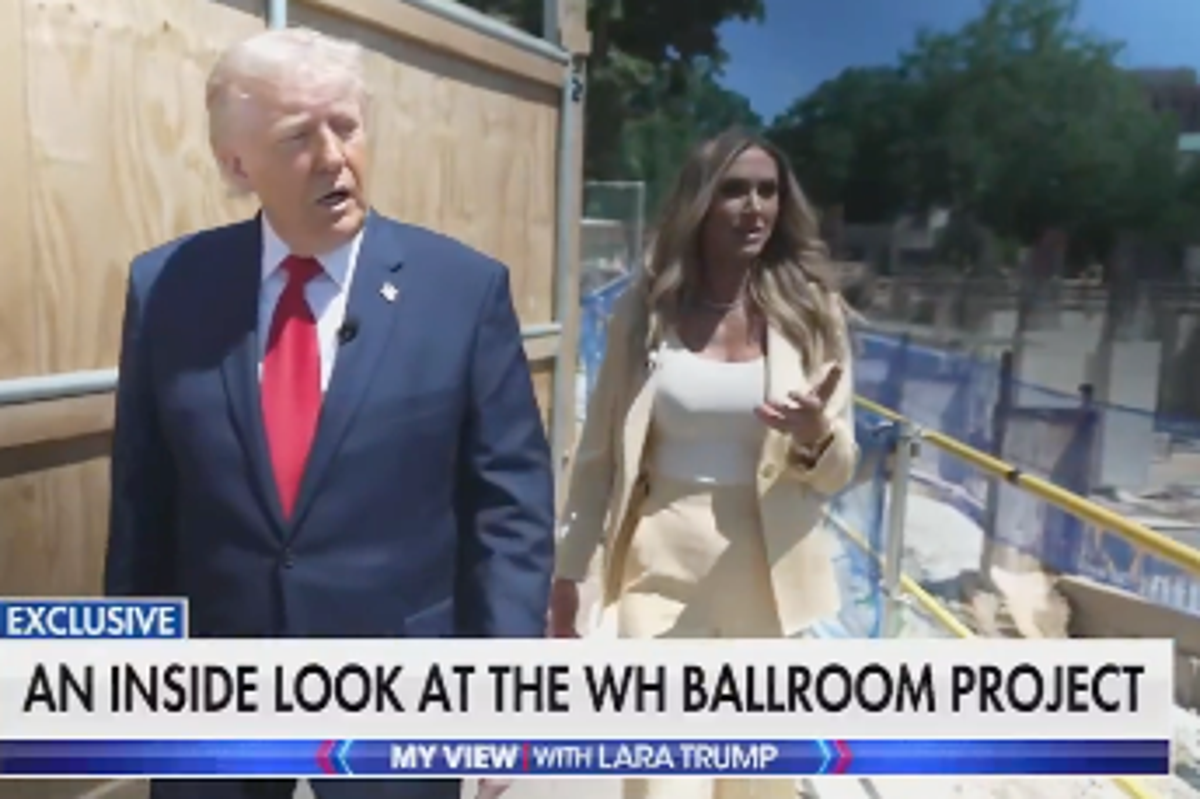
President Donald Trump recently stood amidst the exposed rebar, concrete mixers, and heavy machinery of the new White House State Ballroom construction site, delivering a blunt declaration about the future of the American presidency. Accompanied by his daughter-in-law and Republican National Committee Co-Chair Lara Trump, the president gestured across the massive 90,000-square-foot cavern replacing the historic East Wing. "We're gonna have the inauguration here," Trump stated, laying bare the real timeline and ambition behind the most aggressive, controversial architectural overhaul of the executive mansion since the Truman administration.
The impromptu tour was framed as an update on an institutional upgrade, but it revealed a deeper, more personal objective. This is not just an event space. It is a fortified monument, heavily financed by private billionaires and corporate entities, built to reshape both the physical security of the presidency and the historical legacy of the man occupying the office.
The Fortress Under the Floorboards
The public narrative surrounding the White House State Ballroom focuses heavily on hospitality. For decades, administrations have relied on sprawling, expensive temporary pavilions erected on the South Lawn to host large-scale state dinners. The historic East Room can only seat about 200 guests, forcing the government to shell out upwards of $1 million per event for temporary structures that Trump openly derided as "not a pretty sight."
The new structure solves the capacity problem by accommodating up to 1,000 guests, but the architectural reality extends far beyond crystal chandeliers and catering stations. During his tour, Trump spent considerable time pointing out features that resemble a military bunker rather than a reception hall.
The technical specifications are intense. The walls feature four-inch-thick impenetrable glass reinforced by massive steel and concrete barriers. Overhead, the roof is engineered to be entirely flat and built with heavy structural steel. The president explained that the design is explicitly drone-proof and optimized to support active military deployments.
"Between the drone proofing, the missile proofing we have, and the drone capacity upstairs, we can have all sorts of military up," Trump told reporters, adding that the roofline provides a 360-degree line of sight over Washington, D.C., tailored for tactical sniper units.
This is an unprecedented transformation of the executive residence. A subterranean military complex sits beneath the ballroom floorboards, turning an area once dedicated to administrative offices and social coordination into a heavily fortified command hub. The building is bound together by integrated elevators, specialized climate systems, and deep-set structural columns designed to withstand heavy impacts. Even the perimeter has changed, featuring deep-set titanium fencing engineered to stop heavy vehicles from breaching the grounds.
The Billionaire Backed Executive Mansion
The true friction of the ballroom project lies in its funding and administrative execution. Traditionally, alterations to the White House require painstaking approvals, historical preservation reviews, and congressional appropriations. Trump bypassed the legislative gridlock by turning entirely to private financing.
The price tag has expanded dramatically. Originally projected as a $200 million project when announced in mid-2025, the estimated cost surged to $300 million by autumn, and currently sits at an estimated $400 million. Trump has consistently maintained that corporate donors and private family foundations are footing the bill, branding the structure as a "gift" to the United States that costs taxpayers nothing.
However, the ethics of a privately funded West Wing expansion remain a gray area. While the administration released a partial list of donors, it initially withheld the identities of major corporate and institutional contributors. Independent reporting and disclosures later revealed heavy financial backing from major corporate forces, including BlackRock, Nvidia, and billionaire investor Jeff Yass. Critics point out that allowing private corporations and high-net-worth individuals to directly finance the physical infrastructure of the White House creates unprecedented conflicts of interest.
To ensure the project moved forward without institutional delays, the administration systematically dismantled the bureaucratic checkpoints that usually govern historic federal sites. In October 2025, Trump summarily terminated all six members of the U.S. Commission of Fine Arts, replacing them with new appointees aligned with his aesthetic and political philosophy. When federal funding for security features faced pushback in Congress, the administration simply doubled down on its network of private patrons, securing massive material donations, including $37 million worth of structural steel.
Legal challenges have pursued the project at every step. Preservationists sued to halt the above-ground construction, citing the total demolition of the historic 1902 East Wing structures. The courts have allowed construction to proceed under tight windows, turning the site into a race against the clock.
Architecture as Biography
Every president seeks to leave a mark on the White House, but these interventions are usually subtle. Modern presidents typically limit their personal expressions to the interior decor of the Oval Office, switching out carpets, curtains, and artwork. Trump has taken a different approach, physically altering the exterior footprint of the complex to match a highly specific, classical aesthetic.
The design relies heavily on stark historical cues. The exterior facade draws inspiration from ancient Roman and Greek architecture, featuring heavy classical columns and a prominent porch looking out over the capital. Trump compared the impending structure to the U.S. Supreme Court building, emphasizing a desire for timeless, authoritative permanence.
The motivation for the project is not a matter of speculation. When questioned privately about why he was pouring so much political capital into a construction zone on the North Lawn, Trump was uncharacteristically candid with allies. Fox News host Jesse Watters later reported the president's exact words regarding his motivation. "It's a monument," Trump said. "I'm building a monument to myself—because no one else will."
By showcasing the site to Lara Trump and declaring it the future home of his next inauguration, the president underscored that the ballroom is not meant for an abstract, distant successor. It is being built for his immediate political circle, his family, and his own upcoming ceremonies. The glass bridge connecting the new ballroom directly to the Executive Residence ensures that the line between personal legacy and state power remains permanently blurred.
The construction continues at a breakneck pace, operating day and night to meet the aggressive deadlines set by the Oval Office. As the classical columns rise alongside the titanium perimeter walls, the project stands as a physical manifestation of a presidency that operates by its own rules, funded by private capital, secured by military-grade design, and built to ensure that the Trump legacy is literally etched into the stone of 1600 Pennsylvania Avenue.


