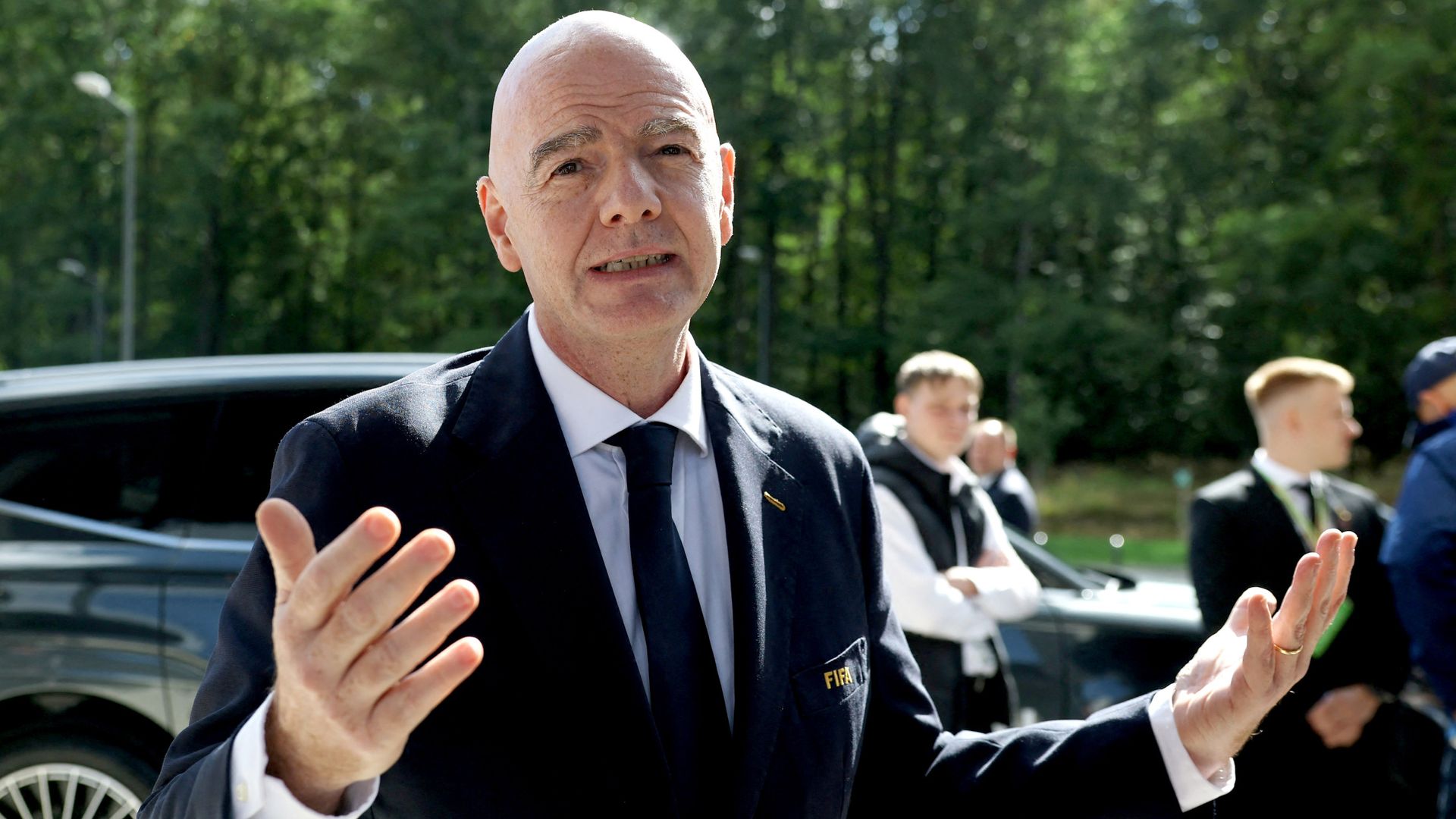
The relationship between global football's governing body and its wealthiest continental affiliate has descended into an open, institutional war. FIFA has formally accused European football chiefs of a coordinated campaign of harassment and misinformation targeting president Gianni Infantino, lodging legal fire in a Florida court to block a sweeping request for evidence discovery. At the heart of this confrontation lies a radioactive commercial dispute over a multi-billion-dollar World Cup private investor plan that nearly restructured the financial architecture of the sport. For years, the fault lines between Zurich and Nyon have widened. Now, the friction has transformed into a high-stakes struggle for institutional survival.
To understand why a routine dispute over corporate transparency has mutated into a bitter court battle, one must look at the mechanics of the failed FIFA Forward Enterprise (FFE) project. Infantino sought to spin off commercial rights, targeting a massive $4.2 billion influx from private investors led by Josh Kushner to fund global development. To European administrators, the maneuver represented an existential threat. They viewed it as an attempt to monetize the crown jewels of international sport without adequate consultation or structural safeguards. When the plan leaked and triggered a global backlash, it exposed deep institutional fractures.
FIFA's legal team has chosen to fight back aggressively. In court filings responding to UEFA's attempts to extract document discovery, FIFA lawyers argued that the European body's actions constitute bad faith. They contend that the primary objective is not document retrieval, but rather a calculated effort to influence the upcoming presidential election by damaging Infantino's reputation. By framing legal inquiries as political warfare, FIFA is attempting to build a fortress around its leadership, casting outside scrutiny as an assault on the organization's sovereignty.
The timing of this legal confrontation is precarious. Infantino faces mounting pressure from European leagues and federations that argue the current administration has strayed from its core mandate as a non-profit global custodian. While support across other confederations in Africa, Asia, and parts of the Americas remains robust enough to preserve his political base, the erosion of European trust cannot be brushed aside easily. Europe generates the lion's share of commercial television revenue, club prestige, and player output that fuels the global ecosystem. A permanent schism between the two power centers threatens to paralyze decision-making at the highest levels of the sport.
Behind closed doors, the operational cost of this civil war continues to mount. Senior advisors have departed, executive committees are divided by mistrust, and member associations are forced to choose sides in a geopolitical tug-of-war. The rhetoric coming out of Zurich portrays the leadership as a defender of the global majority against an entitled European elite. Conversely, critics view the administration's defensive posture as proof of an accountability vacuum.
As the upcoming FIFA Council meetings approach in Zurich, the agenda will ostensibly focus on financial governance and stability. Yet the true agenda is about power. The legal maneuvers in Florida and the diplomatic posturing across capitals are merely symptoms of a deeper power struggle. Global football is discovering that its unprecedented financial expansion has created internal contradictions too large for traditional governance models to contain.


