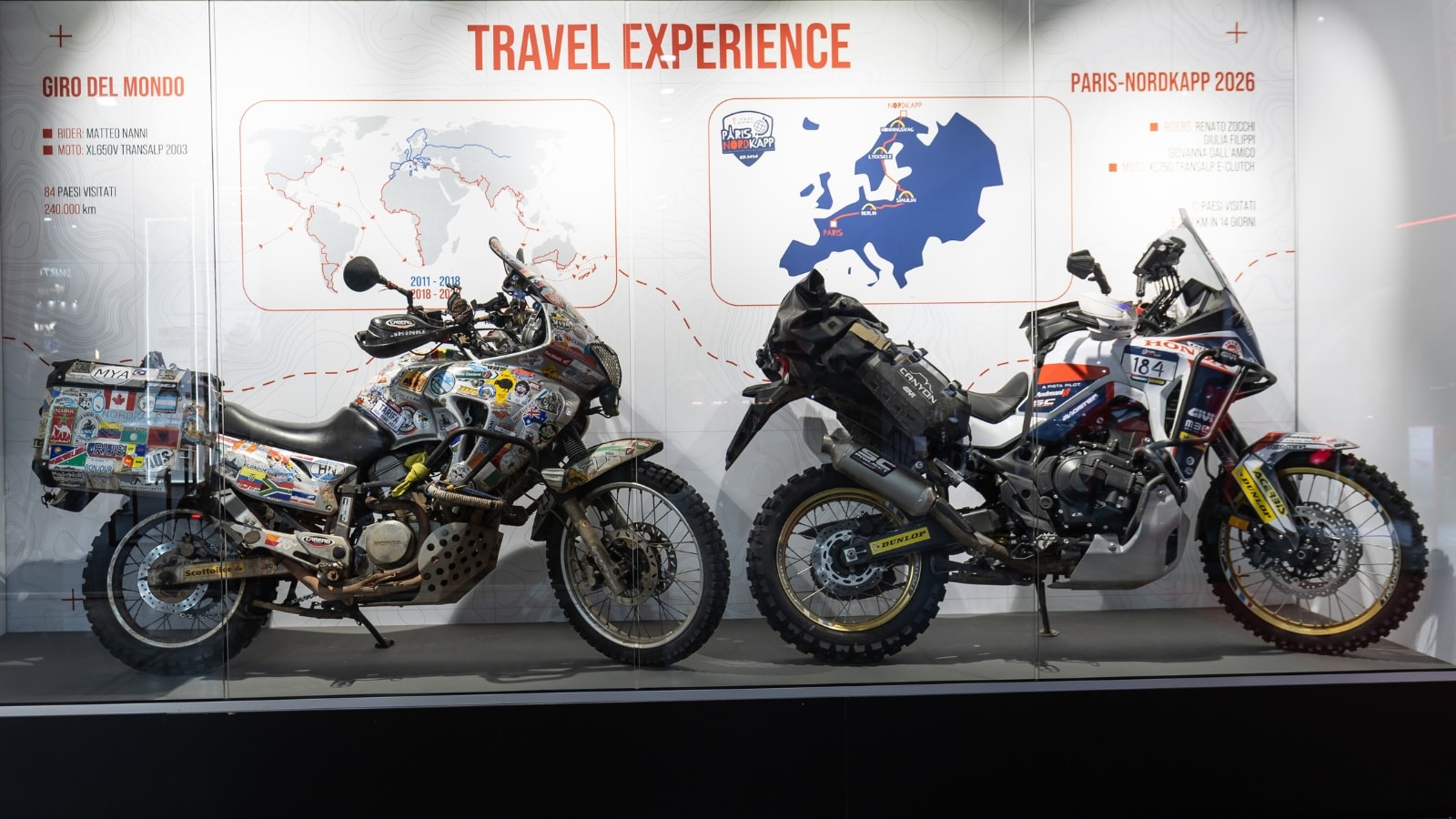
The halls of Fiera Milano Rho during EICMA 2026 told a story that standard press releases completely missed. While the surface narrative celebrated shiny new motorcycles from Royal Enfield, Honda, TVS, and Ducati, the underlying reality on the show floor revealed a massive structural shift in the global two-wheeler industry. Legacy European and Japanese manufacturers are no longer dictating the pace of volume or mid-capacity innovation; instead, Indian manufacturing powerhouses are aggressively capturing the global middleweight market while hedging their bets on electric vehicles and internal combustion platforms simultaneously.
Walk past the velvet ropes at Milan and the economics become obvious. A few years ago, brands like TVS and Royal Enfield occupied peripheral booths, largely viewed by Western analysts as regional players catering to developing markets. At EICMA 2026, they commanded prime real estate, unveiling production-ready global platforms and futuristic EV concepts directly across the aisle from Bologna’s finest engineering. Meanwhile, Honda and Ducati responded not with sweeping, high-volume revolutions, but with calculated technological insulation—doubling down on proprietary transmission tech, modular battery architectures, and high-margin flagship exclusivity.
The Myth of the Unified Electric Transition
If you only read the promotional brochures handed out in Milan, you would believe the motorcycle industry is marching in lockstep toward an all-electric future. The reality is far messier. Every major manufacturer at EICMA 2026 showcased EV concepts, yet their capital allocation strategies tell a story of deep skepticism regarding consumer adoption in the mid-to-heavyweight segments.
Batteries remain heavy. Energy density has not magically solved the packaging nightmare of fitting meaningful range into a standard motorcycle frame without ruining its center of gravity or pushing the retail price beyond what a normal rider will pay.
Consider how Honda approached the floor this year. Rather than betting the farm on full-size electric sportbikes that nobody outside urban commuters actually buys, Honda leaned heavily into swappable battery ecosystems and automated clutch technologies for internal combustion engines. Their strategy acknowledges a hard truth that many executives avoid saying out loud: in markets across Europe, North America, and Asia, charging infrastructure for two-wheelers remains fragmented, and riders refuse to sacrifice weekend touring range for zero tailpipe emissions. By refining E-Clutch systems and compact hybrid-adjacent architectures, Honda is extending the viable lifespan of the petrol engine while keeping its electric urban mobility division modular and low-risk.
Contrast that with the aggressive EV posturing from TVS. Having quietly accumulated deep intellectual property through its acquisitions and European engineering partnerships—most notably with Norton—TVS used EICMA 2026 to prove it is no longer just a commuter-bike giant from Hosur. Their electric concepts and performance prototypes displayed at Milan are designed specifically to bypass the traditional dealership bottlenecks of Western brands. By controlling the entire supply chain, from battery management software to motor winding, TVS can manufacture an electric two-wheeler at a unit cost that legacy European brands simply cannot match without losing money on every sale.
Why Royal Enfield and TVS Are Winning the Middleweight War
For decades, the motorcycle business followed a predictable script. Japanese brands owned reliability and middle-market volume, while Italian marques like Ducati owned emotion, racing pedigree, and high margins. Indian manufacturers built small, cheap, indestructible machines for domestic transport. That script is dead.
The middleweight segment—roughly 350cc to 750cc—is now the single most profitable battleground in global motorcycling. Rising interest rates and inflation across Europe and North America have pushed riders away from $25,000 flagship superbikes toward accessible, character-rich machines priced under $10,000.
Royal Enfield saw this coming ten years ago, and their presence at EICMA 2026 looked like a victory lap. By expanding their modular 650cc twin platform and introducing new liquid-cooled singles alongside their Flying Flea electric sub-brand, they have built an ecosystem that captures a rider at entry level and keeps them inside the brand as their income grows. What makes Royal Enfield dangerous to competitors is not cutting-edge horsepower figures; it is manufacturing scale. When you produce nearly a million motorcycles a year in Chennai, your component amortization allows you to put real metal, decent suspension, and classic styling on a bike at a price point where European brands can only offer bare-bones plastic.
TVS, meanwhile, is attacking the exact same middleweight vulnerability from a completely different angle: aggressive sport-naked and adventure engineering. Through its deep technical collaboration with BMW Motorrad on sub-500cc platforms and its own Apache and Norton development pipelines, TVS arrived in Milan with machines boasting ride-by-wire throttles, multi-axis inertial measurement units, and chassis geometry tuned on European tracks.
To understand how disruptive this is, consider a hypothetical example of product development economics. Imagine an Italian manufacturer developing a new 450cc twin-cylinder adventure bike. Engineering, homologation for strict Euro 5+ emissions, and low-volume European assembly force the retail price to roughly €8,500 just to preserve a slim dealer margin. An Indian giant developing a rival machine with identical electronic rider aids and comparable build quality can amortize those exact same Euro 5+ research costs across global markets—selling hundreds of thousands of units across Asia, Latin America, and Europe—and retail the bike in Milan for €6,200 while enjoying higher net margins. Legacy brands have no easy counter-move to that math.
Ducati’s High-Margin Fortress
How do you survive when Asian manufacturing giants can undercut your prices by thirty percent while matching your build quality? You stop competing on price entirely.
Ducati used EICMA 2026 to reinforce its transformation from a traditional motorcycle maker into a pure luxury performance brand, operating much closer to the Ferrari playbook than the Yamaha playbook. While competitors fought over entry-level commuters and budget adventure bikes, Ducati focused on lightweight V-twin engineering, MotoGP-derived aerodynamics, and bespoke limited editions.
Look closely at the engineering philosophy behind Ducati’s latest unveilings in Milan. By moving away from complex desmodromic valve trains on certain high-volume street platforms in favor of lighter, more service-friendly spring-valve V2 architectures, Ducati achieved two critical business goals simultaneously. First, they drastically reduced the weight and physical bulk of the engine, making the bikes easier and more exhilarating to ride on real roads rather than just racetracks. Second, they lowered warranty claims and manufacturing complexity while keeping retail prices firmly in the premium bracket.
Ducati knows it will never win a volume war against Honda, Royal Enfield, or TVS. It doesn't need to. As long as wealthy enthusiasts in Milan, Munich, Los Angeles, and Tokyo view a Ducati as an emotional status symbol rather than mere transportation, the brand remains insulated from the brutal price wars consuming the lower tiers of the industry. Even Ducati’s eventual push into electric performance—heavily informed by its role as the sole supplier for the MotoE championship—is framed around extreme track performance and exclusivity rather than mass-market commuting.
The Hidden Engineering Reality Behind the Concepts
Journalists love concept bikes because they make for dramatic photography. Industry analysts look at concept bikes to see which regulatory headaches manufacturers are trying to solve three years down the road.
Beneath the sculpted carbon fiber and glowing LED strips of the concepts shown at EICMA 2026, three major engineering bottlenecks dominated private conversations among chassis designers and powertrain engineers:
- Euro 5+ On-Board Diagnostics and Catalyst Longevity: The latest European emissions standards do not just measure what comes out of the exhaust pipe when the bike is new; they require sophisticated on-board diagnostic systems to monitor catalytic converter degradation over the life of the vehicle. This adds expensive sensors, complex wiring harnesses, and thermal management headaches to every internal combustion bike sold in Europe. Many of the "hybrid" and small-displacement EV concepts shown by Honda and TVS are direct reactions to the rising cost of keeping small petrol engines compliant with European law.
- Thermal Runaway and Packaging in Compact Frames: Unlike an electric car, which can hide a massive liquid-cooled battery pack inside a flat skateboard chassis between four wheels, a motorcycle has nowhere to hide heat or mass. Several EV concepts unveiled in Milan featured structural battery casings—where the aluminum battery housing actually serves as the stressed frame member holding the steering head and swingarm pivot. It is clever engineering, but it creates a massive repairability problem. If a rider crashes a structural-battery motorcycle and cracks a mounting tab on the casing, the entire battery pack—often representing half the value of the vehicle—may have to be scrapped.
- Software-Defined Rider Aids as Profit Centers: Look at the dashboards of the new bikes from Honda, Ducati, and TVS. Giant TFT screens and smartphone connectivity are now standard even on budget machines. Manufacturers are quietly building the hardware infrastructure for over-the-air updates and subscription-based feature unlocks. Putting a quickshifter, heated grips, or cornering ABS hardware on every bike at the factory lowers assembly line complexity; charging the customer via an app to unlock the software later creates recurring high-margin revenue long after the bike leaves the showroom floor.
What Competitors Missed About the Milan Show Floor
Most coverage of EICMA treats the event like a beauty pageant—ranking which bike looks fastest or which concept has the wildest bodywork. That misses the real geopolitical and industrial realignment happening right under the fluorescent lights of Rho Fiera.
The center of gravity in global motorcycling has permanently shifted eastward. Ten years ago, European design studios dictated global trends, and Asian factories simply executed the blueprints. Today, companies like TVS and Royal Enfield operate full-scale R&D centers in the United Kingdom and Italy, hiring away top European chassis engineers, aerodynamicists, and industrial designers, and pairing them with massive manufacturing campuses in India.
Meanwhile, Honda is playing a long, defensive game of attrition. By leveraging its unmatched global dealer network and refining semi-automatic transmissions that make riding accessible to younger, less experienced demographics, Honda is protecting its market share against both electric startups and aggressive Indian challengers. They may not always build the most emotionally provocative machines on the floor, but their balance sheet remains the envy of the industry.
The Hard Truth Facing Riders and Dealers
For the everyday rider walking the aisles of EICMA 2026, this hyper-competitive environment looks like a golden age. You can buy a sub-$7,000 middleweight motorcycle today with better suspension, brakes, and electronic safety nets than a flagship superbike possessed fifteen years ago.
For traditional motorcycle dealerships across Europe and North America, however, the outlook is far more precarious. The rapid proliferation of new models—spanning petrol, semi-automatic, and multiple incompatible electric platforms—forces dealers to carry massive parts inventories and invest heavily in specialized technician training and high-voltage diagnostic equipment. At the same time, direct-to-consumer digital sales models pushed by newer EV entrants threaten to reduce traditional showrooms to mere delivery and warranty service centers.
Manufacturers are demanding that dealers upgrade their showrooms to match luxury automotive standards while squeezing front-end margins on affordable bikes. Something has to give. Over the next twenty-four months, smaller multi-brand dealerships that cannot adapt to servicing both complex Euro 5+ electronics and high-voltage electric drivetrains will quietly disappear, leaving the market dominated by massive corporate dealer groups and factory-backed flagship stores.
The gleaming machinery unveiled in Milan proves that two-wheeled engineering is more creative and capable than ever, even as the business model required to sell those machines undergoes its most painful reinvention in half a century.


