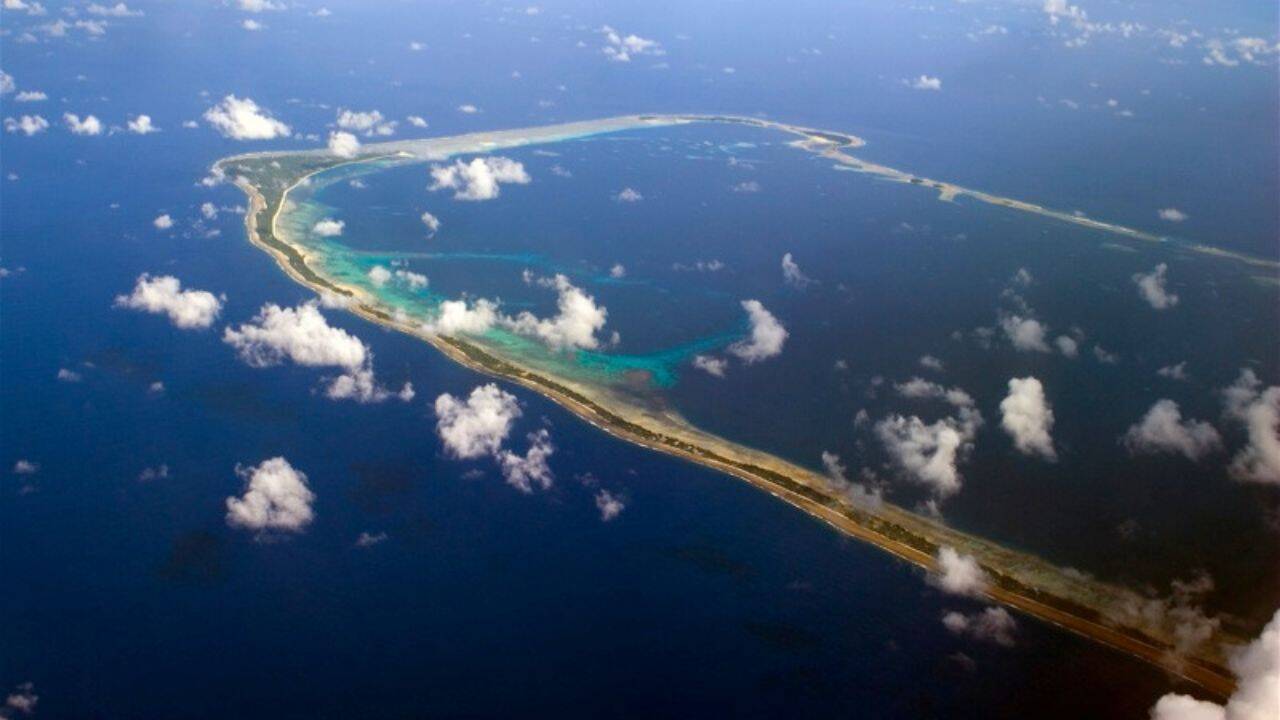
The narrowest island capital in the world measures barely 150 meters across at its skinniest point, a fragile ribbon of concrete and sand squeezed between the heavy salt of the Pacific Ocean and a stagnant lagoon. Funafuti, the administrative heart of Tuvalu, sits precariously low. Most of its landmass rests less than two meters above the current high-tide line.
Global institutions like the World Bank routinely warn that rising seas will erase this nation entirely by the end of the century. They point to satellite altimetry and melting ice sheets. They show computer-generated models of water creeping inland until only coconut palms pierce the surface. In other developments, take a look at: Decoding Soft Power Amplification The Mechanics of Cultural Resurgence Through High Level Statecraft.
Yet those models miss the most urgent mechanism driving the crisis.
The water is not merely rising. The ground is dropping. And the local response involves a radical geopolitical maneuver that could redefine statehood in the twenty-first century. Associated Press has also covered this fascinating subject in extensive detail.
The Geography of Extreme Vulnerability
Tuvalu is an independent Polynesian island nation comprising nine atolls. Total land area covers just twenty-six square kilometers, scattered across nine hundred thousand square kilometers of ocean. Funafuti serves as the primary urban center, where the majority of the population crowds onto Fongafale islet.
Measuring 150 meters from lagoon shore to ocean beach means a severe storm surge does not just flood a street. It breaches the entire island.
During seasonal king tides, seawater bubbles up directly through the porous coral bedrock. Porous limestone acts like a giant sponge. As sea levels inch upward globally, the groundwater table beneath Funafuti rises in tandem, saturating the soil from below while waves batter it from the side.
Conventional engineering treats this as a retaining wall problem. Build higher seawalls. Lay down armor rock. Pump sand back onto eroding beaches.
These fixes fail.
Seawalls redirect wave energy rather than absorbing it. They scour the nearshore environment, dragging more sand out into deep water and leaving the adjacent coastline even more exposed. The World Bank and various international aid agencies have poured tens of millions of dollars into coastal protection projects across the Pacific. Most of them buy a few years at best, acting as expensive band-aids on an amputation.
The Human Factor and Groundwater Collapse
Geography tells only half the story. Human activity on Fongafale accelerates the sinking process.
Decades of rapid urbanization concentrated thousands of people onto a narrow strip of land designed by nature to handle sparse habitation. Construction requires aggregate. Locals mined coral sand and gravel from the beaches and lagoon floor for decades to build concrete foundations, water cisterns, and government buildings.
That extraction destabilized the natural sediment budget. Beaches lost their replenishment mechanism.
At the same time, the dense concentration of septic tanks and localized extraction of freshwater lenses compromised the internal structure of the atoll. Atolls are not solid rock. They are dynamic accumulations of skeletal carbonate debris, shell fragments, and coral sand held together by delicate ecological balances and freshwater pressure.
When humans draw too heavily on the underground freshwater lens, the pressure drops. Saltwater intrudes, killing the vegetation whose root systems help bind the soil. Without vegetation, wind and wave action strip away the topsoil.
The island essentially starves itself of sediment from the inside out.
The Falepili Union and the Climate Refugee Precedent
Recognizing the physical limits of adaptation, Tuvalu pursued a path that few sovereign states have ever dared to walk. In late 2023, Tuvalu signed a landmark bilateral agreement with Australia called the Falepili Union.
The treaty contains provisions regarding security and climate adaptation, but one specific clause dominates all discussions. Australia agreed to establish a special migration pathway allowing up to two hundred and eighty Tuvaluans per year to move to Australia with full residency rights, work access, and health care.
This is not standard foreign aid. It is a managed, phased evacuation of an entire nation.
Critics frame the Falepili Union as a capitulation. It acknowledges defeat, trading sovereign territory for Australian suburban housing estates.
Proponents view it as the only realistic survival strategy for a population facing existential erasure. If the land becomes uninhabitable due to soil hypersalinity and routine inundation, waiting for total submersion is suicidal.
However, the treaty introduces a deeper paradox. What happens to a nation when its people leave?
Redefining Statehood in the Digital Age
International law rests on the Montevideo Convention of 1933. To qualify as a sovereign state under traditional legal frameworks, an entity must possess a permanent population, a defined territory, a government, and the capacity to enter into relations with other states.
If the territory of Tuvalu disappears beneath the waves, does Tuvalu cease to exist?
The government in Funafuti is working aggressively to preempt that legal death sentence. They are building a digital twin of the nation.
Through the Future Now Project, Tuvalu is scanning its entire physical topography, its cultural practices, its oral histories, and its legal codes into a secure, decentralized cloud architecture. The goal is to establish a digitally sovereign state. Even if the coral atolls dissolve into submerged shoals, the government intends to maintain its seat at the United Nations, its exclusive economic zones over millions of square kilometers of lucrative tuna fisheries, and its distinct legal identity.
This challenges the foundational assumptions of geopolitics. For centuries, power and sovereignty mapped directly onto physical soil. Control the land, control the state.
Tuvalu is proving that sovereignty can become detached from geography, existing purely as a legal and digital construct maintained by a diaspora scattered across Sydney, Brisbane, and beyond.
The Economic Realities of Relocation
Moving a nation sounds noble in policy briefs. On the ground, it creates acute economic and social friction.
The two hundred and eighty visas granted annually under the Falepili Union represent a slow trickle compared to the total population of roughly eleven thousand. At that rate, emptying the country takes decades.
Meanwhile, those who remain behind face compounding infrastructure costs. Desalination plants require constant fossil-fuel energy to run, despite Tuvalu committing heavily to solar micro-grids. Imported food prices climb as local agriculture becomes nearly impossible due to saltwater contamination in the soil.
Younger generations naturally look toward Australia or Fiji for economic opportunity, leaving behind an aging demographic structure on the home islands. The social fabric frays as the community splits between those who have secured migration pathways and those left watching the tides rise against their doorsteps.
The Brutal Truth About Global Adaptation
The crisis playing out on a 150-meter-wide strip of coral is not an isolated Pacific anomaly. It serves as a warning system for low-lying coastal cities from Miami to Jakarta to Dhaka.
While mega-cities can spend billions on sea gates, drainage pumps, and land-raising projects, smaller island nations lack the tax base to absorb those costs. They rely on international climate finance frameworks that are chronically underfunded, bogged down by bureaucratic friction, and structured as loans rather than reparations.
The World Bank's warnings are mathematically sound, yet they focus exclusively on the wrong timeline. They project the end date of total inundation based on water height alone.
They ignore the tipping points that arrive long before the water covers the highest point.
When the freshwater lens turns brackish, when the septic systems fail, when the schools flood four times a year during neap tides, the island becomes uninhabitable long before it goes underwater.
The capital of Tuvalu is not waiting to drown. It is being forced to migrate while its leaders draft new laws to keep their flag flying in the cloud after the soil is gone.