When an American president steps onto foreign soil and casually throws verbal hand grenades into a century-old constitutional settlement, diplomatic protocols shatter instantly. Donald Trump’s September 2026 declaration that he would love to see a reunified Ireland and that the partition of the island will happen eventually instantly fractured decades of careful American neutrality. For generations, Washington maintained a strict posture of strategic ambiguity regarding Northern Ireland. White House occupants treated the delicate balance of the Good Friday Agreement with cautious reverence, avoiding any direct endorsement of either unionist or nationalist aspirations. Trump discarded that playbook in County Clare, sparking an immediate international uproar that reverberated from Dublin to Westminster and deep into the sectarian fault lines of Belfast.
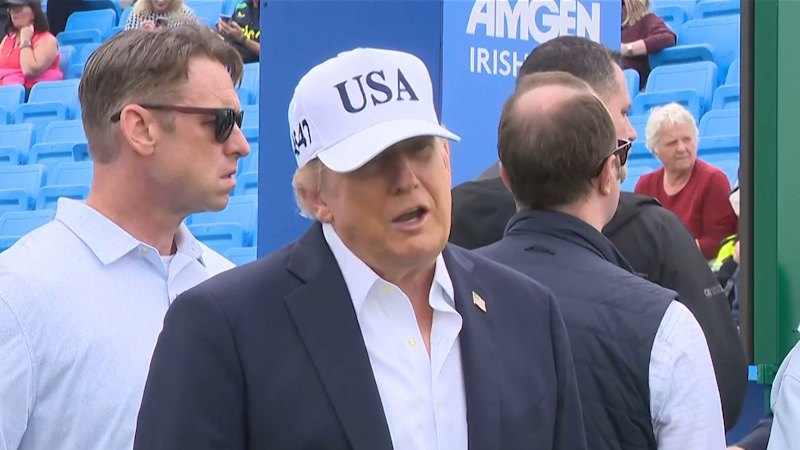
The timing and venue of the remarks added combustible elements to an already volatile debate. Surrounded by supporters at his golf resort in Doonbeg during the Amgen Irish Open, Trump brushed aside traditional diplomatic guardrails with characteristic bluntness. He asserted that a united Ireland would be a fantastic outcome, casually dismissing the immense legal and political hurdles established by international treaty. This intervention did not occur in a vacuum. It followed high-level meetings in Dublin where Irish leaders navigated the complex reality of hosting a U.S. leader whose populist style routinely disrupts established orthodoxies. The shockwaves were immediate. British politicians, already grappling with domestic economic stagnation and shifting regional loyalties, found themselves forced to respond to an American leader casually weighing in on the internal territorial integrity of the United Kingdom.
The Shattered Consensus of Washington Diplomacy
For nearly thirty years, American involvement in Irish affairs was defined by quiet mediation and behind-the-scenes facilitation. From Bill Clinton’s critical intervention during the peace process to subsequent administrations on both sides of the aisle, U.S. foreign policy treated Northern Ireland as a delicate diplomatic ecosystem requiring extreme care. Washington acted as an honest broker, supporting the peace process without taking a side on the ultimate constitutional question of whether the region should remain part of the United Kingdom or join the Republic of Ireland.
Trump’s recent comments fundamentally upend that posture. By explicitly endorsing unification and predicting its inevitability, the former and current U.S. figurehead stripped away the protective layers of diplomatic ambiguity. Irish nationalist parties, most notably Sinn Féin, seized upon the remarks as validation of their long-term political project. Conversely, unionist leaders viewed the intervention as an unwelcome external intrusion into matters of British sovereignty. The departure from bipartisan consensus signals a shift toward transactional diplomacy, where long-standing treaties and constitutional arrangements are subjected to the casual opinions of visiting foreign dignitaries rather than rigorous diplomatic deliberation.
Westminster Pushback and the Conservative Outcry
Across the Irish Sea, the political establishment in London scrambled to minimize the diplomatic friction. British Prime Minister Andy Burnham had previously declared that any referendum on Northern Ireland's future was firmly off the table, arguing that insufficient popular demand exists to justify destabilizing the region. Trump’s public rejection of that cautious approach drew sharp rebukes from across the British political spectrum.
Opposition figures did not mince words. Conservative Party leader Kemi Badenoch publicly rebuked the American leader, comparing the remarks to previous off-the-cuff musings about territorial expansion or annexation. Badenoch argued that loose talk regarding the future of democratic nations creates unnecessary tension and undermines stable international relations. Within Northern Ireland, unionist politicians expressed profound frustration. Former Democratic Unionist Party figures emphasized that the political, cultural, and economic reality remains firmly rooted in the democratic desire of the majority of Northern Ireland's citizens to remain British. Yet, the pushback from London revealed a deeper vulnerability. British authorities realize they no longer hold a monopoly on shaping the narrative around Northern Ireland’s constitutional future, especially when powerful international voices are willing to amplify nationalist aspirations with a single press conference remark.
The Demographic Realities on the Ground
Beyond the immediate verbal sparring match, Trump's intervention highlights profound structural shifts occurring within Northern Ireland. The constitutional question is no longer a static debate frozen in the hostilities of the twentieth century. Demographics, voting patterns, and institutional power have undergone radical transformations since the signing of the 1998 peace accord.
For the first time since the partition of Ireland, census data confirms that Catholics outnumber Protestants in Northern Ireland. While religious affiliation does not automatically translate into a nationalist political preference, this milestone represents a profound cultural pivot. Furthermore, political representation has shifted dramatically. Nationalist parties now dominate Northern Ireland's delegation in the United House of Commons, and unionist parties have lost their historic overall majority in the Northern Ireland Assembly. First Minister Michelle O'Neill of Sinn Féin has actively championed the narrative of a new political era, urging preparations for a future border poll.
However, translating these demographic shifts into a successful unification vote remains an immensely complex challenge. Polling consistently reveals a cautious electorate. Many citizens who identify as Catholic or neutral harbor deep practical concerns regarding the economic costs of absorbing Northern Ireland into the Republic. Questions surrounding healthcare access, pension security, and the integration of public services create significant hesitation. A united Ireland would inherit a multi-billion-dollar annual subvention from London, a fiscal reality that Dublin's financial planners view with understandable caution.
The Fragile Architecture of the Good Friday Agreement
To understand why external comments carry such explosive weight, one must examine the legal framework governing Northern Ireland's future. The Good Friday Agreement established the principle of consent, dictating that Northern Ireland will remain within the United Kingdom until a majority of its people express a desire to form part of a united Ireland through a democratic referendum.
Yet, the treaty left a glaring procedural vacuum. It specifies that the British Secretary of State must call a border poll if it appears likely at any time that a majority would vote for unity, but it fails to define what constitutes that likelihood. There are no quantitative thresholds, no mandatory periodic reviews, and no clear guidelines on whether the decision should rely on election results, demographic surveys, or fluctuating opinion polls.
This deliberate ambiguity was necessary to broker peace in 1998, but it leaves the mechanism vulnerable to political interpretation and external pressure. When a powerful global figure like Trump declares that unification is inevitable, it exerts psychological and political gravity on that ambiguous threshold. It transforms a localized legal mechanism into an international talking point, emboldening advocates on one side while panicking defenders of the status quo.
Populism Meets Trade Policy and Whiskey Tariffs
Trump’s visit also demonstrated how transactional politics often overshadow complex geopolitical principles. During his public appearances, local business figures and audience members lobbied the American leader regarding commercial penalties, specifically targeting U.S. tariffs on Irish whiskey. In classic populist fashion, Trump seized the moment to announce immediate relief, declaring on behalf of the United States that the tariffs would be removed.
The whiskey tariff reversal produced immediate cheers from the crowd, illustrating the dizzying intersection of local economic grievances and grand international pronouncements. Critics noted the stark contrast between addressing niche commercial complaints and casually pronouncing on the territorial integrity of sovereign states. Yet, this dynamic underscores why Trump’s commentary resonates with certain audiences. He delivers immediate, tangible wins on economic grievances while treating rigid diplomatic doctrines as negotiable inconveniences. For whiskey producers in County Clare and beyond, the removal of trade barriers overshadowed the diplomatic tremors felt in London.
The Broader Fallout for Regional Independence Movements
The repercussions of Trump’s remarks extended far beyond the island of Ireland, serving as a catalyst for other regional nationalist movements within the British Isles. Leaders of independence campaigns in Scotland and Wales watched the unfolding controversy with intense interest.
Following the Dublin meetings, figures from the Scottish National Party and Plaid Cymru quickly joined the chorus demanding greater self-determination, arguing that no central government in Westminster has the moral authority to indefinitely block democratic votes on independence. Trump himself demonstrated selective restraint when pressed on Scotland's constitutional future, noting that he would save his thoughts on Scottish independence for another day—a prudent pause given his substantial real estate and golf holdings in that country. Nevertheless, the mere implication that an American president might look favorably upon the breakup of the United Kingdom provides immense psychological momentum to fringe and mainstream independence movements alike.
Navigating an Uncertain Horizon
The uproar surrounding Trump’s Irish unification comments will eventually fade from daily news cycles, but the structural pressures he highlighted will persist. The constitutional status of Northern Ireland remains an open question, governed by a treaty whose procedural mechanisms were designed for an era that no longer exists.
As demographic trends continue to evolve and political pressures mount, the ambiguity at the heart of the Good Friday Agreement will face unprecedented stress tests. External commentary from global leaders may accelerate political timelines, forcing both Dublin and London to confront hard realities they would prefer to postpone. The fragile peace achieved nearly thirty years ago endures, but the foundations beneath it are shifting beneath the weight of modern political volatility.
For further context on how these events unfolded in real-time and the immediate reactions from the ground, you can review this coverage from the scene: Trump Irish reunification comments. This recording captures the exact moment the former U.S. president drew gasps and ignited a transatlantic diplomatic storm by declaring that Irish reunification is bound to happen eventually.