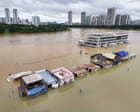
When a massive typhoon strikes China's industrial coastline, the standard media narrative focuses entirely on the immediate drama. We see the dramatic drone footage. We watch stranded residents waving shirts from submerged rooftops, waiting for military helicopters or rescue dinghies. But these gripping images obscure a systemic failure in infrastructure, urban planning, and emergency communication that turns predictable seasonal weather into a recurring humanitarian crisis. The true crisis is not the rain itself, but the widening gap between rapid concrete urbanization and failing municipal drainage systems.
Mainstream coverage treats these rooftop rescues as isolated acts of God. They are not. They are the direct, mathematically predictable result of a development model that paves over natural floodplains and relies on outdated meteorological metrics. While local officials blame historic, unprecedented downpours for the chaos, engineering data reveals that many Chinese megacities are built to withstand only a fraction of the deluge they routinely face today. Meanwhile, you can read related developments here: The Friction of Federalism: Analyzing the DOJ Lawsuit Against Maryland.
The Concrete Sponge Failure
For over a decade, Beijing heavily promoted the Sponge City initiative. The stated goal was ambitious. Municipalities were ordered to use permeable concrete, urban wetlands, and green roofs to absorb 70 percent of rainwater, preventing the massive runoff that overwhelms urban centers during major storms.
The reality on the ground is starkly different. To see the bigger picture, we recommend the excellent report by The Guardian.
When a severe typhoon hits an industrial zone, these green solutions quickly saturate. Once the soil and permeable layers reach capacity, the excess water has nowhere to go because the underlying gray infrastructure—the network of pipes, pumps, and tunnels—remains deeply inadequate. Developers often prioritize visible green aesthetics over expensive, underground drainage overhauls. As a result, the water rises rapidly in low-lying residential neighborhoods, trapping thousands in high-rise apartments and forcing them onto roofs.
This issue is worsened by rapid land reclamation. Coastal cities have expanded aggressively into wetlands and mudflats that historically acted as natural shock absorbers for storm surges. When you replace a mangrove swamp with a concrete manufacturing hub, you eliminate the ecosystem's ability to buffer incoming waves. The water does not disappear. It simply diverts into the nearest residential corridor, rising several feet in a matter of minutes.
The Broken Chain of Emergency Alerts
People do not end up on rooftops by choice. They end up there because the early warning systems failed to spark meaningful action.
China possesses some of the most advanced meteorological satellites and radar arrays in the world. Meteorologists track typhoons with high precision days before they make landfall. Yet, the transmission of this data from weather bureaus to local neighborhoods is severely flawed. Red alerts are issued frequently, but they often lack specific instructions. A generic text message telling citizens to stay safe does little to help a factory worker whose shift ends at midnight or a family living in a illegally converted basement apartment.
Local governments face a massive conflict of interest. Halting economic activity in a major industrial hub costs billions of yuan per day. Officials hesitate to order total evacuations or mandatory business closures until the eye of the storm is practically on top of them. This hesitation creates a deadly bottleneck. By the time a mandatory evacuation order comes down, the roads are already flooded, public transport is shut down, and residents have no choice but to climb upward to escape the rising tide.
The Problem with Digital Isolation
During the peak of recent storms, another vulnerability emerged. The hyper-digitalized nature of daily life in China means that when the power grid goes down, basic survival becomes significantly more difficult.
Most citizens rely entirely on smartphones for communication, news, payments, and emergency coordination. When floodwaters submerge local electrical substations and knock out cell towers, thousands of people are instantly cut off from the world. They cannot call for rescue. They cannot check weather updates. They cannot even buy food or clean water because digital payment networks are inaccessible. Rescue teams are forced to rely on visual searches, looking for flashlights or makeshift flags on rooftops, turning what should be a data-driven operation into a frantic guessing game.
The Supply Chain Echo
The impact of these storms extends far beyond the immediate flood zone. The regions most vulnerable to these typhoons are often the manufacturing heartlands of the global economy.
When a factory district floods, the production of electronics, automotive components, and consumer goods grinds to a halt. Even if a specific factory escapes water damage, the surrounding infrastructure is ruined. Roads are washed out, rail lines are submerged, and nearby container ports are forced to suspend operations due to high winds and storm surges. The global supply chain feels the shockwave weeks later as shipping containers sit stranded in flooded rail yards, causing delays and price spikes across the globe.
Companies operating in these regions often underreport the risks to their shareholders. They treat severe weather as an anomaly rather than a structural certainty. This lack of transparency leaves global markets completely unprepared for the inevitable disruptions that follow every major storm season.
Reworking the Response
Fixing this recurring crisis requires moving past the superficial optics of disaster response. Throwing resources at heroic rescue missions after the fact is a band-aid on a bullet wound.
Municipalities must stop treating flood management as an aesthetic problem. Permeable pavements and urban parks are useful for light summer showers, but they are useless against the crushing volume of a category four typhoon. Cities need massive investments in deep-tunnel drainage systems, subterranean storage reservoirs, and hardened electrical infrastructure that can operate completely isolated from the main grid.
Furthermore, accountability metrics for local officials need to change. Currently, economic growth targets dominate performance evaluations. Until local leaders are judged as heavily on disaster preparedness and infrastructure resilience as they are on GDP growth, the economic pressure to delay evacuations and skimp on underground infrastructure will always win out.
The images of citizens waiting for rescue on submerged rooftops are not just a testament to the power of nature. They are an indictment of an urban development model that values speed over safety and appearance over substance. Until the underlying structural flaws are addressed, the next major storm will yield the exact same results, no matter how many drone videos are captured.