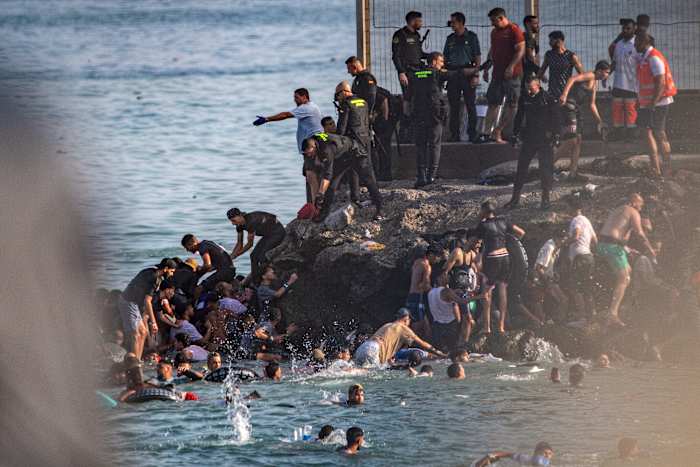
Governments rarely survive the paper trail they accidentally authorize. When Spain chose to declassify a trove of forty documents concerning the late July border catastrophe in Ceuta, Moncloa likely expected a controlled narrative release. Instead, the files exposed a stark administrative blind spot. Spain's National Intelligence Center, known as the CNI, did not merely whisper about an impending breach. They sent precise, time-stamped warnings via WhatsApp and formal intelligence channels hours before thousands of people overwhelmed the perimeter fence and coastal waters of the Spanish enclave.
Prime Minister Pedro Sánchez has insisted that while background monitoring existed, no document could forecast the staggering magnitude of the crisis. That defense collapses under the weight of the actual operational logs. On July 29, messages originating directly from the CNI warned local delegations and police forces about specific social media calls targeting the border during Morocco's national Throne Day celebrations. These alerts identified exact assembly times, digital tracking metrics including groups with hundreds of thousands of followers, and the dual threat of fence assaults and mass swimming attempts.
Intelligence is rarely a crystal ball. More frequently, it resembles an unheeded fire alarm blaring in an empty hallway.
The documents paint a picture of operational inertia at the highest levels of Mediterranean geopolitics. Long before the first crowds surged toward the border town of Fnideq, the CNI noted that Moroccan security apparatuses were exhibiting passive, negligent behavior. While avoiding explicit accusations of state-sponsored orchestration by Rabat, the declassified intelligence reports characterize the local policing response as thoroughly overwhelmed and functionally absent. Hundreds of individuals were visibly massing on beaches and waiting for dusk to break through maritime barriers, yet the diplomatic calculus in Madrid dictated caution over confrontation.
This diplomatic tightrope walk has left Spain's executive branch trapped between domestic outrage and foreign policy pragmatism. Thousands of protesters have taken to the streets in Ceuta, a city whose population of roughly eighty-four thousand was suddenly asked to absorb thousands of newly arrived migrants and unhoused minors. Opposition leaders argue that possessing intelligence of an impending breach without mounting a proportional defense constitutes gross negligence. Meanwhile, the central government continues to pledge millions in emergency aid while trying to stabilize relations with a northern African neighbor whose cooperation remains essential for broader European migration management.
The core issue extends far beyond partisan point-scoring in Madrid. Modern border security frequently fails not because intelligence is missing, but because institutions suffer from an institutional inability to translate raw data into preemptive political decisions. When an encrypted chat message pinpoints an assault time down to the hour, the barrier is no longer informational. It is bureaucratic. Decision-makers hesitate because acting decisively upon tactical intelligence often requires public escalations that governments prefer to avoid until the crisis forces their hand.
As the political fallout intensifies, the declassified files serve as a permanent ledger of a preventable failure. The warnings were logged, timestamped, and transmitted through the proper channels. They simply waited for history to catch up to what the analysts already knew.