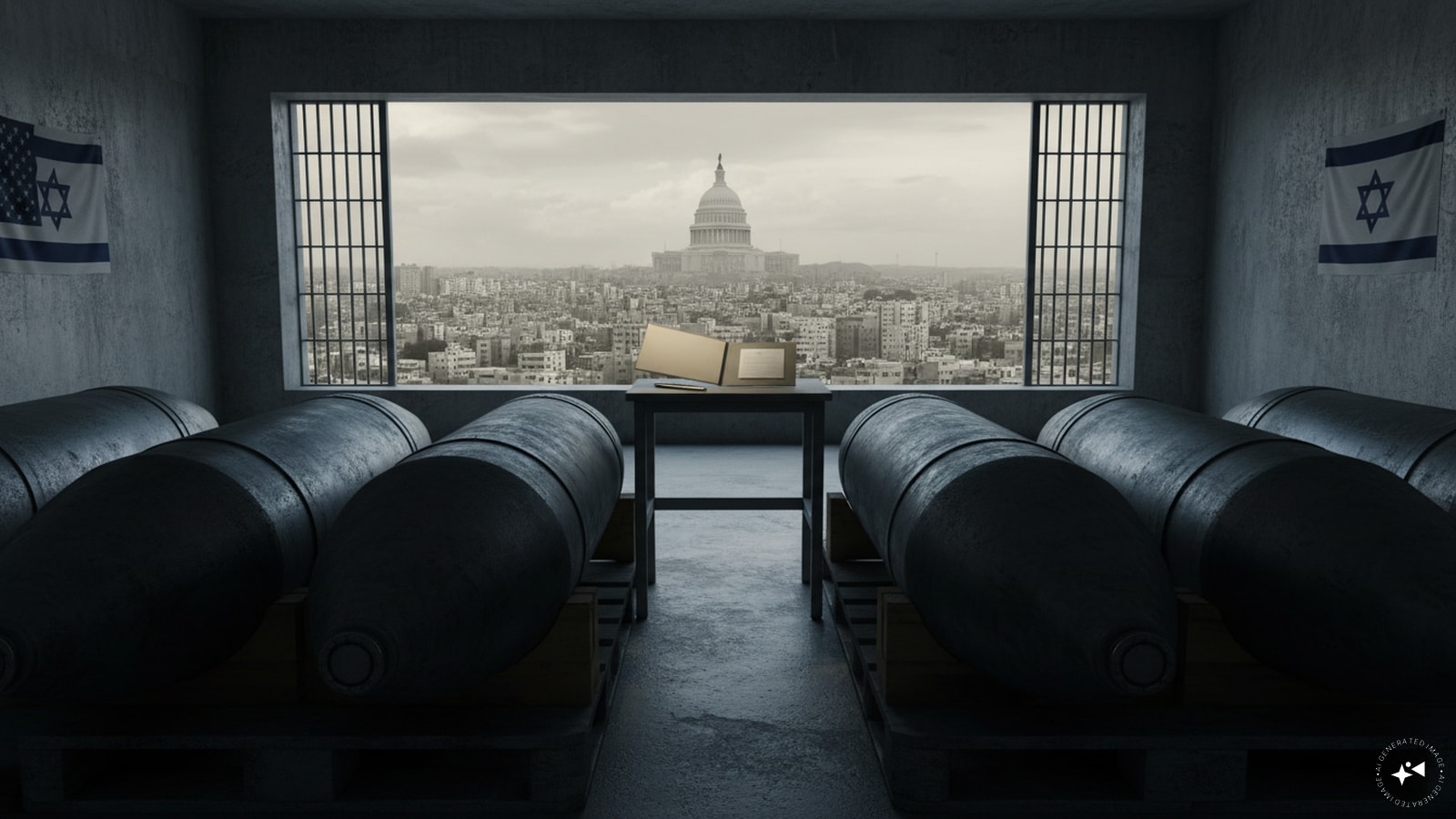
The Trump administration's notification to Capitol Hill of a $2.8 billion weapons package for Israel exposed a deepening fracture in American foreign policy, centering on an immense shipment of 40,000 heavy munitions. At the heart of the transaction lie 20,000 MK-84 general-purpose bombs and 20,000 BLU-117 thermal-coated variants, alongside heavy penetrator warheads. These one-ton explosive devices represent the blunt instruments of modern aerial warfare, capable of leveling multi-story structures and leaving craters large enough to swallow urban intersections. While Foreign Military Financing mechanisms typically grease the wheels of transatlantic defense manufacturing without immediate public scrutiny, this specific tranche arrived at a moment of acute international legal and legislative friction.
Congressional pushback materialized almost immediately. Representative Gregory Meeks, the ranking Democrat on the House Foreign Affairs Committee, took the rare step of placing an institutional hold on the transfer. Meeks articulated a growing anxiety within legislative circles: that ongoing military campaigns in Gaza and Lebanon are outstripping any coherent framework for humanitarian accountability. "This decision does not diminish congressional support for Israel's legitimate defense needs," Meeks stated. "It reflects Congress's responsibility to ensure that US-funded weapons are used lawfully, responsibly and with meaningful safeguards for human life." Yet, the institutional architecture of American arms exports often renders congressional objections little more than speed bumps unless backed by a veto-proof joint resolution of disapproval—a high bar in a polarized legislature.
Military logisticians and defense analysts recognize that transactions of this magnitude are not arranged overnight. Procurement cycles for ordnance stockpiles require months of bureaucratic alignment between the Pentagon's Defense Security Cooperation Agency and prime defense contractors. The inclusion of BLU-117 warheads—engineered with specialized thermal coatings to withstand shipboard or exposed tarmac heat conditions—suggests an effort to replenish depleted theater reserves rather than immediate emergency drops. Israel's defense establishment has watched political shifts in Washington with cautious urgency, seeking to lock in substantial materiel commitments before potential future policy shifts or funding debates alter the rhythm of bilateral assistance.
The broader financial picture surrounding these transfers adds another layer of complexity. The executive branch navigates competing pressures between maintaining an ironclad military alliance and managing mounting domestic criticism over civilian casualties. Every pallet of MK-84s dispatched from domestic munitions plants to overseas airbases deepens the entanglement of American industrial capacity in protracted Middle Eastern conflicts. As the bureaucratic machinery pushes these 40,000 heavy bombs through the pipeline, the debate on Capitol Hill exposes a fundamental question about legislative oversight that will outlive this specific transaction.