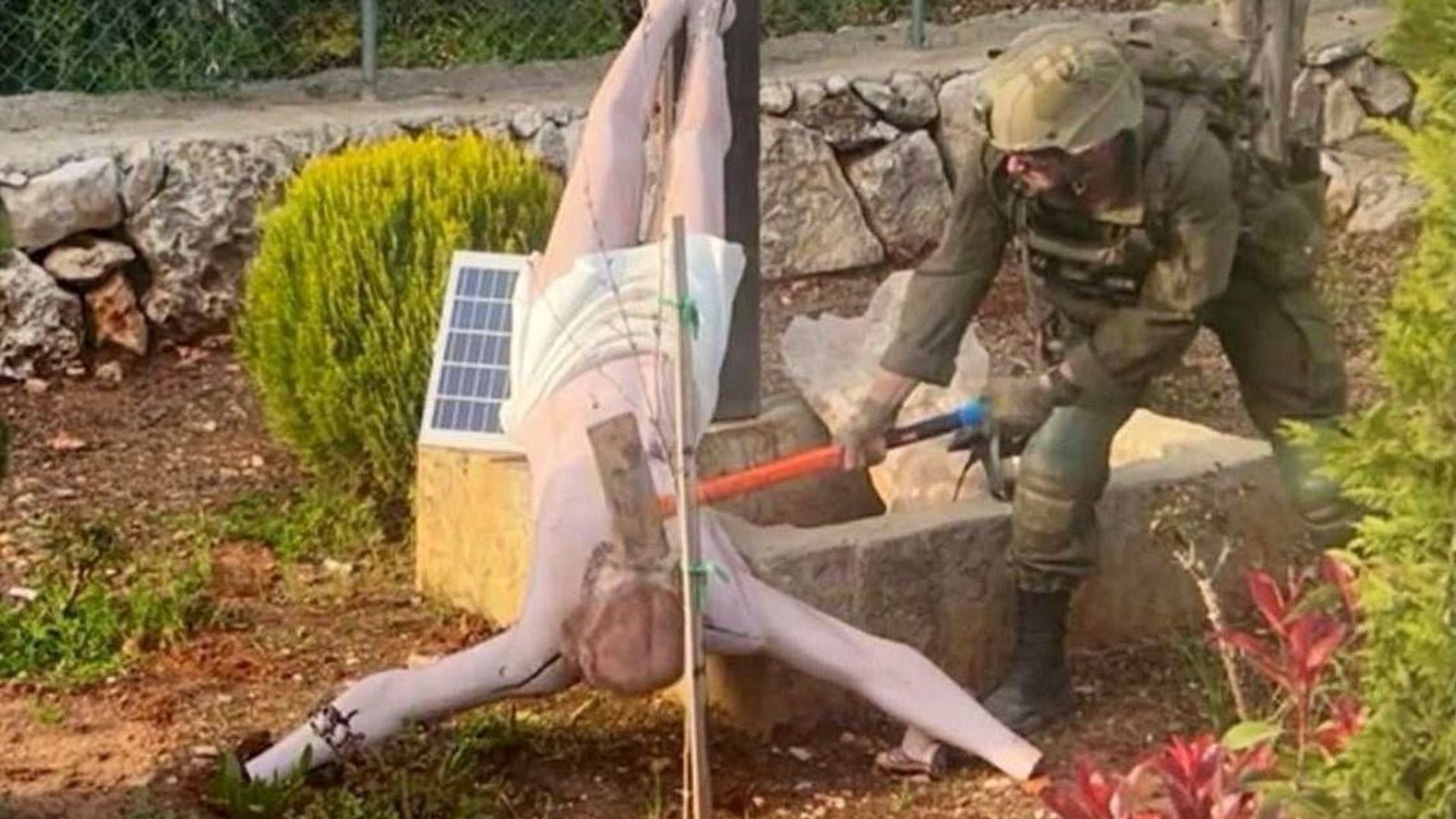
The Israeli military doesn't usually like to air its dirty laundry. But when two soldiers decided to smash a statue of Jesus in a northern Israeli church, the Israel Defense Forces (IDF) moved fast. They didn't just issue a slap on the wrist. They threw the book at them. This wasn't a minor lapse in judgment. It was a targeted act of vandalism that threatened to light a fire under an already tense religious climate.
If you're following Middle Eastern geopolitics, you know that every action has an equal and often more violent reaction. This incident happened in the northern village of Mi'ilya, a predominantly Melkite Greek Catholic community. For the residents there, seeing IDF uniforms associated with the destruction of a religious icon isn't just about property damage. It’s about a breach of the unspoken social contract that keeps the region from sliding into total sectarian chaos.
The military court's decision to jail these soldiers for several days sends a clear signal. The IDF isn't just protecting borders; it’s trying to protect its own legitimacy as a "people's army" in a land of many faiths. When soldiers go rogue like this, they aren't just breaking military law. They're handing a propaganda victory to every critic of the state.
The details of the Mi'ilya incident
The facts are pretty straightforward but nonetheless jarring. Two soldiers, while stationed in the north, entered the village and targeted a statue of Jesus. They didn't just tip it over. They smashed it. Mi'ilya is a unique spot—it’s one of the few entirely Christian villages in Israel, nestled near the Lebanese border. It’s a place where the local population generally maintains a quiet, functional relationship with the state and the military.
The IDF’s response was uncharacteristically blunt. They labeled the behavior as "severe" and "contrary to the values of the IDF." Usually, these statements feel like boilerplate PR. This time, the immediate jail sentence suggested the command was genuinely spooked by the potential fallout. You don't jail soldiers for a week over minor rowdiness. You do it when they’ve touched a third rail of Israeli society: religious coexistence.
It’s worth noting that this isn't an isolated vibe. Over the last few years, there’s been a documented rise in "price tag" attacks and general harassment toward Christian sites in Jerusalem and the Galilee. Often, these acts are carried out by extremist civilians. When it’s men in uniform, the stakes change. The uniform represents the sovereignty of the state. If the state is smashing icons, the state is no longer an arbiter; it’s a participant in the conflict.
How the IDF handles religious vandalism in the ranks
The military justice system in Israel operates on a different frequency than the civilian one. Discipline is the lifeblood of any army, especially one as integrated into daily life as the IDF. When a soldier violates the "Purity of Arms"—a core tenet of their code of ethics—the punishment is meant to be a deterrent for the other 170,000 active-duty personnel.
The two soldiers were sentenced to several days in a military prison. While some might argue a few days isn't much, in military culture, a prison record is a massive stain. It can lead to demotions, removal from combat units, and a permanent mark on their post-service record. The IDF leadership knows that the Christian community in Israel, though small, is a vital demographic. They serve in the military, they work in the hospitals, and they are part of the social fabric. Pissing them off isn't just bad optics—it’s bad strategy.
The broader context of Christian-Jewish tensions
We can't look at this statue smashing in a vacuum. You have to see the bigger picture. In Jerusalem, there’s been a spike in reports of spit-attacks on clergy and vandalism of cemeteries. The Latin Patriarchate and other church leaders have been shouting from the rooftops about an atmosphere of increasing hostility.
When soldiers join in on this behavior, it validates the fears of the local Christian population. They start to wonder if the people meant to protect them are actually the ones they need protection from. The IDF commander who oversaw the sentencing likely realized that if he didn't act, he was essentially giving a green light to every other soldier with a radical streak.
The strategic importance of Mi'ilya
Mi'ilya isn't just any village. It sits in a sensitive security zone. The north is a powder keg. With Hezbollah across the fence and internal tensions high, the last thing the IDF needs is a local uprising or a loss of local intelligence and cooperation because of a smashed statue.
The residents of Mi'ilya were rightfully outraged. Local leaders pointed out that their community is peaceful and law-abiding. To have soldiers—who are often hosted in these areas for operational reasons—turn on the local culture is a massive betrayal of trust. The IDF’s quick sentencing was a desperate attempt to patch that hole before the water started rushing in.
Why this jailing is a win for military ethics
Some people think the military was too harsh. They're wrong. In fact, you could argue they weren't harsh enough. An army that can't control its soldiers' impulses regarding religion is an army that’s losing its grip on professionalism.
Discipline is the only thing that separates a soldier from a militiaman. When those two soldiers swung whatever they used to break that statue, they were acting like members of a mob, not representatives of a modern state. By jailing them, the IDF reinforced the idea that personal religious or political biases stop at the barracks gate.
What happens next for the soldiers
The immediate jail time is just the start. These individuals will likely face a disciplinary hearing that could see them kicked out of their specific units. For many young Israelis, being "tossed" from a prestigious unit is a social and professional death sentence. It’s a loud message to the rest of the ranks: your bigotry isn't worth your career.
The IDF needs to do more than just jail individuals, though. They need to look at the education provided to conscripts. If 18-year-olds are entering the service thinking it’s okay to desecrate a church or a statue, the failure started long before they put on the boots.
Moving forward from the vandalism
This incident serves as a wake-up call. The IDF has to be proactive. Waiting for a statue to be smashed before acting is reactive and weak. They need to double down on training that emphasizes the diversity of the land they’re defending.
If you're interested in how this affects the region, keep an eye on the Northern Command's relationship with local councils. The trust is thin. It’s brittle. One more "isolated incident" could be the one that finally breaks it beyond repair. The military court did its job this time, but the underlying rot that makes a soldier think a statue is a target still needs to be addressed.
Check the official IDF social media channels for updates on policy changes regarding troop conduct in religious areas. Look for statements from the Assembly of Catholic Ordinaries in the Holy Land; their reaction usually dictates how the international community will view these events. Don't just read the headline and move on—understand that in Israel, a smashed statue is never just about the stone. It's about the soul of the country's defense force.