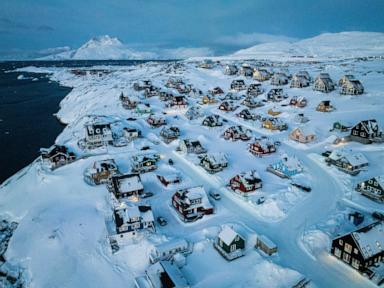
The wind in Nuuk doesn’t just blow. It bites. It carries the scent of salt, frozen granite, and an ancient, crushing isolation that defines life on the edge of the habitable world. Inside the prime ministerial complex, the air is warm, but the atmosphere during a high-stakes diplomatic visit is often just as thin as the air on the ice sheet.
Imagine sitting across from an envoy representing the most powerful military apparatus on earth. You represent roughly 56,000 people. They represent over 330 million, backed by an economy that measures its defense budget in the hundreds of billions. The envoy speaks of strategic necessity, northern flanks, and Arctic security corridors. You, however, are thinking about the fishermen in Ilulissat whose grandfathers carved a living out of frozen fjords, and whose grandchildren want to decide their own future.
This is the reality of Greenland’s modern geopolitical existence. It is a massive landmass of rock and ice caught in a tug-of-war between old colonial ties, rising superpowers, and an unyielding desire for true independence. When Greenland's Prime Minister stood before Washington’s latest diplomatic delegation, the conversation wasn't just about radar installations or mining rights. It was a confrontation between two entirely different worldviews: one that sees the Arctic as a giant chessboard, and another that sees it as a home.
The Weight of Geography
To understand why an American envoy is sitting in Nuuk in the first place, you have to look at a globe from the top down. For decades, the Arctic was considered a frozen wasteland, a buffer zone of impenetrable white that separated the West from the Soviet Union. Climate shifts changed that. The ice is thinning. Shipping lanes that used to require massive icebreakers are opening up. Deep beneath the permafrost lie untouched deposits of rare earth elements—the very materials needed to power the global transition toward electric vehicles and microchips.
Suddenly, everyone wants a piece of the north.
But Greenland is not a blank space on a map. It is an autonomous territory under the Kingdom of Denmark, moving steadily on a path toward full sovereignty. The historical relationship with Copenhagen is complicated, layered with centuries of paternalism and a gradual, hard-fought clawback of local authority. Greenlanders now manage their own domestic affairs, their own schools, and their own resources.
Yet, when American officials arrive with briefcases full of strategic proposals, they often look past Copenhagen entirely. They come straight to the source.
The tension in these meetings is rarely loud. It exists in the pauses between sentences. When an envoy talks about "regional stability," a Greenlandic official hears the echo of the Cold War, a time when the U.S. military constructed Thule Air Base (now Pituffik Space Base) without consulting the local Inuit population. Families were displaced. The landscape was altered. The memory remains.
The Price of Autonomy
It is easy to preach self-determination when your tax base is secure and your industries are thriving. It is a much more delicate dance when your economy relies heavily on an annual block grant from Denmark to keep the lights on and the hospitals running.
This financial reality creates a profound paradox. To achieve true independence from Denmark, Greenland needs economic self-sufficiency. To achieve economic self-sufficiency, it must develop its natural resources, which means inviting foreign investment. But inviting massive foreign investment—whether from American mining conglomerates or Chinese infrastructure firms—risks trading one form of dependence for another.
Consider the dilemma facing a local lawmaker. A foreign corporation proposes a multi-billion-dollar rare earth mining project in a pristine southern fjord. The project promises jobs, infrastructure, and enough tax revenue to potentially replace the Danish subsidy. But it also threatens the traditional hunting and fishing grounds that have sustained the communities for generations.
The choice is never simple. It is a calculation made in the dark of winter, weighing the preservation of cultural heritage against the hard currency needed to fund a modern state.
When the Prime Minister insists on self-determination in front of an American envoy, they are asserting that Greenland alone will make these choices. They are stating that Greenlandic interests will not be subverted to suit the defensive posture of NATO or the commercial ambitions of Wall Street.
The Conversation Behind Closed Doors
What actually happens when these two worlds collide in a conference room? The official press releases are always sanitized. They speak of "productive dialogues," "shared values," and "deepening cooperation." They hide the friction.
The envoy likely brings promises of investment, scientific partnerships, and technical assistance. These are not inherently bad things. Greenland needs infrastructure. Its airports are being modernized, its digital connectivity is expanding, and its scientific community benefit from international collaboration.
But the underlying subtext is always security. The United States views the Arctic through the lens of great power competition. They look at Russia's militarization of its northern coast. They look at China's self-proclaimed status as a "near-Arctic state" and its attempts to invest in Greenlandic airports a few years ago—attempts that were quietly blocked after intense pressure from Washington and Copenhagen.
The American goal is to keep Greenland firmly within the Western security orbit. The Greenlandic goal is to ensure that this orbit does not crush their domestic aspirations.
During these meetings, the Greenlandic leadership must constantly remind their guests that they are an equal partner in these discussions, not a strategic asset to be managed. True self-determination means having the right to say no. It means the right to dictate the terms of foreign presence on your soil. It means ensuring that if an international crisis erupts, the people of Nuuk, Sisimiut, and Qaanaaq are not collateral damage in a conflict they did not start.
The Horizon Beyond the Ice
The meeting ends. The envoy flies back to Washington to brief superiors on Arctic readiness. The Prime Minister remains in Nuuk, looking out at a harbor where the icebergs drift silently out to sea.
The struggle for Greenlandic sovereignty is not a single event; it is a slow, generational march. Every meeting with a foreign power is a brick laid in the foundation of a future state. It is a declaration to the world that the Arctic is no longer a wilderness to be carved up by empires, but a region governed by the people who have survived its harshest winters.
The true test of Greenland's future won't be found in the text of diplomatic communiqués or the strategic doctrines drafted in distant capitals. It will be decided in the quiet determination of a small population refusing to be sidelined on their own land, holding the line at the top of the world.