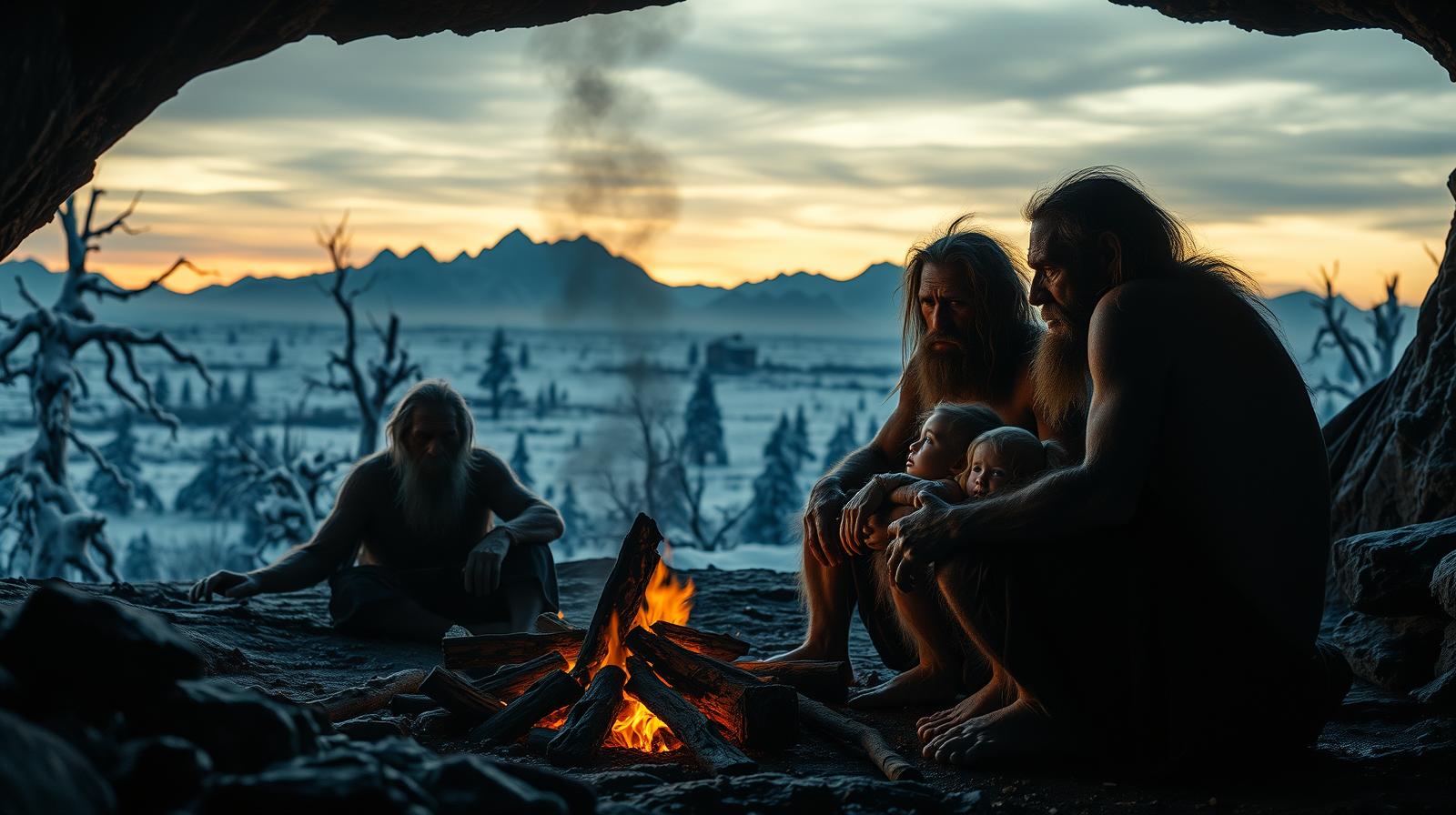
Around 75,000 years ago, the European continent became a graveyard. A sudden, brutal plunge in global temperatures decimated the Neanderthal population, pushing our closest evolutionary cousins to the absolute brink of extinction. For millennia, they had ruled from Iberia to Siberia, but this climate crisis reduced their numbers to a desperate handful. New genomic mapping reveals that the entire future of European Neanderthals hung by a thread, preserved by a single, isolated group in southwestern France that managed to endure the deep freeze and eventually repopulate a vacant continent.
This was not a gradual decline. It was a demographic collapse so severe that it reshaped the genetic trajectory of Europe long before Homo sapiens ever established a permanent foothold there. By examining the silent testimony of ancient teeth and bone fragments, paleogeneticists have uncovered a story of survival that challenges our understanding of Neanderthal resilience, social structure, and ultimate demise.
The Cold Front That Changed Everything
To understand the scale of this ancient catastrophe, we have to look at the climate data locked in deep-sea sediment cores and polar ice sheets. Around 75,000 years ago, the Earth entered Marine Isotope Stage 4. This period was characterized by a massive glaciation event.
Ice sheets marched southward across northern Europe. Vast swathes of forests turned into barren, windswept steppes. The massive herds of mammoth, bison, and reindeer that Neanderthals relied on for food shifted their migration routes or died out entirely.
For a species adapted to cold but reliant on local ecological niches, this shift was catastrophic. Neanderthal populations were always sparse, scattered in small family bands across thousands of miles. When the cold intensified, these fragile networks shattered.
The thermal hammer fell hardest on the plains of central and eastern Europe. East of the Rhine, the archaeological record grows whisper-thin during this period. Fire hearths went cold. Rock shelters were abandoned to the wind. The hominids who had successfully navigated previous glacial cycles found themselves utterly overwhelmed by the speed and severity of this particular freeze.
The Sanctuary in the South
As the rest of Europe froze, a few microclimates remained relatively habitable. The geographic anatomy of southwestern France, with its limestone cliffs, deep river valleys, and proximity to the Atlantic Ocean, acted as a natural buffer against the worst of the Arctic weather.
These valleys acted as ecological sanctuaries. The limestone caves of the Dordogne and Charente regions offered deep, insulated shelter from the howling winds. The south-facing cliffs captured what little warmth the winter sun provided. Crucially, the rivers continued to run, attracting game animals that had fled the barren northern plains.
It was here, in these sheltered valleys, that a tiny remnant population of Neanderthals held out.
Genetic reconstruction indicates that this French group was incredibly small, perhaps numbering only a few hundred breeding individuals. They were completely cut off from any neighboring populations. To the north and east lay hundreds of miles of frozen, uninhabitable wasteland. To the south lay the rugged Pyrenees, presenting a formidable barrier.
This was a classic evolutionary bottleneck. For thousands of years, this single, isolated pocket of humanity survived on the edge of the world, their genetic diversity shrinking with every generation, waiting for the climate to relent.
Reading the Genetic Ledger
The proof of this near-extinction event is not written in stone tools, but in the spiral of ancient DNA.
In recent years, advances in paleogenomics have allowed scientists to extract and sequence highly degraded DNA from specimens spanning tens of thousands of years. When researchers compared the genomes of Neanderthals who lived before the 75,000-year mark with those who lived afterward, they noticed a stark, undeniable shift.
The older Neanderthals, such as those found in the Altai Mountains of Siberia, possessed a relatively diverse gene pool. They carried genetic signatures of ancient migrations and intermixing.
However, every European Neanderthal fossil dated after 70,000 years ago—whether found in Belgium, Croatia, or Germany—tells a completely different story.
They all share a striking genetic uniformity. Their genomes are so similar that they look like cousins. This extreme lack of genetic diversity is the hallmark of a population that has been squeezed through a tight demographic bottleneck.
By running computer simulations of genetic drift, researchers traced this uniform lineage back to a single source population that lived during the height of the Marine Isotope Stage 4 glaciation. The geographical epicentre of this surviving lineage points directly to Western Europe, specifically the cave systems of modern-day France.
The High Price of Isolation
Survival, however, came at a devastating biological cost.
When a population shrinks to a few hundred individuals and remains isolated for millennia, inbreeding becomes an unavoidable reality of daily life. There were simply no outsiders to introduce fresh genetic material.
The consequences of this genetic isolation are clearly visible in the late Neanderthal skeletal record.
- Skeletal Anomalies: Late Neanderthals frequently display congenital defects, such as misshapen vertebrae, abnormal jaw structures, and retained baby teeth into adulthood.
- Immunological Vulnerability: The loss of genetic diversity hit their immune systems hardest. With a highly uniform set of major histocompatibility complex (MHC) genes, a single novel pathogen could potentially wipe out an entire community.
- Reduced Fertility: Accumulation of harmful genetic mutations over generations likely led to lower birth rates and higher infant mortality.
This was a species running on borrowed time. They had survived the climate crisis, and as the glaciers began to retreat slightly around 60,000 years ago, this French remnant group expanded outward. They reoccupied the empty valleys of Germany, pushed south into Italy, and migrated east back toward the Caucasus.
But they did so as genetic ghosts. They were a physically robust population carrying an invisible, debilitating genetic burden.
The Great Isolation of Grotte Mandrin
The extreme nature of this isolation is illuminated by the extraordinary discovery of "Thorin," a late Neanderthal discovered in the Grotte Mandrin in southern France.
Thorin lived approximately 42,000 to 50,000 years ago, right on the cusp of the species' final extinction. When scientists sequenced his genome, they expected him to share genetic ties with other late European Neanderthals.
Instead, they found that Thorin belonged to a completely unknown, highly isolated lineage that had split from other Neanderthal groups around 105,000 years ago. For over 50,000 years, Thorin’s ancestors lived in or near the Rhône Valley without exchanging a single gene with the other Neanderthal populations living just a few days' walk away.
This is a profound revelation for archaeologists. It suggests that late Neanderthals were not just physically isolated by glaciers, but socially fragmented to a degree that is difficult to comprehend. They lived in small, insular worlds, ignoring or actively avoiding other groups, even when the climate warmed and travel became possible.
This lack of social connectivity was likely their fatal flaw. While Homo sapiens constructed vast social networks that spanned hundreds of miles, allowing for the exchange of ideas, resources, and genes, Neanderthals remained stubbornly local.
Redefining the Demise
For decades, the extinction of the Neanderthals has been framed as a dramatic clash of species. The popular narrative cast Homo sapiens as the cognitively superior, technologically advanced invaders who swept into Europe and outcompeted the slow-witted locals.
The genetic data surrounding the 75,000-year bottleneck paint a far more nuanced, tragic picture.
Neanderthals were not conquered. They were already a broken species long before modern humans arrived in significant numbers. The climate crisis of Marine Isotope Stage 4 had done the heavy lifting, stripping them of the genetic diversity and social cohesion necessary to survive in the long term.
When modern humans finally entered Europe around 45,000 years ago, they did not encounter a thriving, confident empire. They encountered a scattered, highly inbred population of survivors who had spent the last thirty thousand years clinging to the edges of existence.
The story of the French refugium is a testament to the incredible physical endurance of the Neanderthals. They survived conditions that would have broken most species. But physical endurance alone was not enough to overcome the silent, compounding decay of their own genetic code.