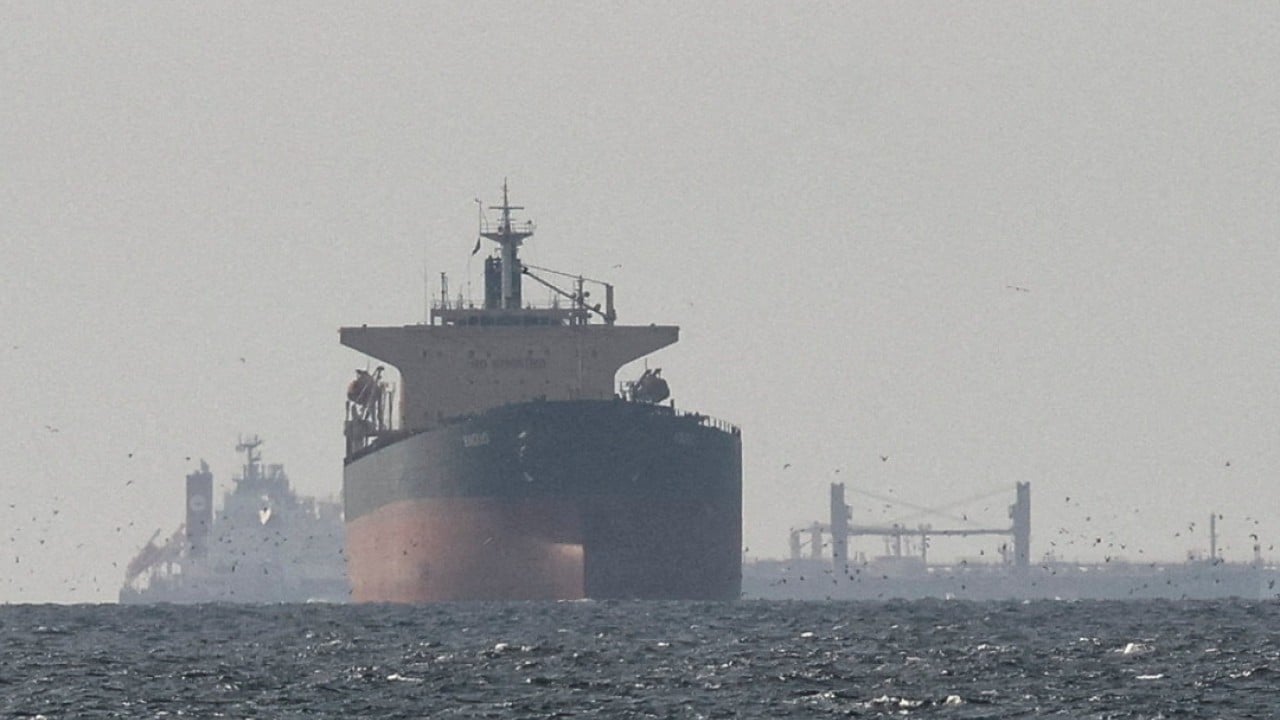
The global energy market operates on a fragile equilibrium where 21 million barrels of oil and approximately 20% of the world’s liquefied natural gas (LNG) pass through a 21-mile wide shipping lane daily. When Tehran signals a "toll" or a blockade on the Strait of Hormuz, it is not merely a military threat but a direct manipulation of the Energy Insecurity Coefficient for Asian economies. China, Japan, South Korea, and India collectively import over 70% of their crude from this corridor. The strategic vulnerability is not just the potential for a physical stoppage, but the immediate inflationary shock and the destruction of the "just-in-time" energy logistics model that powers the Asian manufacturing engine.
The Mechanics of Geographic Chokepoint Leverage
The Strait of Hormuz functions as a natural monopoly controlled by geography. Unlike the Suez Canal or the Panama Canal, there are no viable, high-capacity terrestrial alternatives for the volume of crude produced by Saudi Arabia, Iraq, Kuwait, and the UAE. Any disruption creates a supply-side shock that bypasses traditional price discovery.
Iran’s leverage rests on three specific operational vectors:
- Kinetic Interdiction: The physical seizure of tankers or the deployment of naval mines to render the channel uninsurable.
- Regulatory Harassment: The imposition of arbitrary "transit fees" or environmental inspections under the guise of maritime law.
- The Insurance Premium Wedge: Simply by maintaining a threat posture, Iran forces Lloyd’s of London and other insurers to reclassify the region as a "Listed Area," triggering War Risk Premiums. These costs are passed directly to Asian refiners, creating a stealth tax on East Asian GDP.
The Asian Demand Profile and the Absence of Strategic Depth
The vulnerability of Asian economies is quantified by their high Import-to-Consumption Ratio. Unlike the United States, which has pivoted toward energy independence via the Permian Basin shale revolution, the major powers of Asia remain tethered to the Persian Gulf.
China’s Strategic Petroleum Reserve (SPR) Constraints
Beijing has invested heavily in its SPR, estimated to hold between 80 or 90 days of net imports. However, a significant portion of this reserve is "dead storage" or technically inaccessible for immediate industrial use. China’s daily consumption exceeds 15 million barrels. If the Strait closes, the logistical delay in rerouting oil from West Africa or the Atlantic Basin via the Cape of Good Hope adds 15 to 20 days of transit time. This creates a time-sensitive supply gap that no amount of SPR can bridge without severe industrial rationing.
Japan and South Korea: The Zero-Margin Reality
Japan and South Korea represent the extreme end of energy fragility. These nations lack domestic hydrocarbon resources and have high-density electrical grids that rely on LNG for baseload power.
- LNG Inelasticity: Unlike oil, which can be stored in tanks for years, LNG requires cryogenic infrastructure. The global LNG tanker fleet is specialized. If the Qatari gas flow—which accounts for a massive share of East Asian supply—is halted at Hormuz, there is no "global spot market" large enough to replace those volumes immediately.
- The Economic Multiplier Effect: Because energy is a fundamental input for the automotive, semiconductor, and chemical sectors, a 20% spike in energy costs does not lead to a 20% price increase in finished goods; it leads to margin collapse and potential manufacturing shutdowns.
The Failure of Alternative Routing Logistics
The assertion that pipelines can mitigate a Hormuz closure is a fallacy of scale. Current pipeline capacity is insufficient to absorb the volume of a full maritime blockade.
- The East-West Pipeline (Petroline): Running across Saudi Arabia to the Red Sea, it can handle roughly 5 million barrels per day. This addresses less than 25% of the Hormuz volume.
- The Abu Dhabi Crude Oil Pipeline (ADCOP): Connecting the Habshan fields to Fujairah, it bypasses the Strait but is capped at roughly 1.5 million barrels per day.
- The Gwadar-Kashgar Link: The proposed China-Pakistan Economic Corridor (CPEC) pipelines are plagued by terrain challenges and insurgent activity, making them high-cost, low-reliability alternatives.
The total spare capacity of all bypass routes combined is less than 7 million barrels per day. This leaves a systemic deficit of 14 million barrels per day in the event of a total closure—a volume that cannot be compensated for by any other global production region, including the US, Russia, or Brazil.
The Calculus of a Hormuz Toll
If Iran transitions from military threats to an economic "toll" model, it transforms a regional conflict into a global fiscal crisis. A toll of even $5 to $10 per barrel would generate billions in illicit revenue for Tehran while effectively taxing the industrial productivity of its primary customers.
This creates a Geopolitical Game Theory Dilemma:
- If Asia pays the toll, it subsidizes Iranian regional hegemony and risks Western secondary sanctions.
- If Asia refuses to pay, it faces a domestic energy crisis that could trigger civil unrest and industrial recession.
- If the US Navy intervenes to "clear" the Strait, the resulting kinetic conflict would likely see the destruction of energy infrastructure (terminals and refineries), leading to a long-term supply contraction rather than a short-term price spike.
Quantifying the Inflationary Transmission Mechanism
The impact on Asia is transmitted through the Refining Crack Spread. Most Asian refineries are configured specifically for Middle Eastern "sour" crude. Substituting this with "sweet" crude from the US or North Sea requires significant re-engineering or results in lower yields of high-value products like diesel and jet fuel.
The cost function of a Hormuz disruption for an Asian economy follows a non-linear path:
$$C_{total} = (P_{global} + \Delta P_{risk}) \times V_{import} + L_{logistics} + E_{substitution}$$
Where:
- $P_{global}$ is the baseline Brent price.
- $\Delta P_{risk}$ is the war premium.
- $V_{import}$ is the volume required.
- $L_{logistics}$ is the added cost of longer sea routes.
- $E_{substitution}$ is the efficiency loss from using non-optimized crude grades.
Even a 15-day disruption would likely push Brent oil into the $120 to $150 range, causing a projected 1.2% to 2% contraction in the GDP of energy-dependent Asian states within a single fiscal quarter.
The Strategic Pivot to "Hard" Energy Security
Asian powers are responding by attempting to decouple from the Hormuz bottleneck, though the success of these strategies is decades away.
Nuclear Baseload Resurgence
The "Green Transformation" in Japan and South Korea is being rebranded as "Security Transformation." The reactivation of nuclear plants is no longer an environmental debate; it is a tactical necessity to reduce the LNG-to-GDP dependency. Every gigawatt of nuclear power reduces the requirement for approximately 1.5 million tonnes of LNG per year.
The Continental Bridge
China’s "Power of Siberia 2" pipeline and its deepening energy ties with Russia are calculated attempts to build a Continental Energy Fortress. By shifting from seaborne imports to terrestrial piped gas from the Russian Arctic, Beijing aims to nullify the US Navy's ability to blockade its energy supply—and Iran’s ability to tax it.
The Tactical Inevitability of Escalation
The structural reality is that as long as Asian demand remains concentrated in the Persian Gulf, the Strait of Hormuz remains the world's most effective economic weapon. The "toll" threat is the first stage of a shift from Globalized Commodity Markets to Bilateral Resource Security.
For Asian corporations and state actors, the only viable hedge is the immediate diversification into "Stranded Assets" in non-OPEC regions and the aggressive acceleration of domestic energy storage technologies. The era of cheap, friction-less energy transit through the Middle East has ended. Future energy procurement must account for a permanent "Hormuz Risk Discount" in all industrial planning.
The strategic play for Asian economies is not to seek a diplomatic solution that depends on Iranian or American goodwill, but to fundamentally alter their internal energy mix to ensure that a 21-mile strip of water no longer dictates their national solvency. This requires an immediate capital reallocation toward long-duration energy storage and the localized production of synthetic fuels, effectively bypasssing the maritime hydrocarbon dependency entirely.