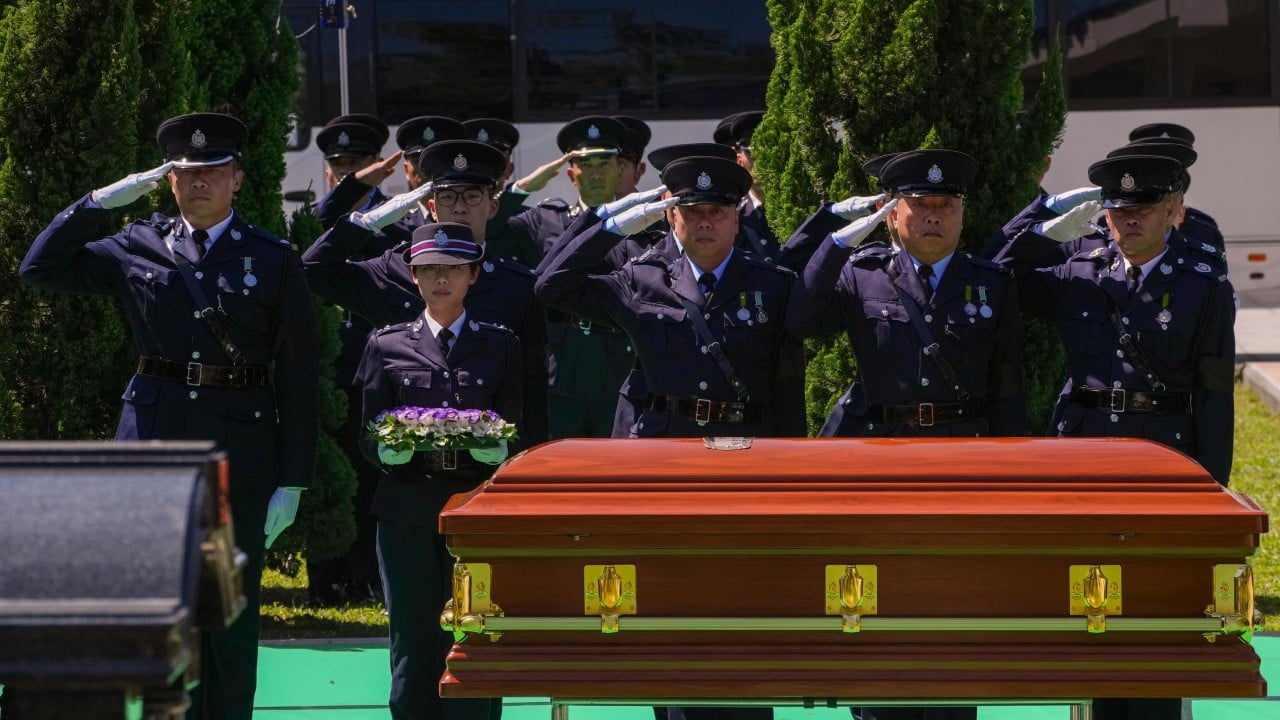
Twenty years of quiet endurance end in a single ceremony. Sometimes a funeral isn't really about death at all. It's about what a city chooses to remember when the headlines move on.
The story of a Hong Kong constable paralysed in 2005 who was recently laid to rest with full honours hits a nerve that goes way past routine news coverage. Most people read a headline like that, feel a brief pang of sympathy, and click away. Honestly, I think that reaction misses almost everything worth paying attention to. When an officer suffers a life-altering injury on duty and spends nearly two decades living with paralysis before passing away, the public conversation around line-of-duty honours gets complicated fast.
We don't have a verified source URL or full text from the competitor article in front of us here, so I won't pretend I read their exact paragraphs or guess at unverified names, dates, or quotes. What I can give you is a clear, grounded look at what a case like this actually means in Hong Kong, how ceremonial funerals work under the Hong Kong Police Force, and why long-term duty injuries raise tough questions that quick news summaries tend to gloss over.
What a 2005 Duty Paralysis Case Means Today
When a police officer in Hong Kong is paralysed during a violent attack in 2005 and passes away years later, two timelines collide. There's the moment of the assault itself, when split-second policing turns catastrophic. Then there's the long, unglamorous stretch that follows—physical therapy, medical complications, adaptive equipment, family strain, and life far outside the spotlight.
People often assume "line of duty" stories end when the immediate medical crisis stabilizes. Not even close. For someone living with severe spinal or neurological injury, the physical toll accumulates over years. Respiratory issues, pressure injuries, chronic pain, and secondary infections are real hazards that don't care how brave someone was on the street.
When full ceremonial honours are granted after years of living with a service-connected disability, it signals something important about institutional memory. The force is saying the clock didn't reset just because the initial incident happened back in 2005. It's a recognition that the sacrifice stretched across decades, not just one shift.
Still, let's be candid. Not every long-term medical case is straightforward in public administration. Over a span of nearly twenty years, questions around medical causation, pension rules, welfare support, and ceremonial eligibility can involve layers of review. Because exact details of the individual officer's medical record and ceremonial classification aren't confirmed in the reference notes here, we have to treat any specific medical or administrative link with care rather than assuming neat answers.
How Hong Kong Police Ceremonial Funerals Actually Work
If you've ever watched a formal police funeral in Hong Kong, you know it isn't thrown together on the fly. Protocol matters deeply in disciplined services. From the guard of honour and pallbearers to the flag draped over the coffin and the final salute, every element has a specific purpose.
Under the Hong Kong Police Force framework, ceremonial arrangements depend on rank, circumstances of death, and official classification. A service funeral or full honours funeral carries distinct weight compared with a standard private or ordinary service funeral. It publicly marks the person not just as a former colleague, but as someone tied to the public trust of the uniform.
Here's where people get confused. They hear "full honours" and assume it's a single rigid template applied identically to every officer. In reality, disciplined services balance tradition with specific rules governing eligibility, family wishes, and service history. Families also have a say in how much of a public spectacle they want after years of private hardship.
Think about that for a second. After spending almost twenty years dealing with paralysis behind closed doors, a family might want quiet dignity, or they might want the city to stand up and show respect one last time. Either way, a formal ceremony puts the institution's stamp on a life that changed permanently on a street patrol.
Why Knife Attacks Hit Policing Differently
Knife attacks in dense urban spaces like Hong Kong present a brutal reality for frontline officers. Firearms get more movie screen time, sure. In close quarters—crowded streets, stairwells, alleys, or transit areas—an edged weapon gives an attacker sudden, intimate range with almost no warning.
Even a single well-placed strike or thrust near the neck, spine, or major vessels can change everything in half a second. Back in 2005, frontline officers didn't have every modern piece of protective gear or tactical training protocol that exists today, though even modern equipment has limits against sudden close-range violence.
When an attack leaves an officer paralysed, the ripple effect hits the whole squad. Younger officers see what happens when routine order-maintenance flips into a life-or-death struggle. Veteran officers carry the weight of knowing a teammate went home changed forever.
The Hidden Cost of Two Decades After a Severe Injury
Let's talk about what happens in the years between the injury and the funeral, because that's the part most articles skip right over.
Living with paralysis isn't a static state. Bodies age. Caregivers age, too. Parents get older, spouses carry heavier loads, and medical needs often grow more complex rather than simpler. A home setup that worked in 2007 might struggle with shifting health demands ten or fifteen years later.
- Medical wear and tear: Long-term immobility or partial mobility strains multiple body systems over time, turning routine infections or breathing trouble into serious emergencies.
- Caregiver burnout: Round-the-clock or frequent care takes a quiet toll on relatives and hired aides alike, even when financial allowances exist.
- Public invisibility: Once the initial court cases and newspaper stories fade, life settles into a private routine that outsiders rarely see.
- Identity shift: Going from an active constable to someone managing severe physical limits requires a massive psychological adjustment.
That's why a funeral years later often feels strangely heavy to those who followed the case. People realize time kept moving for everyone else, while the injured officer lived inside the consequences of one violent day.
What People Usually Misunderstand About Line-of-Duty Honours
Whenever a story like this surfaces, comment sections and casual conversations fill up with assumptions. Most of them sound plausible on the surface and fall apart under scrutiny.
Misconception 1: Ceremonial honours automatically mean the injury caused death on the spot. Not necessarily. An officer can survive an attack, live for years with paralysis or severe disability, and pass away much later. Whether a death is formally classified as occurring on duty or from complications linked to duty depends on official determinations and specific facts of the case.
Misconception 2: Welfare support ends once the immediate crisis passes. Public safety agencies and welfare funds generally maintain ongoing support structures for injured officers and their families, though exact benefits vary by rank, service terms, and rules in place at the time.
Misconception 3: Every violent incident gets the exact same public treatment. Visibility depends on timing, family preference, media coverage at the time of the attack, and broader public mood. A case from 2005 may have faded from daily recall for younger residents who were kids when it happened.
Being honest about what we don't know—rather than filling in blanks with guesswork—is how you respect a real human story. Without confirmed specifics from the original report in this prompt, claiming exact medical causes, family statements, or internal administrative steps would be inventing details, and that's bad journalism every day of the week.
Why This Story Still Resonates in Hong Kong
Hong Kong has always had a distinct relationship with its police force and public institutions. There's pride in civic order, sharp debate over policing and accountability, and strong cultural weight placed on duty, endurance, and family sacrifice.
A constable paralysed in 2005 who reaches the end of his life years later sits right at that intersection. Regardless of how people view broader social or political debates, seeing someone pay a steep physical price on the job and endure it for nearly twenty years cuts through noise. It reminds people that behind policy debates and uniform badges are actual human bodies with limits.
It also prompts a fair question for any city: how well do we support people decades after a workplace tragedy, not just in the first week when cameras are rolling? Applause in the moment is easy. Sustained care over twenty years is the real test.
Practical Ways to Read and Verify Cases Like This
If you come across news about a long-ago injury, a delayed line-of-duty classification, or a ceremonial funeral, don't take a single headline at face value. A few habits help you separate solid reporting from recycled summaries:
- Check the timeline carefully. Look at the gap between the original incident year and the current event. Long gaps often involve evolving medical histories or specific administrative rulings.
- Look for primary or official confirmation. Check statements or notices from the relevant government department, such as the Hong Kong Government portal or official police channels, rather than relying solely on aggregated posts.
- Watch the wording around "honours." Notice whether a report specifies a service funeral, full honours, or general respect, since terminology in uniformed services carries precise meaning.
- Separate tribute from speculation. Grief and respect are natural responses to a hard story, yet claims about exact medical causes or motives should rest on verified facts.
At the end of the day, a full-honours farewell for an officer hurt back in 2005 isn't just a backward glance at an old case. It's a mirror held up to how a community remembers endurance long after the shock fades.