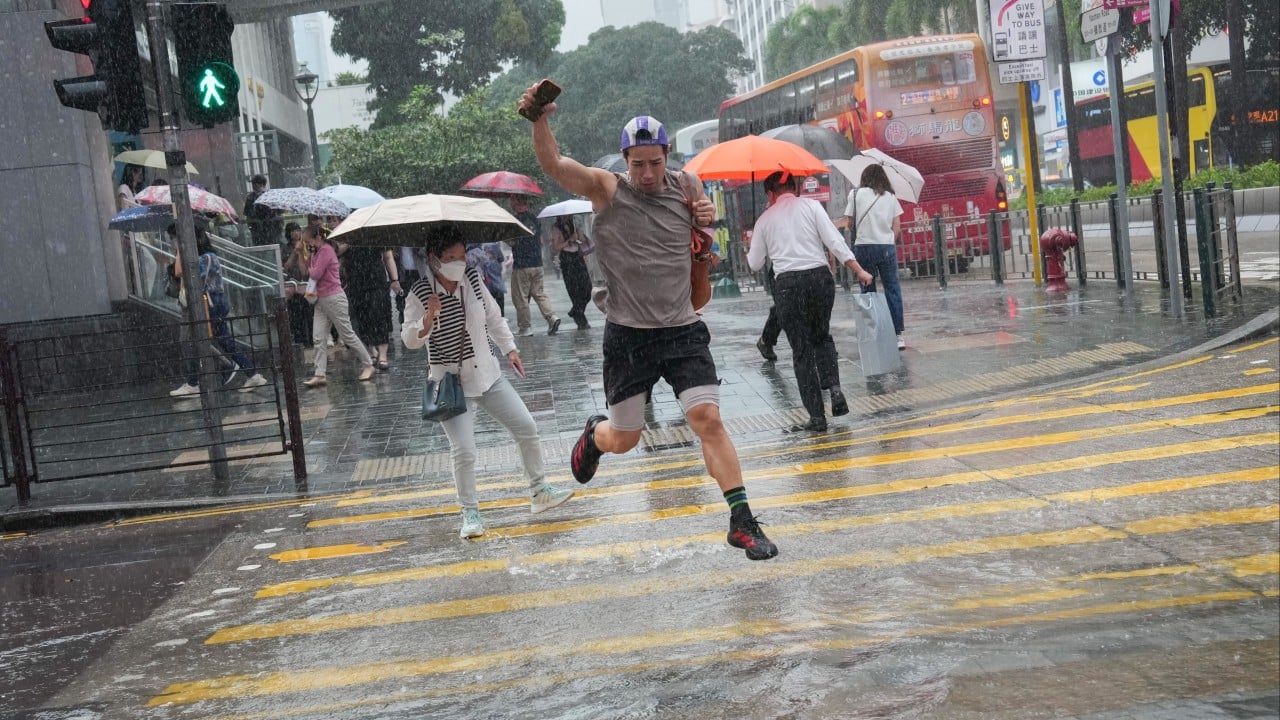
The sky turns a bruised shade of charcoal, the first heavy drops shatter against the pavement, and within minutes, every smartphone in the territory chirps in unison. The Hong Kong Observatory has issued an Amber Rainstorm Warning. News outlets scramble to report it as if a catastrophe is unfolding. Office workers hover by windows. Logistics managers panic.
This is the ritual of the "lazy consensus." The media treats every Amber signal as a prelude to a T8 or a Black Rainstorm, feeding a culture of hyper-vigilance that serves no one. We have become a city of weather-obsessed hypochondriacs, paralyzed by a color-coded system that was designed for infrastructure management, not for dictating the flow of human life. Expanding on this idea, you can find more in: The Brutal Math of the Shahed Attrition War.
The truth? An Amber alert is not a crisis. It is a baseline. In a subtropical coastal city, heavy rain is the status quo. By treating it as "news," we are eroding the city’s resilience and distracting ourselves from the actual structural failures that happen when the rain stops.
The Myth of the Amber Emergency
The Amber Rainstorm Warning means that heavy rain has fallen or is expected to fall generally over Hong Kong, exceeding 30 millimeters in an hour. To the uninitiated or the sensationalist, 30mm sounds like a deluge. To anyone who understands urban drainage and tropical meteorology, it is a Tuesday. Analysts at NPR have shared their thoughts on this trend.
The Observatory’s system is a technical tool for engineers and public works departments. It tells the drainage crews to clear the grates. It tells the slope safety teams to monitor high-risk areas. It was never intended to be a psychological trigger for the general public to stop working or start doom-scrolling.
When the media treats an Amber signal with the same gravity as a Black Rainstorm, they create a "cry wolf" effect. I have seen international firms lose thousands of man-hours because leadership in London or New York sees a "Storm Warning" notification and orders local staff to stay home or "be safe," unaware that the local population is currently walking to the 7-Eleven for a snack without an umbrella.
We are pathologizing the weather. We are turning a standard atmospheric event into a productivity sinkhole.
Why You Are Looking at the Wrong Map
The biggest flaw in the public obsession with the Amber signal is the "Generalization Trap." The Observatory issues these warnings based on a general average. You could be sitting in a bone-dry office in Central while a localized downpour triggers a warning because of a cell over Lantau or the northern New Territories.
If you are making business decisions based on a territory-wide Amber alert, you are failing at basic data literacy. The real threat in Hong Kong is not "The Rain." It is topography.
- Saturation vs. Intensity: A 30mm burst after a week of drought is harmless. That same 30mm after three days of drizzle is a landslide waiting to happen.
- The Concrete Jungle Effect: Our drainage systems are world-class, but they are built for flow, not for debris. The Amber alert doesn't tell you if the drains in your specific neighborhood are clogged with plastic waste and dead leaves.
Instead of checking the color of the warning, smart operators should be checking the Regional Rainfall maps. If you see 70mm in Sai Kung and 2mm in Tsim Sha Tsui, and your business is in Kowloon, the Amber alert is noise. Ignore it.
The Economic Cost of Over-Caution
The "Safety First" mantra is often a mask for "Risk Aversion." In the corporate world, "Better Safe Than Sorry" is the slogan of the mediocre.
Every time a rainstorm warning is sensationalized, the ripple effect through the economy is measurable.
- Delivery Bottlenecks: Logistics platforms spike their fees or throttle their couriers.
- Meeting Cancellations: The "soft" cancellation—where a client uses the rain as an excuse to dodge a tough conversation—becomes rampant.
- Retail Slumps: Malls stay empty not because of the water, but because the notification on the phone told people it was "dangerous" to go out.
I’ve watched project deadlines slip by weeks because of a string of Amber-alert days where nothing actually happened. The rain didn't stop the work; the perception of the rain did. We are training a generation of workers to look for any excuse to disengage.
The Institutional Failure of Communication
The Hong Kong Observatory is staffed by brilliant scientists, but they are trapped in a communication framework from the 1990s. The three-tier system (Amber, Red, Black) is too blunt an instrument for the modern age.
By the time a "Red" signal is issued, the damage is often already done. Conversely, the "Amber" hangs over the city for hours, often long after the clouds have parted, because the bureaucracy requires a specific set of data points to "downgrade" the signal.
We need to move away from color-coded anxiety and toward high-resolution, localized risk assessment. Until that happens, the burden of sanity falls on you.
How to Actually Navigate a Hong Kong Rainstorm
Stop looking at the headline on the news app. Start looking at the ground.
- Audit Your Commute: Do you live near a "Black Spot" for flooding? If no, the Amber alert is irrelevant to your travel time.
- Check the Radar, Not the Signal: The HKO app has a rain radar that updates every few minutes. It shows you exactly where the cells are moving. If the rain is moving South-East and you are in the North-West, go to your meeting.
- Stop the Panic-Sharing: Do not send "Stay safe!" messages to your group chats when it starts to drizzle. You are contributing to a collective anxiety that makes the city less efficient and more fragile.
The obsession with weather warnings is a symptom of a larger problem: a desperate desire for a predictable world in a city that is defined by its volatility. Hong Kong was built on the sides of mountains by people who didn't wait for the clouds to clear.
The next time your phone vibrates with an Amber alert, don't look for an exit. Look for an opportunity. While your competitors are busy checking their umbrellas and wondering if they should head home early, you have an open field.
The rain isn't the problem. Your reaction to it is. Stop letting a 30mm measurement dictate your ambition.
Get back to work.