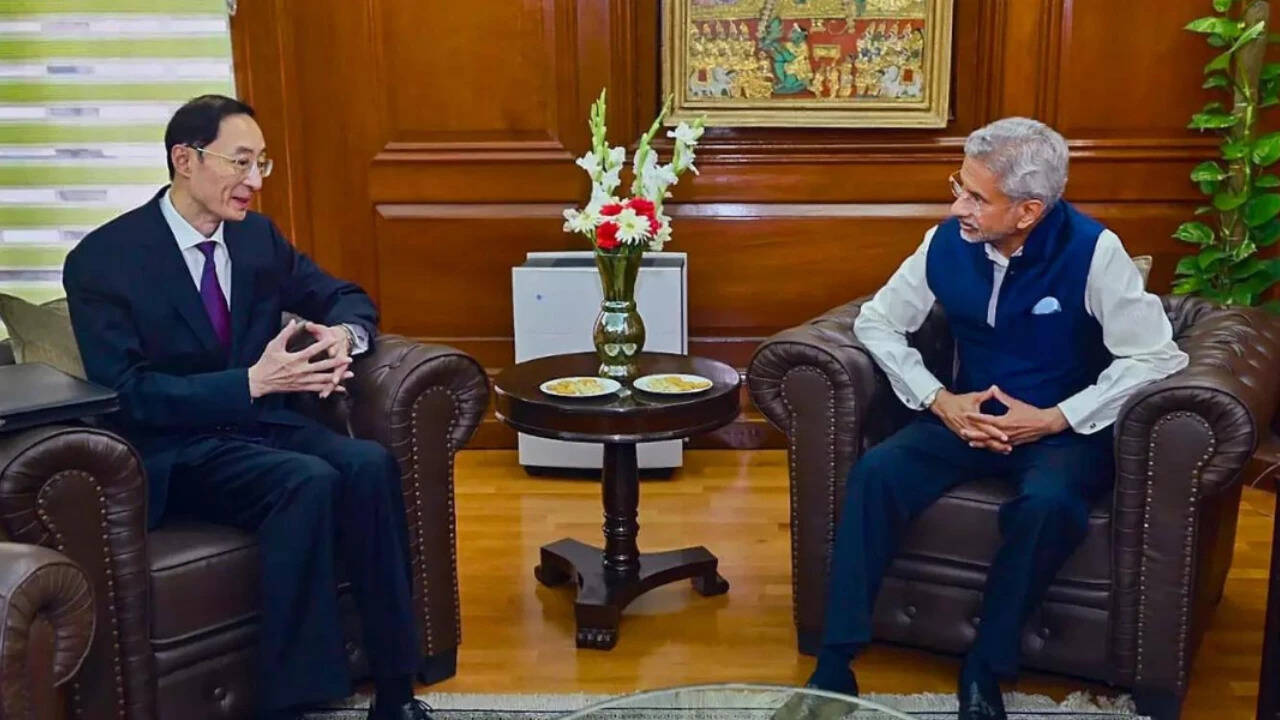
Beijing has officially scrubbed Sun Weidong from his post as Vice Foreign Minister, ending the career of the man who served as the primary bridge between the world’s two most populous nuclear powers. The removal, announced by the State Council on April 14, 2026, followed no trial, no public scandal, and no explanation. While state media frames this as a standard personnel reshuffle, the timing and the target suggest a much more aggressive restructuring of the Chinese diplomatic corps. Sun is not just another bureaucrat; he was the "Asia hand" who held the line during the most volatile period of China-India relations in a generation.
The disappearance of such a high-profile figure into the black box of the Chinese bureaucracy is no longer an anomaly. It is the new operating procedure. Since early 2024, the purge has expanded from the military’s Rocket Force into the heart of the Ministry of Foreign Affairs (MFA). By removing Sun, the CCP is effectively decapitating the institutional memory required to manage the delicate border disputes and economic friction with New Delhi.
The Architect of Fragile Peace
Sun Weidong’s tenure was defined by the impossible task of balancing Xi Jinping’s "Wolf Warrior" expectations with the pragmatic necessity of preventing a full-scale war with India. Following the 2020 Galwan Valley clash, it was Sun who navigated the labyrinthine negotiations that kept the Line of Actual Control (LAC) from turning into a permanent frontline.
He was promoted to Vice Foreign Minister in late 2022 precisely because he understood the Indian psyche. He wasn't just a messenger; he was a stabilizer. In the months leading up to his removal, Sun had been active, meeting with Indian Ambassador Pradeep Kumar Rawat as recently as March 2026 to discuss "managing differences." His sudden exit suggests that the "management of differences" is no longer the priority in Beijing.
The Institutional Memory Gap
When a diplomat of Sun’s caliber is removed without a successor of equal stature, the institutional knowledge of the department evaporates. This creates a dangerous vacuum. The current MFA lineup—Qi Yu, Ma Zhaoxu, Hua Chunying, and Miao Deyu—is heavily skewed toward ideological purity and Western confrontation rather than regional neighborhood management.
- Ma Zhaoxu: Primarily focused on global governance and multilateralism.
- Hua Chunying: The face of aggressive public diplomacy, better known for Twitter sparring than back-channel border negotiations.
- Miao Deyu: A specialist in policy planning, lacks the "on-the-ground" seasoning of an ambassador to a hostile neighbor.
This shift signals a transition from professional diplomacy to ideological enforcement. Under the "Chairman Responsibility System," loyalty to the leader has superseded the technical expertise required to handle complex geopolitical files. In the old era, a diplomat’s value was measured by their ability to prevent crises. Today, it is measured by their ability to amplify the center’s voice without hesitation.
Why Sun Became Expendable
The purge of the military leadership in late 2025 and early 2026, which saw the fall of General Zhang Youxia and General He Weidong, provides the necessary context. Those removals were reportedly tied to disagreements over the timeline for a "kinetic move" against Taiwan. If the military is being purged to ensure absolute compliance for a future conflict, the diplomatic corps must be aligned to handle the fallout.
Sun Weidong belonged to a class of diplomats who believed in the "Cold Peace." This philosophy argues that as long as trade flows and dialogue continues, the border remains manageable. However, if Beijing’s strategic focus has shifted toward a definitive resolution of its territorial claims—whether in the South China Sea or the Himalayas—men like Sun become liabilities. They are viewed as too conciliatory, too "expert" in the nuances of the enemy, and therefore potentially soft.
There is also the matter of the "Kailash Manasarovar Yatra" and the hydrological data sharing agreements Sun had been brokering. These were small wins meant to build trust. In a climate where trust is seen as a weakness, these initiatives may have been the very thing that painted a target on his back.
The Digital Erasure
In the modern CCP framework, a dismissal is often followed by a systematic purging of the digital record. We are seeing the "Qin Gang Protocol" applied to Sun. Mentions of his recent meetings are being quietly archived or delinked. This is a deliberate strategy to prevent the formation of "factions" or "cliques" around seasoned veterans.
By making the removal sudden and silent, the state sends a message to the remaining staff: no one is indispensable. This creates a culture of "performative loyalty" where diplomats compete to be the most vocal in their defense of the party line, regardless of the diplomatic cost.
The Cost of the Purge
The immediate result of Sun’s removal will be a hardening of the Indian stance. New Delhi has already expressed skepticism about Beijing’s "sincerity" in border talks. Removing the most familiar face in those talks confirms India’s worst fears—that the diplomats no longer have a seat at the table in Beijing, and the hawks have taken over.
We are entering a period of high-stakes guesswork. Without a reliable interlocutor like Sun, foreign intelligence agencies are forced to rely on satellite imagery and signals intelligence to guess China’s intentions. The "human element" of diplomacy has been sacrificed at the altar of political security.
The state is no longer a collection of institutions; it is a single will. While this makes for a unified front, it removes the internal "check and balance" of expert dissent. When the experts are purged, the only voices left are those that say "yes." History suggests that this is exactly when the most catastrophic strategic errors occur.
Sun Weidong is gone. The bridge he built is now unmanned. In the coming months, we will see if Beijing intends to cross it or burn it.