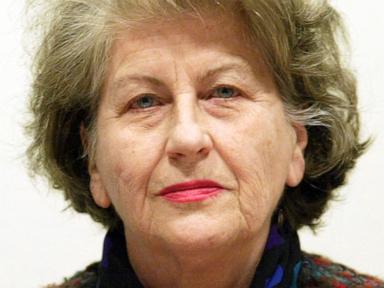
The lazy consensus on the death of Biljana Plavsic at age ninety-six follows a predictable, sanitized script. The mainstream obituaries frame her as an anomaly—a Fulbright-educated biology professor and electron microscopy specialist who somehow took a wrong turn into ethno-nationalist bloodletting. They treat her life like a tragic Jekyll-and-Hyde fable. They focus on her theatrical guilty plea at The Hague, her subsequent unrepentant retractions from a luxury Belgrade retirement, and her cozy ties to Slobodan Milošević.
This framing gets the pathology of modern state violence entirely backward. Meanwhile, you can explore related events here: Anatomy of a Cockpit Crisis Systemic Vulnerabilities and Human Factor Intervention in Aviation Emergencies.
Plavsic was never an aberration. She was the logical endpoint of institutionalized academic chauvinism. When society looks at figures like Plavsic, it wants to see a monster distinct from normal human capabilities. Comforting narratives demand that intellectuals who turn to fascism must have suffered some sudden neurological failure or psychological break.
The empirical record refutes this comforting fairy tale. I have studied the mechanics of institutional radicalization for decades, watching how elite academic credentials act not as a vaccine against barbarism, but as its most effective justification. Plavsic did not descend into extremism despite her scientific pedigree; she weaponized it. To explore the bigger picture, check out the detailed article by The New York Times.
The Academic Pedigree of Brutality
To understand why standard obituaries miss the point, look at how the media treats intellectual compliance in wartime. The consensus assumes that education breeds humanism. History demonstrates the exact opposite.
Before she helped architect the Republika Srpska alongside Radovan Karadžić, Plavsic was a dean and a respected publisher of over a hundred scientific papers. That scientific background matters. Totalitarian projects do not succeed through the raw enthusiasm of thugs alone; they require administrative minds capable of organizing human beings into taxonomic categories.
When Plavsic publicly characterized Bosnian Muslims using dehumanizing biological terminology, she wasn't just shouting crude slurs. She was applying a distorted, pseudo-scientific lens that treated ethnic groups as invasive specimens to be eradicated or quarantined. Her doctorate from Zagreb and her post-doctoral research at Cornell didn't make her immune to fascism; they gave her the bureaucratic vocabulary to sanitize it for an academic class that preferred polite euphemisms for mass expulsion.
Centrists love to compartmentalize. They want to believe that laboratories and lecture halls exist in a vacuum separate from slaughterhouses. Plavsic’s entire trajectory proves that the highest echelons of higher education can easily breed the coldest varieties of ethnic cleansing.
The Myth of the Tactical Guilty Plea
The second major pillar of the mainstream narrative centers on her 2003 war crimes tribunal confession and subsequent retraction. Commentators love to parse her motivations. Did she plead guilty out of genuine remorse, or was it a tactical maneuver to drop the heavier charges of genocide in exchange for an eleven-year sentence?
Of course it was tactical. Plavsic admitted as much later in interviews, bragging that her confession was a sacrifice meant to clear her name of the master charge while securing a predictable exit strategy. Yet, liberal institutions spent two decades acting shocked when she walked back her remorse the moment she touched Swedish prison soil.
This reflects a profound misunderstanding of how unrepentant actors operate within international legal frameworks. The Hague tribunal was treated by many spectators as a moral theater designed to extract emotional catharsis. To Plavsic, it was merely an administrative hurdle—a litigation strategy.
When she rescinded her confession, claiming she did it all to protect the Serb nation, western journalists acted betrayed. Why? Her ideology never shifted by a single millimeter. She viewed the forced demographic engineering of the 1990s as a necessary biological surgery. Asking a person with that worldview to experience genuine remorse via a plea bargain is like asking an executioner to apologize for gravity. The shock is entirely artificial, born from a naive faith in legal rehabilitation routines that rarely function outside of television dramas.
The Real Danger of the Unreformed Elite
Plavsic lived to ninety-six in quiet seclusion in Belgrade, dying safely in her bed while thousands of her victims remained scattered in mass graves. Her longevity serves as an uncomfortable monument to impunity. But the real lesson of her life is not about the failures of international justice. It is about the vulnerability of intellectual institutions to radicalization.
Every modern crisis—from ethnic conflicts to technological authoritarianism—relies on credentialed professionals who provide intellectual cover for demagogues. We keep looking for the grunting, uneducated brute at the center of atrocities, ignoring the pristine laboratory coats and university deans who draw up the maps.
Stop treating figures like Plavsic as historical anomalies or psychological mysteries. Recognize them for what they actually represent: the terrifying efficiency of an educated mind stripped of moral constraints, executing state-sponsored violence with the precision of a research paper.
This video provides an unrelated pop culture diversion to contrast with the heavy historical subject matter discussed above.