The desert around Albuquerque has a way of swallowing sound. On a Tuesday morning in 2023, the only noise in a gravel-strewn mobile home park on the edge of the city was the low idle of an unmarked sedan. Inside sat federal agents, their eyes fixed on a drop-off. They watched a courier deliver a package containing seventy-four thousand fentanyl pills.
They did not move. They did not open their car doors. They did not flash badges or draw weapons. Instead, they took notes. They counted. They tracked. For a different look, read: this related article.
Then, they let the courier drive away, leaving seventy-four thousand doses of a chemical weapon sitting in a residential neighborhood.
To the strategists at the Drug Enforcement Administration, those seventy-four thousand pills were not a public safety hazard. They were bait. The agents were playing the long game, executing a high-stakes law enforcement strategy designed to build a massive conspiracy case against cartel bosses far up the food chain. But while the federal government was playing chess, the citizens of New Mexico were breathing in the smoke of a burning house. Related insight on the subject has been provided by Reuters.
The strategy went on for two years. Between 2023 and 2025, federal investigators repeatedly monitored major shipments of synthetic opioids as they flowed into New Mexico communities, opting to look through a telescope rather than make an arrest. The logic behind it is as old as policing: let the small fish swim so they lead you to the whale.
But when the bait is lethal in microscopic amounts, the math changes.
While federal agencies monitored the shipments, the collateral damage was tallying up in real time. Imagine a mother in Española—a town already worn down by generations of economic abandonment—waking up to find her fifteen-month-old daughter unresponsive on the floor after swallowing a stray pill. That is not a metaphor. That is what happened last year. Her story is one of hundreds that form a devastating statistical anomaly: while overdose deaths across the United States dropped by fourteen percent last year, New Mexico saw a brutal twenty-one percent spike.
The disconnect between federal strategy and local survival became a flashpoint when an Associated Press investigation shattered the silence, largely driven by a DEA whistleblower named David Howell. Howell raised his hand within the agency as early as 2023, warning that the operation was gambling with human lives. He was sidelined for his trouble. Yet he kept documenting the unchecked shipments, tracking a massive haul of one.eight million pills that rolled across the state line without interception.
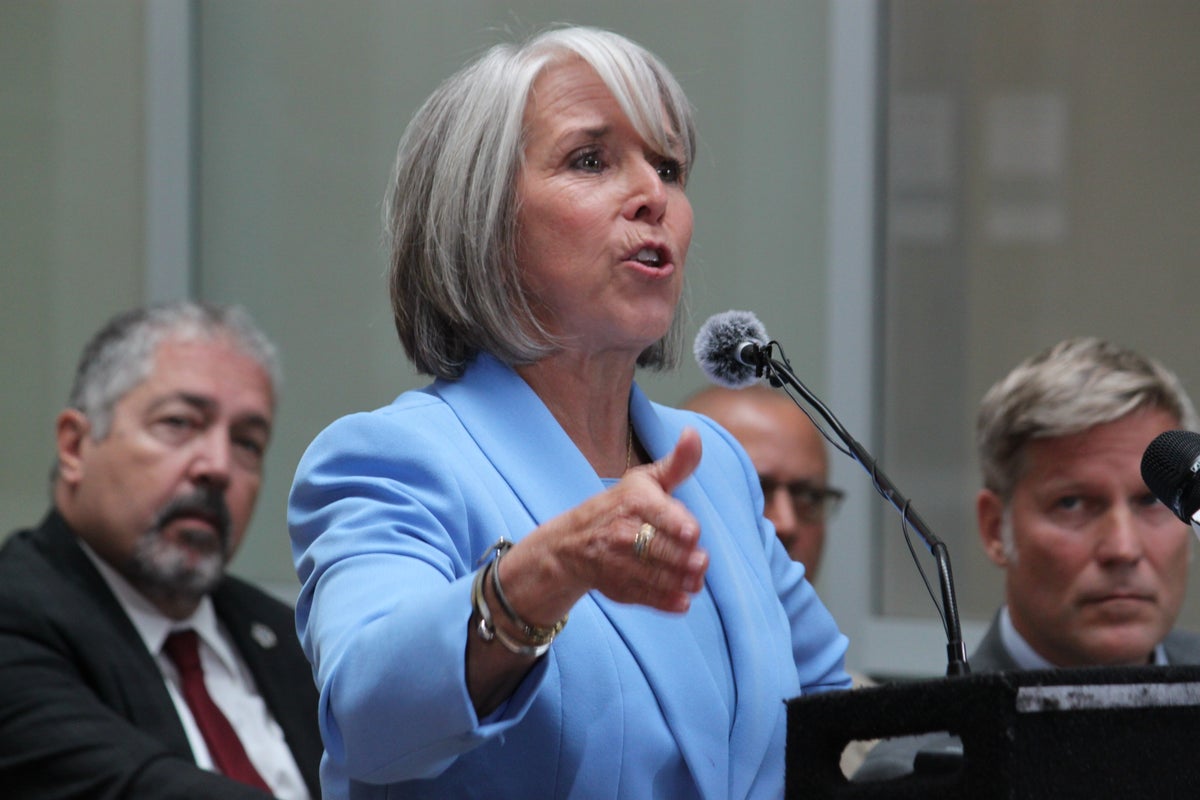
The revelation sparked an unprecedented civil war between state leaders and federal law enforcement. Standing inside the state medical examiner’s office in Albuquerque—a room that handles the physical reality of the crisis every single day—New Mexico Governor Michelle Lujan Grisham directed her fury squarely at Washington.
The state is now exploring a massive civil lawsuit seeking billions of dollars in damages from the federal government. New Mexico’s attorney general has launched a criminal investigation to determine if federal agents violated state laws by knowingly exposing residents to deadly contraband.
It is an extraordinary legal maneuver, turning a standard policy debate into a criminal question. The federal government’s defense, voiced through former U.S. Attorney Alex Uballez and agency spokespersons, relies on the grim reality of limited resources. They argue that intercepting every transaction is impossible, and that dismantling an entire trafficking network does more long-term good than seizing a single trunk full of contraband.
But that corporate risk-assessment logic crumbles when it meets the families left in its wake. Michael Glownia, who founded a nonprofit after losing his daughter to an overdose in 2023, pointed out the bitter irony of the situation. For years, the DEA has blanketed the country with its "One Pill Can Kill" public awareness campaign, warning Americans that a single dose can end a life instantly. Yet behind closed doors, the same agency determined that hundreds of thousands of those exact pills were an acceptable cost of doing business.
The financial damages New Mexico is seeking are astronomical because the true cost of addiction is cumulative. It ripples outward. It fractures emergency room budgets, fills foster care systems with children who have nowhere else to go, and strains municipal resources until the social fabric begins to fray. Albuquerque Mayor Tim Keller described the federal operation as an unapproved, undisciplined experiment conducted on his constituents without their consent.
The legal battle ahead will likely take years to resolve, tangled in the dense protective netting of federal immunity and bureaucratic jurisdiction. Washington will argue that its strategies are lawful, reasonable, and consistent with institutional guidelines. The state will counter that no strategy is reasonable if it requires the slow poisoning of the population it is sworn to protect.
A deep sense of betrayal remains. The people of New Mexico are left with the knowledge that while they were burying their children, federal investigators were standing just down the street, holding clipboards, and watching the cars drive by.