The air in Edmonton on a mid-July afternoon has a very specific weight. It hangs. It clings to your skin like a damp wool blanket, thick with the scent of sun-baked asphalt and the sharp, green aroma of cut grass that has had far too much to drink.
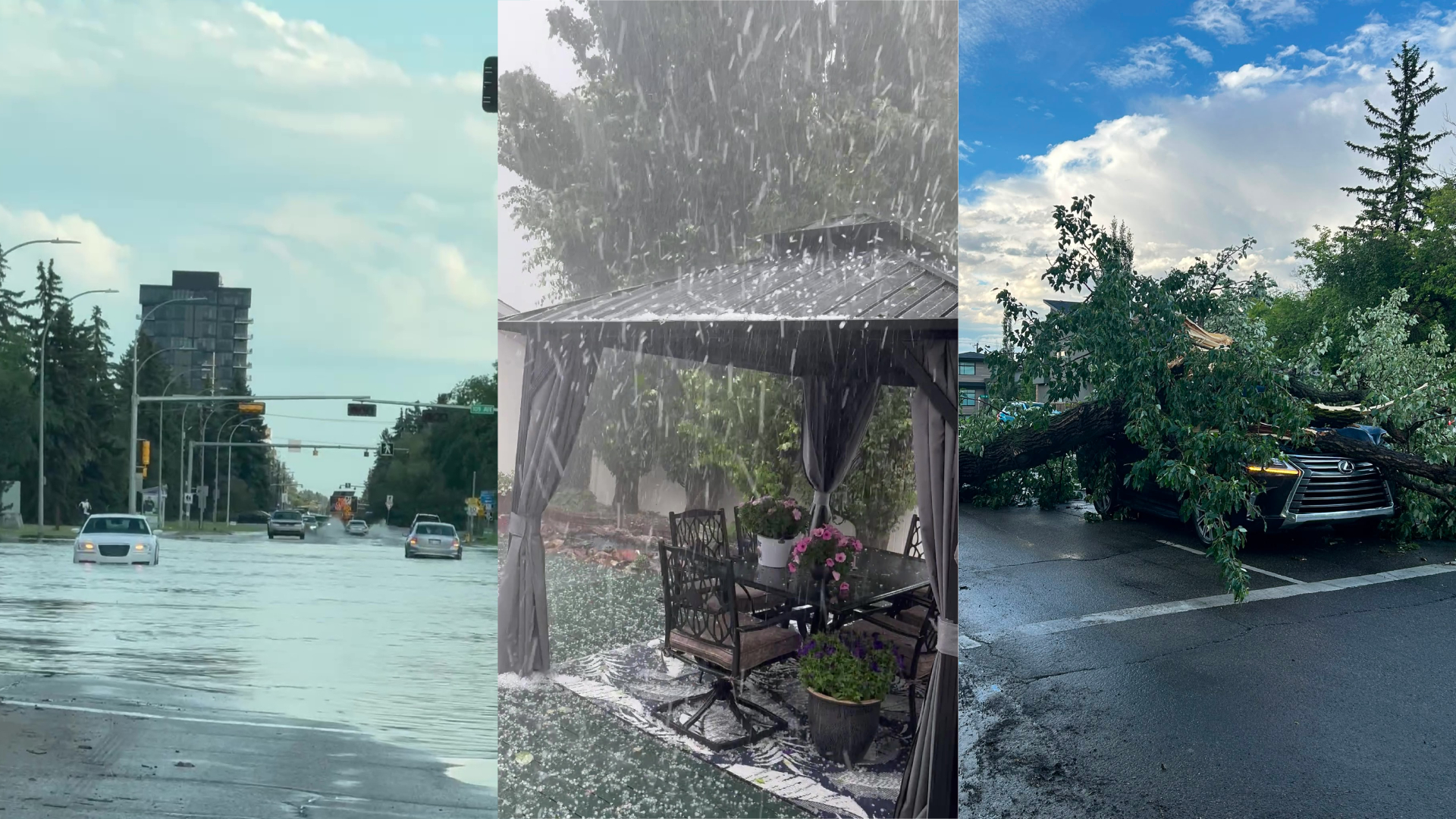
If you lived through the weekend of July 10, you already know this feeling. You know the exact shade of yellow-green the sky turns just before the clouds decide to tear themselves apart. You remember the sound of hail bouncing off your deck like spilled marbles, and the sight of Whitemud Drive disappearing under several feet of muddy, stalled-out water. We barely had time to sweep the leaves and shattered twigs from our driveways before the atmosphere decided to reset the stage.
Now, on this Tuesday, July 14, 2026, the quiet has returned. But it is an uneasy quiet.
By mid-afternoon, the phones across central Alberta began to chime with that familiar, jarring buzz. Environment and Climate Change Canada issued a severe thunderstorm watch for Edmonton, St. Albert, and Sherwood Park. Further west, toward the foothills, the alert was more urgent: a tornado watch.
The sky is cooking again. And we are waiting for the dinner bell.
The Cauldron in the Foothills
To understand why a summer evening in Alberta can turn violent so quickly, you have to look west, where the flat plains suddenly collide with the jagged wall of the Rocky Mountains.
Consider a hypothetical resident—let us call her Sarah—living in a quiet subdivision in Sherwood Park. On a normal Tuesday, Sarah would be watering her petunias or planning a barbecue. Today, she is eyeing her backyard patio furniture, wondering if she should drag the heavy glass-topped table into the garage. She looks at her phone, then at the horizon.
The horizon looks perfectly fine. For now.
But three hundred kilometers to the west, near Rocky Mountain House and Edson, the atmosphere is constructing a monster. Think of the atmosphere as a massive, invisible engine. On a hot day like today, the sun bakes the earth, heating the air close to the ground. This warm air is full of moisture evaporated from our saturated soil. It wants to rise.
Meanwhile, high above, cold mountain winds are sweeping east.
When a slow-moving, low-pressure system pushes through the province, it acts as a massive shovel, lifting that hot, humid surface air rapidly into the cold upper atmosphere. As that warm air shoots upward, it condenses into towering cumulonimbus clouds. If the winds at the top of the sky are blowing in a different direction or at a different speed than the winds at the bottom, the rising column of air begins to spin.
Meteorologists call this embedded rotation. To the rest of us, it is the birth of a supercell.
These are not your average summer rain showers. These are self-sustaining atmospheric factories. They manufacture golf-ball-sized hail. They generate straight-line winds capable of peeling the shingles off your roof like paper stickers. And occasionally, when the spin reaches all the way to the damp earth, they drop a funnel.
The Anatomy of the Wait
The hardest part of a storm watch is not the rain. It is the waiting.
For Edmontonians, the primary threat is not expected to arrive until late—roughly between 10 p.m. and 1 a.m. That means the worst of the weather will roll in under the cover of darkness.
There is a psychological vulnerability to a nighttime storm. When a system hits at noon, you can see the shelf cloud approaching. You can see the lightning arcs tracing paths across the dark belly of the sky. At midnight, you only see the world in sudden, blinding flashes of white, followed by the kind of thunder that rattles the picture frames in your hallway.
Sarah decided to pack up her patio. She dragged the chairs inside and moved her car into the garage, clearing out the clutter she had been meaning to organize since spring. It is a ritual thousands of Albertans perform during storm season. We check the weather apps. We look out the window. We look back at the screen.
It is easy to get desensitized to these warnings. We see them so often in July. But the memories of Saturday's 60 km/h winds and typhoon-like conditions are still too fresh to ignore. The ground is already saturated; the local creeks are full. Any sudden deluge of torrential rain tonight will have nowhere to go but up onto our streets and into our basements.
The difference between a "watch" and a "warning" is a distinction that bears repeating, especially when the sun is still shining. A watch means the ingredients are in the cupboard; the storm could happen. A warning means the cake is in the oven; the danger is occurring or imminent.
If that watch upgrades to a warning tonight while you are asleep, you need to know exactly what your feet will do before your brain is fully awake.
Finding Level Ground in the Dark
If the sky does break, the rules of survival are remarkably simple, yet we often forget them in the panic of the moment.
Imagine the wind rising to a high, steady scream. If a tornado warning is issued for your neighborhood, your home is your fortress, but only if you use it correctly.
- Go low: The basement is your best friend. Put as many walls between yourself and the outside world as possible.
- Avoid the glass: If you do not have a basement, an interior bathroom, closet, or hallway on the lowest level is the safest bet.
- Ditch the temporary: Mobile homes, tents, and vehicles offer zero protection against rotating winds. If you are on the road, do not try to outrun the storm. Do not park under overpasses—they can act as wind tunnels, accelerating the debris that causes the real harm.
There is a strange, quiet solidarity in these moments. We sit in our living rooms with the lights flickered low, watching the radar maps on our screens, connected by a shared vulnerability to a sky that does not care about our property lines, our commutes, or our evening plans.
By 9 p.m., the wind in Sherwood Park begins to cool. The mugginess of the afternoon is slowly replaced by a sharp, electric chill. Out in the west, past the city lights, the darkness is not just night falling. It is the shadow of the foothills coming to meet us.
We lock our doors. We set our phone alerts to high volume. We wait for the sky to speak.