Flour settles into the ridges of your knuckles like fresh snow. Your lower back aches from leaning over a scarred wooden cutting board, kneading a stiff, stubborn ball of brioche dough that refuses to yield to human heat. It is eleven o'clock on a Tuesday night in late November, the kitchen smells faintly of yeast and panic, and you have forty-eight hours before twelve people arrive expecting warm cinnamon rolls and effortless hospitality.
We rarely talk about the physical toll of caring for the people we love. Cooking for a crowd is an act of devotion, yet we often execute it with tools built for obsolescence—flimsy plastic hand mixers that smell like burning ozone the moment they hit cold butter, or cheap appliances that walk across the countertop like panicked crabs before dying quietly in a landfill three years later.
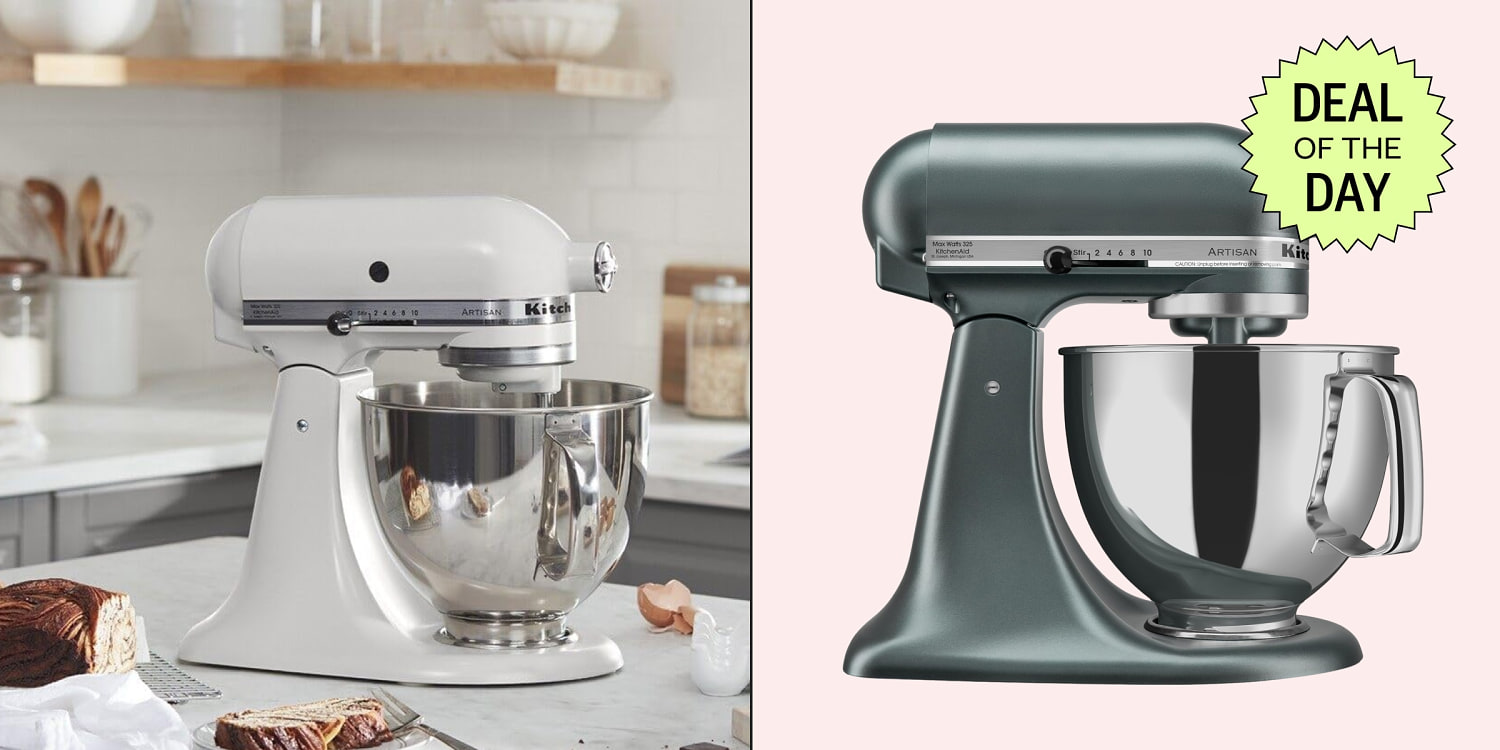
Right now, ahead of the holiday rush, the classic KitchenAid Artisan Series 5-Quart Tilt-Head Stand Mixer has dropped by $150, bringing a legendary $449.99 workhorse down to $299.99 across major retailers. On paper, that is a simple seasonal discount. In reality, it is the barrier dropping between you and a thirty-year kitchen companion.
The Myth of the Disposable Kitchen
To understand why a price drop on a heavy metal mixer matters, you have to look at what happened to the American kitchen over the last four decades.
Consider a hypothetical home cook—let’s call her Clara. Ten years ago, Clara bought a $40 hand mixer because she only baked twice a year. Then she had kids. Then she started hosting Thanksgiving. Over a decade, Clara burned through four cheap mixers, snapped three plastic dough hooks, and spent $180 replacing broken gear while throwing twelve pounds of unrecyclable electronics into the trash. She thought she was being frugal. She was actually paying a recurring tax on fragility.
Modern appliances are engineered around a quiet, cynical assumption: that you will accept things breaking. Manufacturers replace bronze gears with nylon, swap die-cast zinc bodies for hollow ABS plastic, and seal motors so they cannot be repaired.
KitchenAid’s flagship tilt-head mixer refuses to participate in that bargain. Designed originally by engineer Herbert Johnston in 1919 after watching a baker laboriously knead bread dough with a heavy iron spoon, the machine was built with the mechanical honesty of a tractor. Even today, the Artisan Series weighs twenty-six pounds. That weight is not decorative. It is solid, die-cast metal absorbing the violent torque of heavy rye dough so the machine stays planted on your granite while you walk away to prep the filling.
What Happens Inside the Bowl
If you have never used a planetary mixer, the difference between it and a standard twin-beater hand mixer can seem abstract. Let’s use an analogy from astronomy.
A cheap hand mixer spins in place like a top; you have to physically move it around the bowl, scraping the edges constantly while unmixed flour hides at the bottom. A KitchenAid uses planetary mixing action. The beater spins rapidly on its own axis while simultaneously orbiting the circumference of the bowl—much like the Earth rotating on its axis while revolving around the sun.
In a single rotation, the beater touches fifty-nine distinct points inside that five-quart stainless steel bowl.
The result is mechanical alchemy. Cold butter and granulated sugar do not merely combine; they shear against each other at microscopic angles, trapping millions of tiny air pockets that expand in the oven to create a tender, fine-grained cake crumb you simply cannot achieve by hand. When you whip egg whites for a holiday pavlova, the wire whip incorporates air with such uniform velocity that the meringue holds glossy, structural peaks in less than four minutes.
I learned this the hard way during my first winter hosting dinner parties in a cramped apartment with zero counter space. I resisted buying a stand mixer for years, convinced it was a status symbol for people with marble islands and matching aprons. Then I tried to make three batches of Italian buttercream in one afternoon using a handheld beater. My wrist cramped so badly I dropped the bowl onto the tile floor, splattering warm sugar syrup across my cabinets and weeping quietly beside the stove. The following week, I bought a refurbished Empire Red KitchenAid. That was fourteen years ago. I have since dropped it once during a move, replaced a twenty-dollar carbon brush myself with a flathead screwdriver, and used it every single Sunday. It still hums with the exact same low, reassuring purr.
Decoding the $150 Discount
Seasonal retail pricing can feel like a shell game. Retailers routinely inflate a "list price" in October only to slash it in November and call it a miracle. So it is worth examining the cold numbers behind this specific markdown.
The KitchenAid Artisan 5-Quart Tilt-Head (Model KSM150PS) carries a verified manufacturer's suggested retail price of $449.99. Throughout most of the spring and summer, it rarely dips below $379.99. Seeing it hit $299.99—a full $150 off retail, or roughly a 33 percent reduction—places it at its historical floor for brand-new units.
You might wonder whether the slightly cheaper KitchenAid Classic 4.5-Quart ($249.99 on sale) is the smarter buy, or if you should jump up to the heavy-duty Bowl-Lift models. Here is how the math actually breaks down on your counter:
- Capacity: The 5-quart Artisan bowl holds enough dough for nine dozen cookies or four loaves of bread in a single batch. Dropping down to 4.5 quarts shaves off just enough volume to cause flour spillover when you double a holiday cookie recipe.
- Motor Power: At 325 watts, the Artisan hits the sweet spot for home bakers. It handles dense brioche and double-batch chocolate chip cookie dough without straining, whereas smaller 275-watt motors can overheat during extended ten-minute kneading cycles.
- Clearance: The tilt-head design lifts the motor housing completely out of the way, making it effortless to swap attachments or scrape the bowl under standard eighteen-inch upper kitchen cabinets. Bowl-lift models are taller and bulkier, often forcing you to pull them out from under cabinets just to add ingredients.
And then there is the power hub—that small, circular cap on the front of the mixer's head. Unscrew it, and the machine stops being a baker's tool and becomes a modular kitchen engine. Because KitchenAid has kept that exact hub dimension unchanged since the 1930s, a mixer bought at $299.99 today can drive a brass pasta roller, a meat grinder for homemade sausage, a grain mill, or a vegetable sheet cutter. Attachments bought for your grandmother's mixer in 1974 will slide straight into a brand-new machine bought this afternoon.
The Real Reason People Gift Heavy Metal
Walk through any department store in December and you will see dozens of sleek, chrome-plated boxes stacked near the front doors. People buy stand mixers as wedding gifts, housewarming presents, and holiday centerpieces not because they are practical, though they are. They buy them because they are one of the few modern objects that carry the weight of permanence.
We live in an era where almost everything we give each other evaporates. Gift cards get spent on groceries; sweaters pill and lose their shape; phones become sluggish bricks within four years.
A twenty-six-pound die-cast mixer refuses to disappear. It sits on the counter through first apartments, career changes, burned dinners, birthday cakes baked at midnight, and clumsy toddlers standing on wooden chairs begging to lick the paddle. Over decades, the enamel finish picks up tiny, honorable battle scars—a faint scratch near the speed lever from a stray measuring cup, a smudge of cocoa powder permanently wedged beneath the lock latch.
Taking $150 off the price tag removes the hesitation that keeps most home cooks standing on the sidelines, rubbing their sore wrists over a mixing bowl and telling themselves they don't bake quite enough to justify the splurge. You do not buy a machine like this for the baker you already are. You buy it for the person you become when the friction of hard kitchen labor disappears—when whipping up fresh pasta on a rainy Wednesday or rolling out cardamom buns on a snowy Sunday morning feels less like a chore and more like breathing.
Years from now, long after the cardboard box has been recycled and the receipt has faded to blank thermal paper, someone you love will stand at a kitchen counter, click that metal lever to speed four, and listen to the steady, rhythmic whir of steel gears turning flour and butter into warmth.