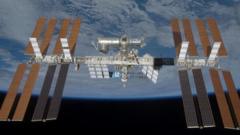
The crew of the International Space Station recently retreated to their return spacecraft while engineers scrambled to isolate a pressure drop in a high-stress structural module. This maneuver, often downplayed as a standard safety protocol, underscores a systemic vulnerability in low Earth orbit infrastructure. As the facility operates well past its original design life, structural fatigue and micrometeoroid damage are no longer theoretical risks. They are daily operational hazards that require constant, reactive maintenance just to keep the outpost habitable.
Pressure Under Pressure
The immediate cause of the recent sheltering incident traces back to the Service Module Transfer Tunnel, a critical junction area connecting Russian and American hardware. Air leak rates in this specific zone have fluctuated for years, but a sudden spike forced mission controllers to restrict crew movement and seal off sections of the station. This is not a simple matter of swapping out a faulty rubber gasket. The leak is occurring in a highly stressed metallic skin that endures extreme thermal cycling every ninety minutes as the station moves between intense sunlight and orbital darkness. Meanwhile, you can read other events here: Why Everyone Is Misunderstanding the International Space Station Air Leak Crisis.
When an orbital facility experiences a pressure deviation, the protocol is rigid. Astronauts move to their respective rescue vehicles—in this case, a Soyuz and a SpaceX Crew Dragon—to ensure they can evacuate if the pressure drop accelerates beyond the life support system's ability to compensate. The crew remained isolated for hours while ground teams monitored pressure telemetry from sealed compartments. While the immediate threat subsided after engineers applied specialized sealing compounds to suspected micro-cracks, the patch is a temporary fix for a deeper, material degradation problem.
The Chemistry of Orbital Decay
To understand why these leaks are accelerating, one must look at the structural metallurgy of the station. The hull relies on specific aluminum-lithium alloys chosen decades ago for their high strength-to-weight ratios. At the time of construction, these materials represented the peak of aerospace engineering. However, decades of exposure to atomic oxygen, solar radiation, and internal pressurization cycles have altered the material properties. To see the bigger picture, check out the detailed analysis by Ars Technica.
Metal fatigue occurs at the microscopic level. Every time the station moves from the shadow of the Earth into direct sunlight, the exterior skin expands. When it enters eclipse, it contracts. Over nearly three decades, these thousands of thermal cycles create microscopic dislocations in the crystalline structure of the metal. Eventually, these dislocations coalesce into micro-fractures.
The environment inside the station compounds the issue. Human respiration and perspiration introduce moisture into the cabin air. Despite advanced environmental control systems, trace amounts of moisture can condense in the uninsulated gaps between the internal pressure hull and the external micrometeoroid shielding. This creates a highly localized, corrosive environment that accelerates crack propagation along structural welds.
The Micrometeoroid Menace
Internal degradation is only half the battle. The exterior of the station faces a relentless bombardment of hypervelocity particles. While large pieces of space debris are tracked by ground-based radar, millions of sub-millimeter particles slip through the tracking network completely undetected.
A particle measuring less than half a millimeter, traveling at relative speeds exceeding twenty thousand miles per hour, possesses the kinetic energy of a high-caliber bullet. The station utilizes Whipple shielding—a design consisting of a thin outer bumper spaced away from the main pressure hull. The idea is simple. The outer bumper vaporizes the incoming projectile, scattering the energy across a wider debris cloud before it hits the inner wall.
- Whipple Shield Effectiveness: Highly efficient against particles under one centimeter.
- The Structural Limit: Repeated impacts on the same shielding panel weaken the aluminum bumper over time, reducing its ability to disrupt subsequent impacts.
- The Blind Spots: Certain structural nodes, hatch mechanisms, and optical windows cannot accommodate bulky Whipple shielding, leaving them vulnerable to direct strikes.
When a hypervelocity particle strikes a pre-stressed, fatigued section of the hull, it does not always create a clean puncture. Often, it induces a shockwave that causes the brittle internal metal to flake off—a process known as spalling. This creates irregular, microscopic pathways for air to escape, making the leaks incredibly difficult for astronauts to locate with standard ultrasonic leak detectors.
The Cost of Extension
The political decision to extend the operational lifespan of the station has outpaced the physical reality of the hardware. Originally intended to operate until the early 2010s, the platform has seen its retirement date pushed repeatedly. Each extension requires engineering teams to rewrite their risk assessment models, frequently relying on historical data that did not account for the current density of orbital debris or the cumulative effects of long-term radiation exposure on sealing polymers.
Maintaining a aging pressure vessel in a vacuum requires a massive diversion of crew time. Instead of conducting cutting-edge microgravity research, astronauts are increasingly deployed as high-tech maintenance technicians. Finding a microscopic leak requires sealing individual hatches, waiting for hours to observe pressure deltas, and using handheld acoustic sensors to listen for the faint hiss of escaping gas. This process disrupts scientific schedules and introduces prolonged periods of operational stress.
The financial calculus is equally challenging. The logistics chain required to deliver specialized repair kits, advanced sealant epoxies, and structural reinforcement brackets consumes significant cargo capacity on commercial resupply flights. This reduces the mass available for scientific payloads and upgraded life support components, creating a cycle where maintenance costs cannibalize the actual utility of the orbital laboratory.
The Next Generation Gap
The current strategy relies heavily on the assumption that commercial space stations will be ready to assume the operational burden before the current platform suffers a catastrophic decompression event. This transition timeline is optimistic. Designing, launching, and validating a new modular pressure vessel requires years of rigorous flight testing, and the private aerospace sector faces significant technical hurdles in duplicating the complex life-support architectures pioneered by state space agencies.
New commercial designs plan to use inflatable soft-goods structures made of layered Vectran and Kevlar rather than traditional aluminum hulls. While these materials offer superior micrometeoroid protection and thermal insulation, their long-term reaction to atomic oxygen and internal human-generated contaminants remains unproven over multi-decade lifespans.
The immediate reality remains fixed on the current orbital outpost. Patching cracks from the inside is a losing game against the physics of material fatigue. Every successful repair merely resets the clock until the next structural weld yields to the relentless pressure differential of open space. Astronauts will continue to shelter in their return vehicles, monitoring pressure gauges, waiting to see if the latest patch will hold against the vacuum.