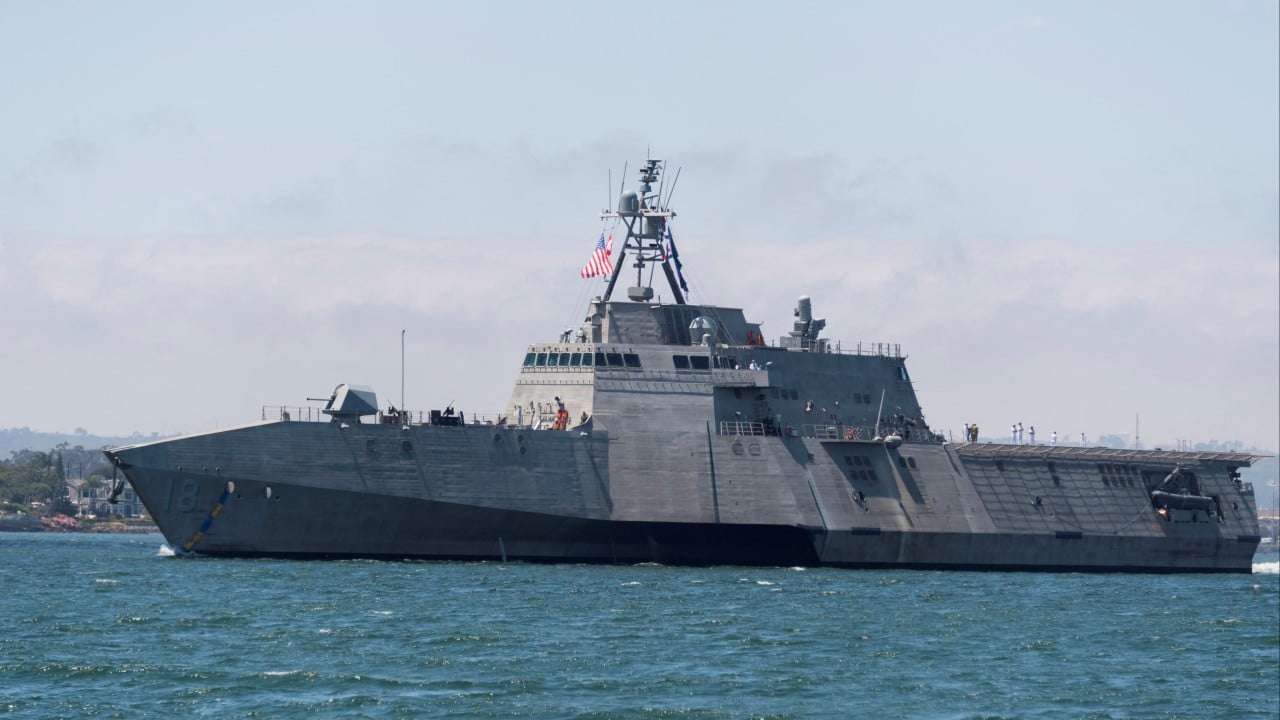
Salt crusted on the bridge windows at dawn smells like old pennies and hot metal. Out on the open water, three miles from a reef that exists mostly on paper and radar screens, a young officer lowers binoculars and exhales. Another hull is sitting off the starboard quarter, gray against gray, matching speed, matching course, waiting to see who blinks first.
To most people reading a morning wire report, a headline about the People's Liberation Army Navy following a United States patrol vessel in a South China Sea hotspot sounds like routine background noise. Two flags. Two warships. Another press release out of Beijing or Washington. Easy to swipe past while waiting for coffee.
It is not background noise. It is a test of nerve at thirty knots in water where roughly one-third of global shipping passes every year.
I have stood on cold steel decks in the middle of the night where the hum of the propulsion shafts vibrates straight through the soles of your boots into your teeth. You learn quickly out there that big geopolitics shrinks down to tiny physical details: a rudder angle that is two degrees too sharp, a radio call that goes unanswered for forty seconds, a swell that lifts a bow just enough to turn a routine shadow into a collision course. Even when nobody fires a shot, the friction wears people down.
The Quiet Choreography of a Shadow
When Beijing announces that its naval forces tracked or followed a U.S. patrol vessel in contested waters, the language is always crisp, formal, and measured. Behind that diplomatic phrasing sits a tense game of seamanship.
Think of it like two drivers tailgating each other at seventy miles an hour in dense fog, except neither car has brakes that stop on a dime and neither driver wants to look weak in front of the passengers. A warship carries thousands of tons of steel, fuel, and munitions. Stopping or turning sharply takes time and distance.
To make these stakes concrete, let us use a hypothetical scenario grounded in how surface patrols actually operate in the South China Sea. Suppose Petty Officer Maya Lin—a fictional surface warfare watchstander standing the 0000-to-0400 mid-watch aboard a U.S. patrol vessel—watches a PLA Navy frigate hold a steady parallel track less than two thousand yards away. Below her, engine-room crews monitor oil temperatures and shaft RPMs; above her, radar sweeps churn out crisp green blips. Nothing dramatic happens on screen. Yet Maya's pulse sits higher than it should because she knows how fast calm water turns messy when two crews read the same maneuver differently.
Why do these encounters keep happening in the exact same stretches of ocean? Because two rival visions of international law collide right there.
Washington frames its presence around freedom of navigation and overflight under international maritime norms, arguing that waters beyond a coastal state's twelve-nautical-mile territorial sea should remain open to lawful military transit without prior permission. Beijing asserts broad historical and maritime claims across much of the South China Sea—anchored by sweeping lines and fortified features—and treats foreign warships operating near disputed islands, reefs, or claimed zones as unwelcome intrusions that require monitoring, warning, and shadowing.
Neither side is going to wake up tomorrow and abandon its legal theory. Both governments have spent decades building military hardware, diplomatic coalitions, and domestic political expectations around their respective positions.
Why a Routine Patrol Carries So Much Weight
Confused by how a simple "following" incident can rattle markets and ministries thousands of miles away? You are in good company. Even seasoned observers sometimes miss why a non-violent shadow matters so much.
One reason is misperception. Out at sea, intent is invisible. A ship turning ten degrees to port might be avoiding a fishing trawler or catching a better angle on a swell, yet the other bridge crew can easily read that same turn as an aggressive cut-off. Add poor weather, night visibility, or language friction over bridge-to-bridge radio channels, and an ordinary maneuver starts looking like a threat.
Consider what happens next when a shadow stretches across hours or days:
- Fatigue creeps into watch teams rotating through four-hour shifts in humid tropical heat.
- Every radio exchange gets logged, translated, and analyzed by capitals half a world away.
- Political leaders feel pressure not to appear timid, while commanders on the scene try to keep things professional without surrendering freedom of action.
If we use a metaphor for how crises spiral, think of a dry forest during a late-summer drought. A single spark does not always start a wildfire; sometimes a spark lands on damp moss and dies out. The danger is that the timber is already bone-dry. Years of territorial disputes, artificial island building, coast guard standoffs, and sharp rhetoric have dried out the margin for error.
And there is a human cost that rarely makes the summary box. Sailors on both sides are young men and women away from home for months at a time, living in tight berths, eating cafeteria food, and carrying out orders set by leaders in distant capitals. Most of them do not want a war. They want to finish their patrol safely, get their mail, and go home in one piece.
What Is Actually at Stake Beneath the Surface
Strip away the press briefings and look at what sits inside and around the South China Sea. It is one of the busiest maritime arteries on Earth, linking East Asia's manufacturing hubs with energy suppliers in the Middle East and markets across the globe. When tensions flare there, shipping insurance rates, transit times, and supply-chain nerves don't stay confined to the water; they ripple into household prices and factory schedules far inland.
There is also a deeper question of precedent. If a powerful navy successfully deters foreign patrols simply by shadowing them persistently and raising the operational stress every time, that sets a quiet rule for how crowded seas are policed in the future. Conversely, if patrols continue right up to the edge of friction without clear guardrails or reliable communication channels, the odds of an accidental bump—or an escalatory spiral after a bump—remain stubbornly real.
Sometimes people ask whether hotlines and crisis-management agreements solve this. Those channels matter, and diplomats keep trying to keep lines open. Yet agreements on paper only hold up as well as the discipline of the people standing watch and the restraint of the leaders giving orders when emotions run hot.
Uncertainty is part of the story, too. Nobody outside a handful of decision-makers knows exactly where Beijing's red lines sit on any given week, or how Washington will calibrate its next patrol in response to a sharp statement from the PLA. Admitting that uncertainty isn't a weakness; it is the honest starting point for anyone trying to make sense of the region without falling for easy slogans.
Out on the bridge as dawn breaks, the sun clears the horizon and turns the wake gold for a few seconds before the glare hits the glass. The other ship is still there, gray and steady, a reminder that peace in contested waters rarely announces itself with a bang—it holds together, or frays, one watch at a time.