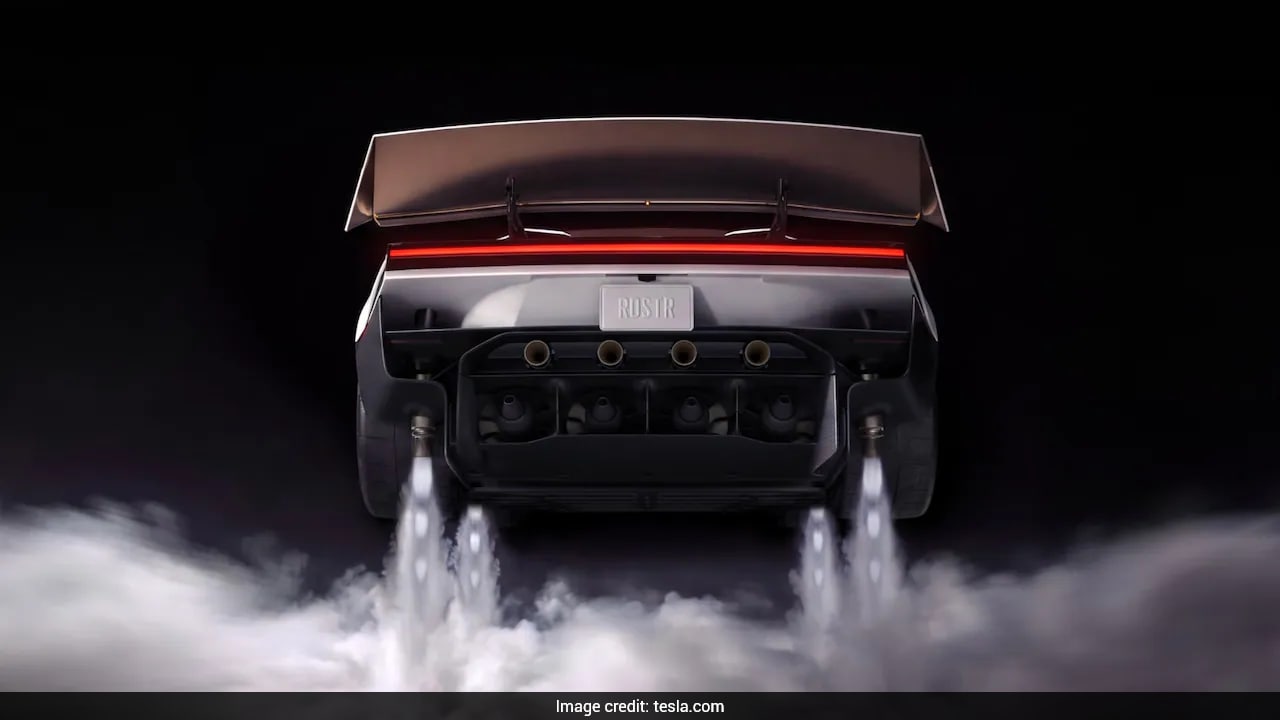
Cold air bites the knuckles on a desert proving ground just before dawn. Somewhere out past the perimeter fence, a coyote yips at the first gray smear on the horizon. You stand beside a low-slung two-seater with a battery pack humming softly beneath your boots, watching a plume of compressed gas hiss into silence while engineers check telemetry screens in the glow of coffee cups.
Nobody in the crowd believes the machine can fly. Half the room thinks it is a stunt meant to keep investors staring at the screen. The other half wonders what breaks first when an electric sports car trades rubber grip for thrust.
A car is supposed to stay on the ground. That rule is older than paved highways. It lives in our bones every time we feel tires bite into wet tar on a sharp curve, every time suspension springs compress over a pothole, every time a brake pedal shudders under a panic stop. When a headline claims a Tesla Roadster flew and landed safely, our brains reach for familiar anchors. How high did it climb? How far did it travel? What does a stunt like that cost?
Those questions are fair. They are also incomplete.
To understand why the idea of a flying or rocket-assisted Roadster pulls so hard at our curiosity, we have to separate verified engineering from bold claims, and we have to ask what happens to human beings when a machine stops obeying the road. Because the real story is not a neat table of altitudes, distances, and price tags. The real story is the quiet terror and sudden freedom of letting go of the pavement.
The Weight Of A Promise We Almost Forgot
Years ago, electric cars were treated like golf carts with ambitions. People worried about range anxiety on two-hour drives between suburbs. Charging stations were scarce, slow, and often broken. I still remember sitting in a cold parking lot in late November watching a dashboard estimate drop faster than the mileage counter climbed while the cabin heater pulled power from the pack. You learned to read the road differently when every kilowatt mattered.
Then electric performance cars changed the math on acceleration. Instant torque pinned people back into their seats and made quiet sedans outrun loud muscle cars off the line. Suddenly, speed without exhaust noise felt normal.
Once people accept silent, ferocious acceleration on asphalt, their imagination looks upward. That is where stories about a next-generation Tesla Roadster—and whispers of cold-gas thrusters or suborbital hops—take root. In public discussion, two very different ideas often get tangled together. One is a high-performance electric roadster engineered for extreme acceleration and top speed on earth. The other is the much bigger vision of point-to-point rocket transport or thruster-augmented flight, where vehicles hop across continents or briefly leave the ground before settling back down.
Honesty matters right here. If a claim cannot be verified in public flight records or production specifications, treating it like a routine commuter flight misleads you. At the same time, dismissing the physics behind thrust, lift, and controlled descent misses why engineers even sketch these ideas on whiteboards.
A machine that leaves the ground does not just change its altitude. It changes what happens when something goes wrong.
On a road, when a tire blows or a control arm snaps, gravity already has the car. Skid marks tell the story. Guardrails catch what tires cannot. In the air, gravity is waiting with a much longer drop, and "landing safely" depends on thrust vectoring, attitude control, structural margins, and split-second software decisions that leave zero room for guesswork.
How High, How Far, And What Physics Demands
When readers ask how high a flying Roadster goes and how far it travels, they are usually picturing a sports car popping into the sky like a movie prop or blasting across an ocean like a jet. Real physics is less theatrical and far stricter.
Consider a hypothetical scenario to feel the difference between a short hop and true distance. Suppose an experimental testbed uses cold-gas thrusters to lift just a few dozen feet off a test pad, hover over a wide apron, and settle back onto landing pads. That kind of low-altitude, short-range test is about stability, balance, and thrust control—not commuting from city to city. It proves whether a heavy, uneven object like a car chassis can hold itself level without wings.
Now push the thought further. What would it take to go genuinely far—say, hundreds or thousands of miles?
To travel far in the air or near space, a vehicle needs one of two things: continuous aerodynamic lift from wings moving through air, or enough speed and propellant to arc high above dense atmosphere and come back down on target. A car body is shaped to slice air cleanly at highway or track speeds, not to generate sustained lift at low speeds like an airplane wing. Without wings, staying aloft takes raw thrust. And raw thrust eats mass fast.
Propellant is heavy. Tanks are heavy. Reinforcement around thruster mounts is heavy. Add weight to a vehicle, and you need more thrust to lift it. Add more thrust, and you need more propellant. Engineers call this the tyranny of mass ratios, and it shows up everywhere from small drones to orbital rockets. Even a short vertical hop requires carefully metered impulse; stretching distance across a country multiplies energy demands dramatically.
Altitude brings its own trade-offs. Climbing higher thins the air, which reduces aerodynamic drag on long-range trajectories, yet thin air also means control surfaces like flaps or rudders lose bite. At low altitude, air is thick and responsive, but drag climbs quickly with speed and obstacles are everywhere.
That is why questions about "how high" and "how far" are really questions about energy budgets and mission profiles. A brief hover or short hop tests control loops and structural stress. Long-distance point-to-point flight is an entirely different class of engineering that looks much closer to rocketry and aerospace operations than to building an automobile.
Inside The Mind Of Someone Watching The Test
Meet Maya, a hypothetical character who works as a flight-test instrumentation engineer on demanding aerospace programs. She is not there for press releases. She is there because every sensor channel on a test vehicle tells a truth that speeches cannot hide.
On test mornings, Maya's hands stay busy before her mind can wander. She checks pressure transducers, vibration limits, battery temperatures, and abort thresholds. When a test vehicle lifts even a few feet, her eyes flick across numbers rather than the horizon. A tilt of two degrees that looks tiny from a lawn chair can mean a lateral drift that strains a landing strut.
What scares engineers like Maya is rarely the dramatic explosion people picture in movies. It is the quiet creeping error: a valve sticking by ten milliseconds, a sensor reading noisy data under vibration, a battery cell heating faster than expected under high discharge.
I have stood in control rooms and test bays where the hardest part of the day was saying no. Saying no when the weather is almost good enough. Saying no when the data is ninety percent clean instead of one hundred percent. Safety in experimental flight is built out of boring discipline long before a vehicle ever leaves the ground.
And when a test vehicle does rise, hold steady, and touch down cleanly without scraping metal or tipping wide, the relief in the room is physical. Shoulders drop. Coffee gets drunk cold. Nobody cheers like a stadium crowd at first; everyone checks the post-flight logs to see if the machine behaved the way the math predicted.
What Does It Actually Cost?
"What's the cost?" sounds like a single number on a price tag. In reality, cost splits into three distinct buckets, and mixing them up causes endless confusion.
- Sticker price versus development cost: A production sports car has a retail price shaped by manufacturing scale, features, and market positioning. An experimental prototype or flight-capable test article has a development cost shaped by custom parts, engineering hours, testing facilities, insurance, and regulatory oversight. Calling a prototype's price tag a consumer car price—or pretending a consumer car price covers aerospace-grade flight hardware—distorts the whole picture.
- Operating and infrastructure cost: Even if a vehicle can fly or hop, operating it safely is expensive. Flight vehicles need pre-flight inspections, specialized maintenance, trained operators or pilots, dedicated takeoff and landing zones, and strict safety perimeters. A car can park in a driveway. A flying or rocket-assisted machine cannot casually pull up to a crowded grocery store.
- The hidden human and regulatory cost: Noise, blast overpressure, airspace rules, and public trust all carry real weight. Imagine living three blocks from a test pad where loud thrusters fire before sunrise. Even if every landing is spotless, community acceptance and airspace clearance take years of painstaking work and legal compliance.
When someone asks what it costs, the honest answer is that money is only the visible layer. Time, engineering rigor, regulatory approval, and public safety sit right underneath it.
Why We Care So Much About A Car Leaving The Ground
Step back from the hardware for a moment and ask a stranger why this story sparks arguments at dinner tables. Almost nobody actually expects to commute to work inside a rocket-powered sports car next Tuesday.
Yet the image hits a nerve. It touches our old dream of escaping traffic, borders, and limits. For more than a century, the automobile promised personal freedom—the key in your pocket, the open road ahead, no timetable but your own. Over time, congestion, speed limits, and routine replaced that early thrill with bumper-to-bumper fatigue.
So when a car story hints at flight or suborbital leaps, it feels like a rebellion against gridlock and gravity at once. It reminds us how fast our sense of the possible can shift when engineers refuse to take "that's just how cars work" as the final word.
At the same time, healthy skepticism protects us. Sensational headlines love certainty where real engineering has nuance. Knowing the difference between a concept, a controlled test, and everyday transportation keeps us grounded without killing our curiosity. We do not have to choose between gullibility and cynicism. We can pay attention, ask sharp questions, and respect the physics.
Out past the desert fence, the sun clears the ridge and warms the metal on the hood. A breeze carries the smell of dry sage and ozone across the concrete pad. If the machine rises into clear air and settles back onto its pads without a scratch, the triumph is not magic—it is math, patience, and nerve holding together under pressure.
Watch the ground when it touches down, not just the sky when it climbs; the real measure of any leap is how gently you can return to earth.