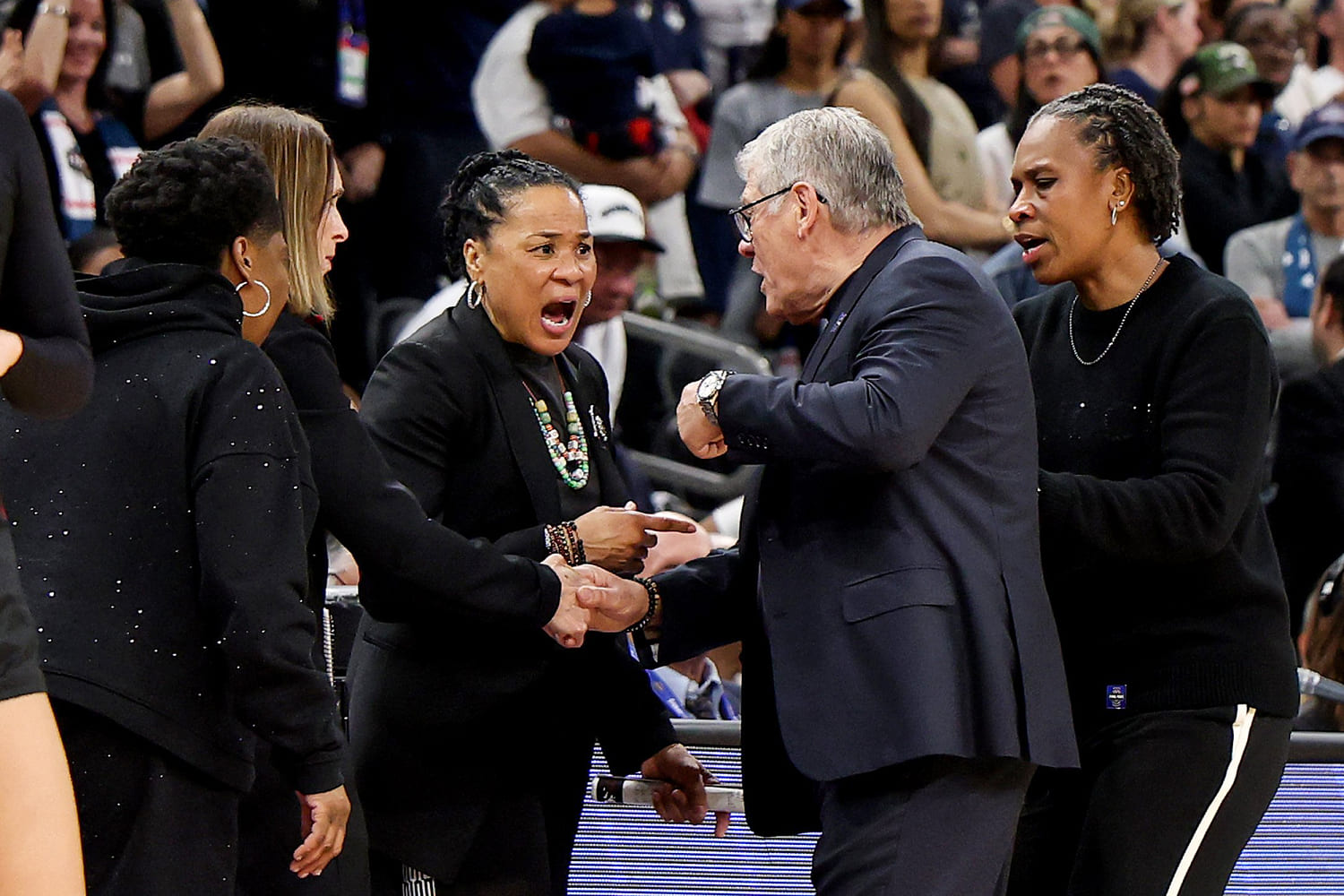
The air inside a Final Four arena doesn't circulate like normal air. It is heavy, thick with the evaporated sweat of a hundred practices and the suffocating pressure of a million eyes. When the buzzer sounds, that air usually rushes out in a gasp of relief or a scream of triumph. But when Geno Auriemma and Dawn Staley met at mid-court after their collision in the national semifinals, the air stayed trapped. It felt jagged.
Basketball at this level is a contact sport, and not just between the players on the hardwood. It is a contact sport between legacies.
On one side, you have the architect. Geno Auriemma didn't just build a program at UConn; he built a standard that for decades felt like an unscalable wall. On the other, you have the challenger who became the peer. Dawn Staley didn't just rebuild South Carolina; she turned it into a cultural force that redefined what dominance looks like in the modern era. When these two worlds hit each other, the sparks were never going to be polite.
The friction started long before the apology. It was baked into the way their teams played—physical, unapologetic, and relentless. To understand the "dustup," you have to understand the specific brand of tension that exists when the old guard realizes the new guard isn't just knocking at the door, but has already changed the locks.
The Anatomy of a Sideline Fever
During the heat of the game, words were exchanged. Not the kind of words you use at a post-game presser, but the sharp, instinctive barbs that fly when your heart rate is 160 beats per minute and your season is dissolving or crystallizing in real-time. Auriemma had made comments regarding South Carolina's style of play, suggesting a level of physicality that leaned toward the "illegal." Staley, never one to let a slight against her players go unanswered, fired back.
It wasn't just about a foul call. It was about respect.
Imagine two master painters sharing a single canvas, each trying to drown out the other's colors. Geno’s UConn has always been about precision, a clinical and beautiful execution of basketball fundamentals. Staley’s South Carolina is a tidal wave—physical, athletic, and psychologically indomitable. When Geno suggested the Gamecocks played "bully ball," he wasn't just critiquing a strategy. He was poking a nerve in a sport that has historically used words like "physical" as a coded way to diminish the skill of certain athletes.
Staley felt that. She heard the subtext. And she stood her ground.
The Weight of the Words
The apology came later, after the adrenaline had retreated and the cold reality of the scoreboard had settled in. Geno reached out. He admitted he had crossed a line. He acknowledged that his comments had painted a picture of the South Carolina program that was unfair.
But an apology in the high-stakes theater of NCAA basketball is rarely just about saying "I'm sorry." It is an admission of a shift in the tectonic plates.
For Geno Auriemma to apologize to Dawn Staley is a signal. It is a rare moment of vulnerability from a man whose career has been defined by a certain untouchable swagger. It was a realization that the narrative had moved past him. You don't apologize to someone you don't view as an equal. You apologize to the person who has earned the right to hold you accountable.
Consider the optics of that phone call. Two of the greatest minds to ever whistle a play, sitting in the quiet of their respective offices, peeling back the layers of a public spat. It is the human side of the machine. We see the suits, the shouting, and the technical fouls, but we rarely see the moment a legend realizes they were wrong.
Geno’s move was necessary. Not just for his own image, but for the health of the game. When the most successful coach in history disparages the rising powerhouse, it creates a rift that fans and media are all too happy to widen into a canyon. By closing that gap, he didn't just settle a "dustup"—he validated the evolution of the sport.
Beyond the Box Score
The invisible stakes here weren't about a single win or loss. They were about the soul of women’s basketball. The game is currently in a state of explosive, beautiful volatility. Ratings are through the roof. Stars like Caitlin Clark and Angel Reese have turned the sport into a national obsession. But at the center of that whirlwind are the coaches who have to manage the fire.
If the leaders of the sport are at war, the sport suffers. If they can find a way to clash, bleed, and then shake hands with genuine contrition, the sport grows.
The "physicality" Geno complained about is actually the new baseline. The game has changed. It’s faster, harder, and more punishing than it was in the nineties or even the early 2010s. South Carolina didn't win because they were "bullies"; they won because they were the ultimate evolution of what a basketball team can be. Geno’s apology was, in many ways, an acceptance of this new reality.
It was a white flag raised not in defeat, but in recognition.
The Echo in the Hallway
Critics will say the apology was a PR move. They’ll argue that Geno was simply trying to get the heat off his back after a disappointing finish. But those people haven't stood on a sideline. They don't know what it’s like to have your identity tied to the performance of twenty-year-olds in front of twenty thousand screaming fans.
The emotions are raw. The mistakes are public.
When Dawn Staley accepted that apology, she did so from a position of absolute strength. She didn't need his validation, but she accepted his respect. That is the hallmark of the current era: the old giants are still standing, but they are no longer the only ones in the room. They are sharing the space with a new breed of excellence that refuses to be sidelined or characterized by outdated tropes.
The "dustup" is over. The headlines have faded. But the impact of that moment remains. It serves as a reminder that even in the most competitive environments on earth, there is room for the messy, complicated process of being human.
We want our heroes to be perfect, but they are often just people trying to make sense of a world that is moving faster than they expected. Geno Auriemma blinked. Dawn Staley didn't. In that exchange, we saw the passing of a torch that neither of them probably wanted to let go of, but both knew had already moved.
The court is clean now. The fans are gone. The lights are off. But somewhere in the silence of that arena, the echoes of those sharp words and the following quiet apology still hang in the rafters, a permanent part of the game's long, evolving story.
Basketball is a game of runs. Eventually, everyone has to learn how to play from behind. For the first time in a long time, the architect had to find a way to bridge the gap he created. He did it with a phone call. She answered. The game moved on, heavier and more honest than it was before the whistle blew.