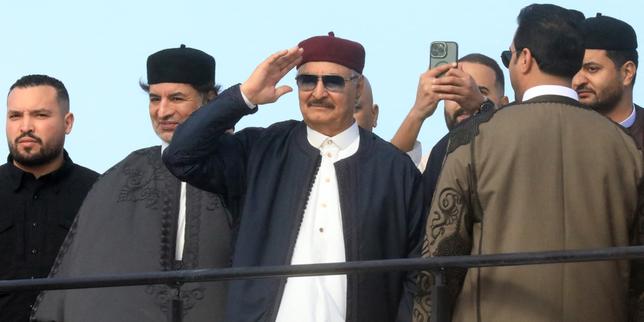
Khalifa Haftar sits atop a crumbling throne in Benghazi, his once-absolute grip on the Cyrenaica region slipping as the internal friction between his sons turns into a public liability. The recent assassination of his military intelligence chief, Fauzi Al-Mansouri, acts as a grim bellwether for a regime struggling to maintain the illusion of order. While the world watches the grand geopolitical chess game involving Moscow, Ankara, and Washington, the real story unfolds in the quiet, lethal competition between Saddam and Khaled Haftar. This isn't just a matter of inheritance; it is a structural failure of a clan that mistook the accumulation of offices for the consolidation of power.
The marshal’s strategy has always been one of maximalist control. By installing his children into every critical artery of the state—Saddam in the military and security apparatus, Khaled managing tactical units, and Belqasim overseeing the vast financial flows of reconstruction—Haftar created a system designed to be immune to external subversion. Yet, this very architecture has become a magnet for internal decay. When power is treated as an heirloom, the heirs invariably start measuring the distance between their current influence and their ultimate objective. The vacuum left by the marshal’s advanced age is already being filled by the clashing ambitions of those who believe they are the rightful, or perhaps more capable, successor.
The assassination of Al-Mansouri within the perceived safety of Benghazi exposes a terrifying reality for the Haftar inner circle. It suggests that their security apparatus is porous, potentially compromised by the very rivalries that weaken the regime from within. In a society where tribal loyalties and military allegiances are easily traded for economic opportunity, the Haftar sons have created a fragile, transaction-based empire. They rely on the ability to pay, to fund, and to promise, but they lack the organic legitimacy that once allowed their father to project strength across the desert.
Consider a hypothetical scenario where one son attempts to secure a separate line of credit with a foreign power—perhaps a new energy deal or a security partnership. This move would fundamentally undermine the other brothers, who see such resources as their own domain. This is not merely an exercise in sibling rivalry; it is the breakdown of a command structure that requires total unity to survive. If the brothers begin to prioritize their own survival and wealth over the stability of the Libyan National Army, the entire architecture of the East will begin to dissolve long before the father departs the scene.
The international community, particularly the current push from Washington for a unified Libyan executive, misunderstands the nature of this beast. The plan to merge the eastern and western administrations fails to account for the fact that the eastern administration is no longer a monolith. It is a cluster of competing interests centered on specific individuals who are increasingly desperate to protect their own fiefdoms. Treating them as a single negotiating partner is a strategic error that ignores the reality on the ground. When the central authority is actually a shell covering a deep, internal power struggle, the search for a unified government becomes an exercise in rearranging deck chairs on a sinking ship.
Financial control is the true pivot point of this struggle. Belqasim’s management of the reconstruction funds provides him with a level of autonomy that makes him a rival to his own brother, Saddam, who commands the military muscle. Money flows are being diverted to shore up local loyalties, ensuring that in any eventual showdown, the brothers have their own private armies of supporters. This shift from national control to hyper-local patronage confirms that the Haftar era is shifting from a centralized military dictatorship into something far more chaotic.
The external backers of the marshal—most notably Russia—are likely adjusting their own strategies to account for the inevitable succession fallout. A regime that is cannibalizing itself from within is a poor long-term investment. Moscow understands that while the Haftar brand has utility, the brand itself is currently being diluted by the incompetence and greed of the next generation. We are observing the late-stage degradation of a movement that spent a decade trying to build an institution, only to find that it could only build a family business.
The assassination of key security figures is unlikely to be the last tremor. As the brothers perceive the end of the marshal’s effective rule, the pace of these "security incidents" will almost certainly increase. They are not just fighting for a throne; they are fighting to ensure they are the ones holding the keys to the vaults when the final collapse occurs. The transition, if it can be called that, will not be a peaceful handover of power. It will be a brutal pruning of branches to see which one remains standing.
Stability in the East is a myth maintained by those who profit from the status quo. The reality is a precarious, violent drift toward a fragmented future. Whether this results in a full-scale conflict between the brothers or a slow, silent stripping of assets, the end result is the same. The concentration of power into a single family line has provided the very conditions for the total collapse of that same line. When the history of this era is written, it will not be remembered for the marshal’s ambitions, but for the devastating cost of his attempt to defy the natural attrition of power.
The security apparatus that once terrified opponents is now a mirror reflecting the insecurities of a family that has outstayed its own survival. Every new appointment, every new promotion of a son to a higher rank, only accelerates the inevitable friction. They are not cementing their future. They are signing their own death warrants. History has shown time and again that when a ruler tries to manufacture a dynasty in a region defined by shifting sands, the desert eventually claims everything. The Haftar family is merely waiting for the wind to shift.