Most modern high-density housing developments feel less like homes and more like filing cabinets for humans. You know the look. Endless rows of identical concrete towers, casting massive shadows on the streets below, completely cutting off the city from whatever natural beauty happens to lie nearby. It is a depressing, soul-crushing formula that developers repeat worldwide because it is cheap and easy.
But it does not have to be that way.
In the coastal city of Qinhuangdao, China, located about 200 miles east of Beijing, an architectural experiment has quietly shattered the standard high-rise playbook. Designed by Israeli-American architect Moshe Safdie and developed by Kerry Properties, Habitat Qinhuangdao (originally known as Golden Dream Bay) tackles a seemingly impossible problem. How do you cram thousands of residential units onto a beachfront site while giving everyone a private garden, wide-open views, and direct sunlight?
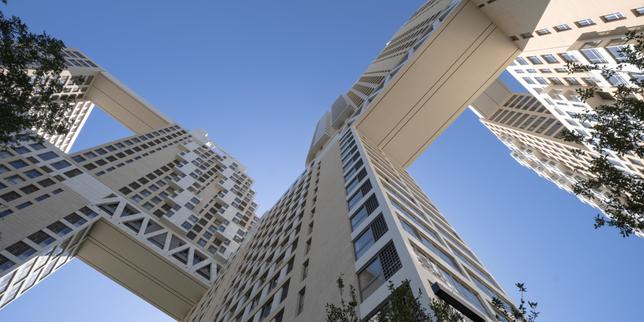
The answer is a massive, stepped, porous mountain of architecture that looks less like a traditional skyscraper and more like a futuristic pixelated cliffside. Safdie did not just build another apartment complex. He proved that urban density and high quality of life do not have to be mutually exclusive.
The Evolution of For Everyone a Garden
To understand why Habitat Qinhuangdao matters today, you have to look back to 1967. A young Moshe Safdie shocked the architectural world with Habitat 67 in Montreal, a modular complex of prefabricated concrete boxes that stacked together to ensure every single unit had its own private rooftop terrace. It was a brilliant statement against the monotony of suburban sprawl and dense urban blocks. The core mantra was simple: for everyone a garden.
The problem with Habitat 67 was that it was expensive and difficult to replicate. For decades, critics dismissed it as a beautiful, utopian one-off.
Habitat Qinhuangdao is the realization of that 1967 dream on a massive scale. Phase I opened in 2017, and Phase II wrapped up recently, doubling the size of the initial project to bring the total to around 2,500 residential units spread over 4.8 million square feet. Instead of a Wall of Towers that isolates the city from the Bohai Sea, Safdie Architects arranged the complex into individual 15-story to 16-story slab blocks that stack vertically in two tiers, rising to a total height of 30 stories.
By staggering these blocks and joining them corner-to-corner, the design creates massive "urban windows." These gigantic voids in the building structure let the city breathe. They preserve view corridors from the inland urban areas to the coast, ensuring the complex does not become a privatized barrier that hogs the ocean view.
Engineering the Solstice
Architects love to talk about light and air, but local zoning laws in China force them to back up those poetic ideas with hard numbers. In Qinhuangdao, strict local ordinances dictate that every single residential unit must receive a specific amount of direct, natural sunlight daily, measured at the absolute lowest point of the winter solstice.
Think about that challenge for a second. When you build a standard wall of high-rises, the southern towers inevitably cast massive, permanent winter shadows over everything behind them.
Safdie solved this through rigorous geometric orientation. By aligning the structural blocks on a precise north-south axis and stepping the profiles downward toward the sea, the architecture acts as a massive sun-catcher. As the sun moves low across the winter sky, light pours through the urban windows and angles across the stepped terraces.
Because the units offset from one another, the roof of one apartment becomes the private terrace or solarium of the unit above it. Partner-in-charge Sean Scensor noted that this layout essentially makes a huge percentage of the standard apartments feel like penthouses. You get the security and efficiency of high-density living, but when you step outside, you feel like you are floating in the sky.
The Three Dimensional Community
A common failure of mega-scale residential projects is the total death of street life. You ride an elevator from your dark hallway down to a dark parking garage, drive away, and never interact with your neighbors. Safdie avoids this by treating circulation as a public space.
Habitat Qinhuangdao features an elaborate, multi-level pedestrian system that turns the entire complex into a three-dimensional neighborhood.
- The Ground Level: A fully landscaped park system featuring interactive children's playgrounds, an amphitheater, planted promenades, and an interconnected network of streams, ponds, and fountains.
- The 15th Floor Skyway: A massive community thoroughfare that links the building blocks midway up the structure. Residents can jog, walk, or chat while completely surrounded by greenery, suspended hundreds of feet in the air with panoramic views of both the city and the ocean.
- The Link Bridges: High-altitude skybridges at the upper tiers that house unique apartment layouts, topped with communal garden spaces and swimming pools.
To tie the complex back into the larger city, the master plan relies on two distinct axes. A north-south beachfront boardwalk anchors the waterfront side, while an east-west bazaar-like retail spine cuts directly through the project. This configuration draws people from surrounding neighborhoods through the complex and down to the beach, ensuring the site remains a vibrant, public destination rather than a gated enclave for the wealthy.
Conventional Bones, Unconventional Geometry
It is easy to sketch a futuristic city on a iPad. It is an entirely different thing to build it within the brutal constraints of real estate economics. If a building is too complex to construct, developers will abandon it immediately.
While Habitat Qinhuangdao looks wildly unconventional from the outside, its skeleton relies on highly rational, conventional geometry. Safdie Architects did not use wildly expensive, experimental materials or impossible cantilever engineering. The complex uses standard concrete construction and highly efficient, vertical service cores. The magic lies entirely in how those standard blocks are arranged, rotated, and stacked.
This is the lesson global developers need to learn. You do not need an infinite budget to build human-centric housing. You just need to stop relying on lazy, rectangular grid layouts that maximize developer profit at the expense of human sanity.
Your Next Steps in Urban Design Thinking
If you are an urban planner, developer, or just someone who cares about the future of our cities, you cannot treat projects like Habitat Qinhuangdao as mere architectural novelties. They are blueprints for survival in an increasingly crowded world.
If you want to move away from soul-crushing tower designs in your own local community or next project, start by changing how you evaluate density.
First, stop measuring density purely by Floor Area Ratio (FAR) or units per acre on a flat plane. Start analyzing the volumetric efficiency of your site. Look at how stacking blocks diagonally or corner-to-corner can unlock open space without sacrificing total square footage.
Second, audit your local sunlight and wind patterns using modern microclimate simulation tools. Do not just design a building envelope and hope for the best. Use the solar angles of the winter solstice to carve out terraces, courtyards, and urban windows that pull natural light deep into the site.
Third, eliminate the traditional divide between structural circulation and community space. Look at your hallways, fire stairs, and elevator lobbies. Find ways to push them outward, open them up to fresh air, and connect them with shared terraces or skybridges. Turn the act of moving through a building into an opportunity for human connection.
Our cities are only getting denser. The choice we face is whether that density will take the form of suffocating concrete walls or porous, sun-drenched gardens in the sky. Safdie showed us the path forward in China. The rest of the world needs to start paying attention.