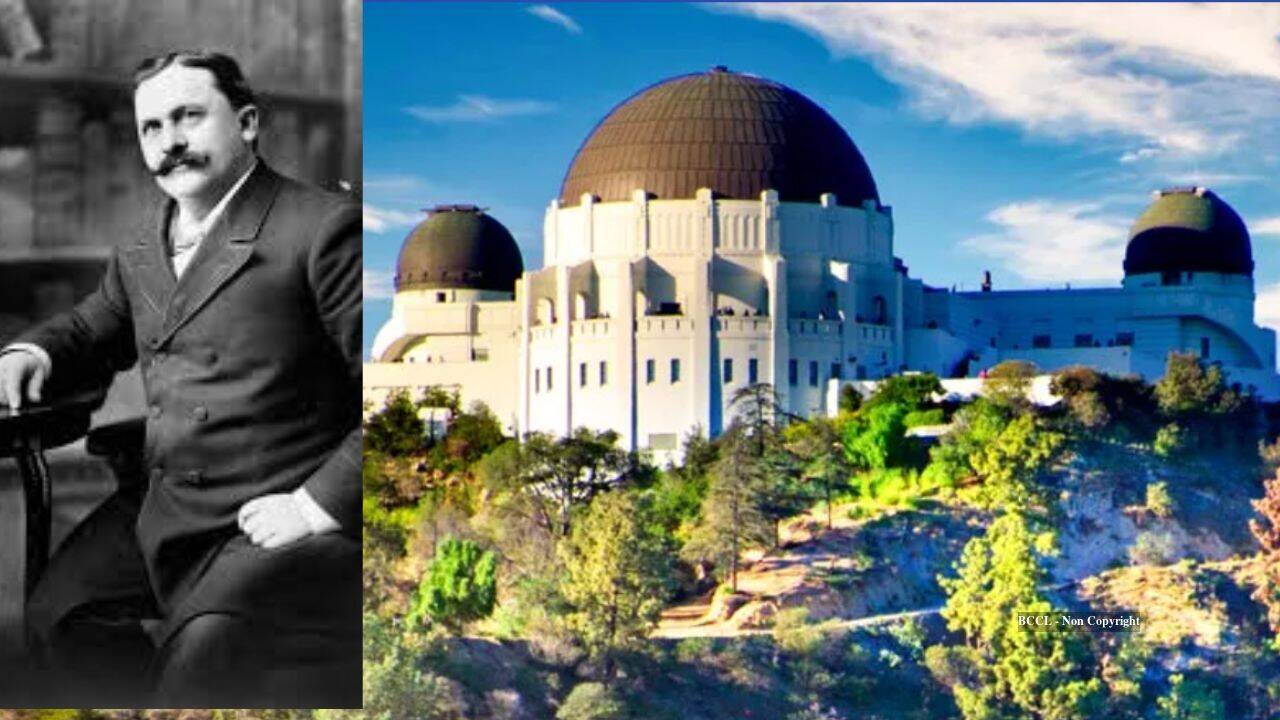
History loves a saint. We look at Griffith J. Griffith handing over three thousand acres of Los Angeles real estate to the public in 1896 and we melt. The narrative writes itself: a wealthy industrialist, plagued by personal demons and a brush with attempted murder, decides to cleanse his soul by gifting a massive urban wilderness to the citizens of Los Angeles.
It is a comforting bedtime story. It is also entirely backward.
Let us stop pretending that G.J. Griffith was a civic-minded altruist acting out of pure municipal love. Look at the mechanics of what actually happened. A mining speculator bought a massive chunk of Rancho Los Feliz for a song, held it while infrastructure caught up, and then dumped a piece of it on the city when keeping it became an expensive tax liability that failed to yield immediate extraction value. The public swooned then, and urban historians swoon now, swallowing the PR spin hook, line, and sinker.
I have spent two decades watching developers and high-net-worth operators unload stranded assets onto municipalities under the guise of public generosity. The playbook has not changed in a hundred and thirty years. You buy cheap scrubland on the periphery of a burgeoning metropolis. You lobby for the city to run roads, water, and power lines out that way. You monetize the prime parcels closest to the urban core. And when you are left with the steep, rugged, fire-prone canyons that cost a fortune to grade and defend, you hand them to the taxpayers, collect a massive tax write-off, and etch your name in bronze at the park entrance.
Generosity is rarely free. In real estate, it is simply the final exit strategy of a smart investor.
The Myth of the Unselfish Land Baron
The standard telling of the Griffith Park origin story paints the donation as an act of sudden contrition. In 1903, Griffith shot his wife in a drunken delusion at a Santa Monica hotel, spent a couple of years in San Quentin, and came out a broken man trying to buy back his reputation. But let us look at the timeline. The initial land transfer for the park happened in December 1896. He did not shoot his wife until years later.
The donation was not a post-prison spiritual awakening. It was a calculated business move executed by a man who understood how to extract maximum value from municipal expansion.
Griffith owned the Griffith Ranch, part of the old Spanish land grant. He operated an ostrich farm there for a hot minute, tried various agricultural plays, and watched Los Angeles sprawl northward. But holding thousands of acres of steep, mountainous terrain in the Santa Monica Mountains is an expensive hobby. You pay property taxes. You pay for fire management. You deal with squatters and erosion.
By deeding the rougher acreage to the city, Griffith achieved three things instantly:
- He dumped a massive holding cost onto city taxpayers.
- He exponentially increased the valuation of the adjacent land he still controlled.
- He bought bulletproof political capital in city hall that protected his remaining commercial interests for decades.
This is the dirty secret of urban philanthropy. When a billionaire hands a city a chunk of land, check to see what they own across the street. In almost every historical instance, the land retained by the donor spikes in value because the city now maintains a permanent, beautiful amenity right next door. The public pays to landscape and patrol the park, while the private landowner reaps the capital gains.
The Economics of Scrubland
Let us examine the raw economics of late nineteenth-century Los Angeles real estate. Land was cheap if you bought early enough, but liquidity was a constant problem. You could sit on desert scrub and rolling hills forever, waiting for the population to boom, but cash flow does not come from dirt alone.
Griffith made his initial fortune through mining syndicates and real estate speculation in the boom of the 1880s. When that bubble burst, land values stagnated. If you are holding thousands of acres of Rancho Los Feliz in the 1890s, you are staring down a deflationary spiral. You cannot farm it efficiently. You cannot easily subdivide the steep canyons without millions in grading capital that simply did not exist at scale back then.
What do you do? You create a civic legacy.
Imagine a scenario where a modern tech founder buys fifty thousand acres of arid land outside a major Sunbelt city for twenty dollars an acre, lobbies the county board of supervisors to approve a massive highway expansion nearby, and then gifts the steepest fifteen thousand acres to the municipality in exchange for zoning variances to build high-density luxury towers on the remaining perimeter. We would call that what it is: a masterclass in lobbying and asset recycling.
Swap out the tech founder for a Victorian-era Welsh immigrant with a mustache and an inflated military title, and suddenly we call it a romantic gift to the people.
The mechanics are identical. Griffith was playing three-dimensional chess while the city council was playing checkers. He kept the flat, accessible land along the Los Angeles River and the transit corridors for future commercial and residential exploitation, and he gifted the vertical topography—the parts that would cost a fortune to flatten—to a municipal government desperate for green space.
Why We Fall for the Noble Pioneer Trope
Humans are wired for simple narratives. We want our villains to wear black hats and our benefactors to be selfless saints. The idea that a hard-nosed speculator engineered a brilliant land swap with the municipal government lacks the emotional resonance of a tortured soul finding redemption through nature.
So the myth persists. Tour guides tell you about his vision. Textbooks celebrate his generosity. Nobody talks about the tax mechanics, the capitalization rates, or the adjacent property holdings.
This lazy consensus infects modern urban planning just as badly. Whenever a modern developer slaps a public plaza in the middle of a sterile glass-and-steel mixed-use development, urbanists faint with joy over the "activation of public space." They write glowing profiles about how the developer "gave back" to the community.
Give me a break.
That public plaza is not a gift. It is a floor-area-ratio bonus generator. The developer surrendered two percent of the ground footprint to concrete and a few olive trees in exchange for the legal right to build four extra stories of luxury penthouses into the sky. It is a transaction. A cold, calculated financial trade disguised as civic grace.
When you understand that property development is always a transaction, you stop falling for the marketing. You start asking the right questions.
People Also Ask
Was Griffith J. Griffith a hero or a villain?
Neither. He was a ruthless, ambitious opportunist operating within a corrupt and chaotic frontier economy. Reducing historical figures to binary moral categories is a lazy substitute for critical thinking. He built an empire, made terrible personal choices, and executed a brilliant real estate maneuver that happened to leave behind a great public recreation area. Both things can be true at once.
Did Griffith Park cost Los Angeles taxpayers money?
It has cost billions over the past century. Maintaining thousands of acres of rugged chaparral, fighting seasonal wildfires, paving roads, installing water lines, building the observatory, and policing the grounds requires a massive, ongoing public subsidy. The land was free; the maintenance is an infinite money pit. That is the genius of the donation—the city inherited a permanent operating expense while the original owner's estate walked away clean.
Can modern cities replicate the Griffith Park model today?
No, because modern municipalities are financially sophisticated enough to spot the trap. Today, when developers offer land to cities, municipal risk analysts run the long-term infrastructure and maintenance liabilities through a discount model. Cities are increasingly rejecting gifts of undevelopable slope-failure zones because the maintenance costs dwarf the recreational value.
The Uncomfortable Truth About Urban Green Space
We treat urban parks as sacred, untouched altars of democracy. We pretend they exist outside the brutal laws of capital accumulation.
They do not.
Every square foot of green space in a major metropolis is a battleground of economic interests. Griffith Park became what it is because it served as a pressure valve for a growing industrial city and a financial anchor for adjacent real estate speculation. It is a masterpiece of land economics, not a miracle of charity.
Next time you hike up to the observatory and gaze out over the sprawling basin of Los Angeles, stop romanticizing the nineteenth-century baron who handed over the hills. Look at the perimeter. Look at who owns the flats below. Look at where the money went.
The park was never about the public good. It was about the ultimate ROI.