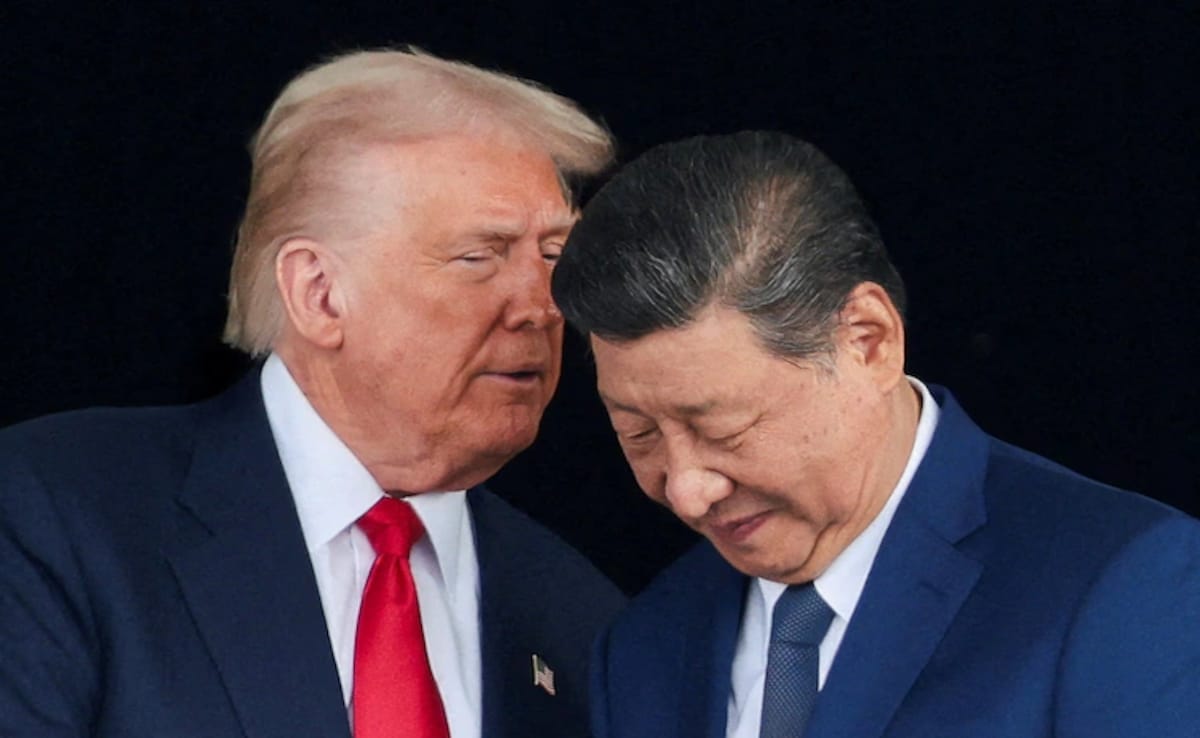
The financial press loves a predictable ghost story. They want you to believe that a sit-down between Trump and Xi regarding Iran and oil sanctions is a clash of civilizations—a high-stakes poker game where one man’s gain is the other’s ruin. They focus on the "war" in Iran as if it were a localized geopolitical fuse. They are wrong.
The reality is far more cynical and much more profitable for those who can see through the smoke. Trump and Xi aren't enemies in the energy theater; they are unintentional co-conspirators in a global price-fixing scheme that has nothing to do with "energy independence" and everything to do with managing the decline of traditional crude.
The Myth of the "Iran Wildcard"
Most analysts treat Iran like a volatile variable that could explode and send oil to $150 a barrel. I’ve sat in rooms with hedge fund managers who sweat through their shirts every time a drone flies over the Strait of Hormuz. They’re missing the forest for the trees.
Iran is not a wildcard. It is a release valve.
When the "mainstream" media talks about Trump tightening sanctions, they ignore the fact that China is the primary buyer of "teased" Iranian barrels. China isn't "defying" the U.S. out of spite; they are providing a necessary floor for the market. If Iranian oil truly hit zero, the shock to the global supply chain would trigger a recession that would torch Trump’s domestic approval ratings. He knows this. Xi knows this.
The sanctions are theater. They exist to maintain the USD’s hegemony in oil pricing (the petrodollar) while allowing China to buy discounted energy that keeps their manufacturing engine from seizing up. It’s a symbiotic relationship masquerading as a trade war.
China’s False Hunger for Oil
Every "expert" article starts with the premise that China is desperate for oil. This is a fundamental misunderstanding of Beijing’s long-term play.
China is currently the world leader in "electrification of everything" not because they want to save the polar bears, but because they want to destroy the strategic leverage of the U.S. Navy. If your economy runs on sunlight and lithium—which you control—the US Fifth Fleet’s presence in the Persian Gulf becomes a massive, expensive irrelevance.
[Image of global lithium reserves map]
While Trump talks about "drill, baby, drill," Xi is building a world where drilling is a legacy cost. When they meet, they aren't debating how much oil China will buy; they are negotiating the speed of the transition. Trump wants to keep the oil flowing to protect the incumbent energy giants who fund the GOP. Xi wants to buy just enough oil to keep the lights on while he finishes building the "Great Green Wall" of solar and wind infrastructure.
The Invisible Math of Sanctions
Let's look at the actual numbers that the "lazy consensus" ignores. In any given month, "ghost tankers" move hundreds of thousands of barrels of Iranian crude under various flags.
$P_{actual} = P_{brent} - D_{sanction}$
In this equation, $P_{actual}$ is what China pays, and $D_{sanction}$ is the "risk discount." This discount is effectively a tax paid by Iran to China for the privilege of circumventing U.S. policy. Trump’s aggressive rhetoric actually increases this discount, making energy cheaper for Xi.
Why would Trump do this? Because it forces Iran to the brink without actually removing their supply from the global total. It’s a controlled burn. If you actually wanted to stop Iranian oil, you wouldn't sanction the tankers; you would sink them. Nobody wants that, because the resulting $12-per-gallon gas in Ohio would end any American presidency in weeks.
The Tech-Energy Convergence Failure
The biggest blind spot in the current discourse is the failure to realize that energy policy is now technology policy. The "energy crisis" isn't about lack of fuel; it's about the lack of efficient storage and distribution.
Trump and Xi’s talks will likely touch on AI—specifically how AI-managed grids can optimize energy consumption. The "hidden" agenda is the decoupling of GDP from oil barrels. For the last 50 years, if you wanted 3% GDP growth, you needed a corresponding increase in energy input. That correlation is breaking.
- The US Play: Using AI to squeeze every last drop out of Permian shale through hydraulic fracturing optimization.
- The China Play: Using AI to balance a massive, volatile renewable grid that makes oil obsolete for base-load power.
The "conflict" is just a disagreement over which technology wins the next century.
The Actionable Truth for Investors
If you are betting on a massive price spike due to "war" or "tighter sanctions," you are the liquidity for the big players.
- Stop watching the tankers. Watch the copper and lithium supply chains. That is where the real war is being fought.
- Ignore the "hardline" rhetoric. Every time Trump tweets about "maximum pressure," look at the volume of Malaysian "blended" crude entering Chinese ports. It’s the same oil.
- Realize that "Energy Independence" is a marketing slogan. The U.S. is a net exporter of crude but still imports specific grades for its refineries. We are locked into a global system that requires "enemies" like Iran to keep the gears greased with cheap, illicit oil.
The status quo is a scripted play. Trump provides the pressure, Xi provides the outlet, and Iran provides the cheap fuel that prevents the global economy from collapsing under its own weight.
The talks between Trump and Xi aren't about stopping a war. They are about managing a cartel where everyone—including the supposed "enemies"—has a seat at the table.
Sell the volatility. Buy the transition. Stop believing the headlines written by people who have never looked at a shipping manifest.
The real energy war is already over, and the oil was just a distraction.