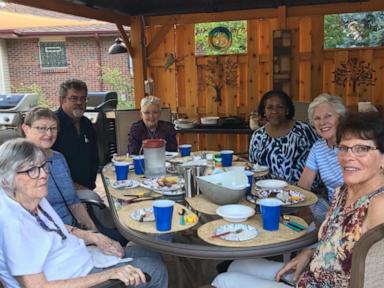
America is facing an unprecedented retirement affordability crisis, forcing aging single women to reinvent their living arrangements out of sheer economic survival. The idealized vision of "Golden Girls" style communal living—where aging friends share a beautiful home, split the grocery bills, and laugh over cheesecake—has transitioned from a sitcom trope into a rapidly growing lifestyle trend. But beneath the heartwarming media profiles of chosen families lies a much harder, systemic truth. For the vast majority of older women entering these arrangements, cohousing is not a whimsical lifestyle choice. It is a desperate, unregulated triage measure for an economy that has systematically failed them.
The math driving this shift is unforgiving. Single women face a compounding disadvantage as they age, enduring a lifetime of the gender wage gap, career interruptions for caregiving, and statistically lower Social Security payouts. When a spouse dies or a divorce occurs late in life, the economic floor drops out entirely. With traditional assisted living facilities now averaging over $5,300 a month and independent senior apartments trailing closely behind, communal housing has become the only viable alternative to homelessness for millions.
Yet, translating a television premise into reality reveals a minefield of legal, financial, and emotional liabilities that mainstream coverage consistently ignores.
The Economic Mirage of Shared Expenses
The initial appeal of senior house-sharing is purely financial. By splitting a mortgage or rent, utilities, and property taxes among three or four residents, individual monthly living costs can drop by 50% or more. This allows women on fixed incomes to retain their independence and avoid being forced into substandard institutional care.
The financial upside, however, assumes a level of stability that rarely exists in communal households. When three people co-sign a lease or jointly purchase a property, they become financially entangled in ways that traditional banks and landlords are ill-equipped to handle.
Consider the logistical nightmare of a joint mortgage among retirees. If one roommate suffers a medical emergency, burns through her savings, and stops paying her share of the housing costs, the remaining residents are legally responsible for the shortfall. Banks do not care about roommate agreements; they care about the total monthly payment. A single vacancy or financial default can trigger a domino effect, putting the entire household at risk of foreclosure or eviction.
Furthermore, the hidden costs of aging in place are rarely distributed equitably. Modifying a home to accommodate physical decline—installing wheelchair ramps, widening doorways, or remodeling bathrooms for accessibility—requires significant capital. Disagreements over who pays for these upgrades, especially if only one resident currently needs them, routinely fracture otherwise stable households.
The Unspoken Caregiving Burden
The most dangerous assumption inherent in the modern cohousing movement is that roommates can substitute for professional medical care. Media narratives frequently highlight the benefit of having someone around to notice if you fall or help you after a minor surgery. This works well when everyone is relatively healthy. It fails catastrophically when a resident develops a chronic, degenerative illness or cognitive decline.
Living with someone who has mild cognitive impairment or early-stage dementia transitions a roommate from a peer into an unpaid, untrained, full-time caregiver.
This dynamic creates intense ethical and physical strain. A roommate who signed up to share a kitchen and split utility bills suddenly finds herself managing another adult's medication schedule, cooking every meal, and monitoring behavior. Because women are socially conditioned to accept caregiving roles, many endure these situations long past their breaking point, sacrificing their own health and financial security in the process.
When the burden becomes too great, eviction becomes an agonizing necessity. Evicting a vulnerable, aging friend from a shared home is a logistical and emotional horror. If the ailing resident is a co-owner of the property, removing them legally to ensure they receive proper institutional care can require protracted, expensive court battles over partition sales and guardianship.
Zoned Out of the American Dream
Even when a group of women finds the perfect partners and establishes a solid financial agreement, they frequently run headfirst into a wall of local government bureaucracy. The American housing market was built around the nuclear family, and municipal zoning laws heavily reflect this bias.
In many suburban jurisdictions across the country, strict "unrelated occupant" laws cap the number of people who can live together if they are not related by blood, marriage, or adoption. Originally designed to prevent overcrowded college party houses or exploitative boarding homes, these ordinances are now being weaponized against seniors.
A group of four retired women renting a large suburban home can find themselves facing thousands of dollars in fines or code enforcement evictions simply because local statutes draw the line at three unrelated adults.
Amending these zoning laws requires navigating a sluggish, souvent adversarial local political landscape. Homeowners' associations (HOAs) pose an even more immediate threat. Many HOAs maintain strict rules regarding long-term guests, vehicle parking limits, and structural modifications, effectively outlawing the operational realities of a senior cohousing arrangement before it even begins.
The Friction of Chosen Families
Living with peers in your twenties is difficult; doing it in your seventies is an entirely different structural challenge. By the time a person reaches retirement age, their habits, biases, sleep schedules, and personal boundaries are deeply calcified.
Simple domestic disagreements can escalate into irreconcilable living situations. Consider a hypothetical example where four women share a home: one insists on keeping the thermostat at 68 degrees to manage hot flashes, another requires a 75-degree environment due to poor circulation from diabetes, a third has a dog that barks at night, and the fourth is highly sensitive to noise. In a traditional family structure, these conflicts are navigated through established, decades-old dynamics. In a newly formed household of seniors, they become grounds for legal dissolution.
The absence of an objective, third-party authority—like a landlord or a facility manager—means that every interpersonal conflict must be resolved through direct confrontation or mediation. When communication breaks down, the living environment turns toxic, directly impacting the physical and mental health of vulnerable residents.
Designing a Bulletproof Co-Living Framework
For women determined to pursue this path despite the structural headwinds, success requires abandoning the romanticized sitcom narrative and adopting a cold, corporate approach to domestic life. A handshake agreement is an invitation to disaster.
The foundation of any resilient cohousing arrangement is a comprehensive, legally binding cohabitation agreement drafted by an elder law attorney. This document must explicitly outline the protocol for every worst-case scenario.
First, it must define clear exit strategies. If a resident wants or needs to leave the house, the agreement must dictate how their financial equity is calculated, how long the remaining residents have to buy them out, and how a replacement roommate is selected and vetted.
Second, the contract must establish hard boundaries regarding health and caregiving. It must explicitly state what level of medical decline triggers a mandatory transition to a higher level of professional care, eliminating the ambiguity and guilt that often paralyzes households when a roommate’s health deteriorates.
Third, financial contributions must be structured through a joint household operating account, with a mandatory reserve fund equal to at least six months of total household expenses. This buffer ensures that if one resident experiences a financial shock, the household can maintain its mortgage and utility obligations without facing immediate crisis.
The "Golden Girls" phenomenon is a rational response to an irrational economic reality. It offers a powerful antidote to the epidemic of senior loneliness and the crushing burden of housing inflation. But celebrating it as a simple, heartwarming lifestyle trend obscures the profound risks involved. Only by treating shared housing as a complex business venture can older women truly protect their savings, their health, and their dignity.