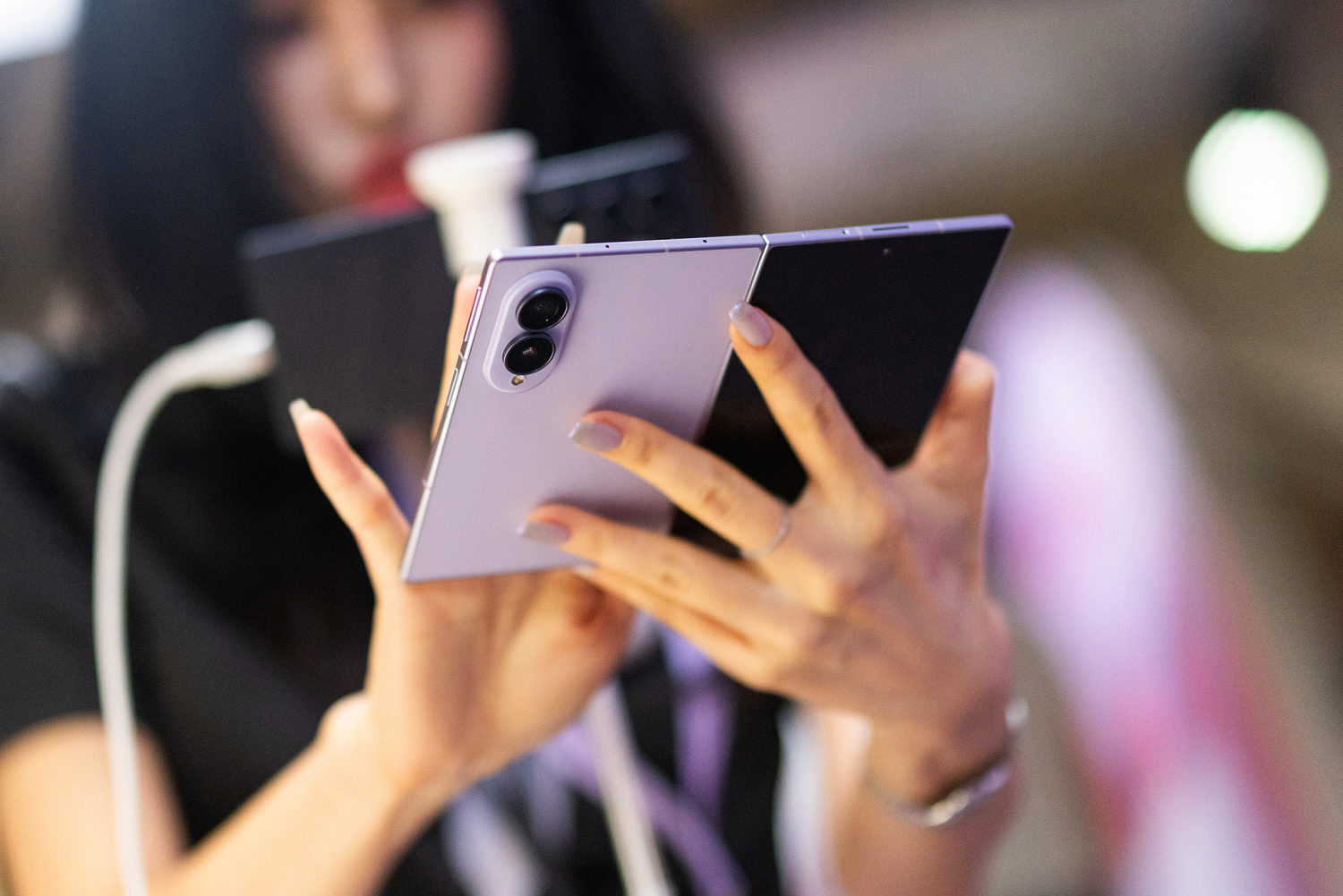
The Snap That Changed Nothing
Snap.
That was the sound that was supposed to redefine how we interact with information. It was 2019, and the tech industry stood on its tiptoes, holding its breath for the arrival of the foldable phone. Engineers promised us a revolution in our pockets: a pocket-sized rectangle that could unfurl into a cinematic canvas, merging the portability of a smartphone with the raw spatial real estate of a tablet.
Yet here we are, years into this grand experiment, and the world hasn't quite shifted on its axis the way the pitch decks swore it would.
Walk down any crowded city street. Look at the train commuters glued to their screens, or the cafe patrons scrolling through morning feeds. You will see an endless sea of rigid, flat glass slabs. The promised folding revolution remains a niche curiosity, a high-priced flex for early adopters rather than the ubiquitous standard we were told was inevitable.
Why? Because folding a piece of glass in half turned out to be the easy part. The hard part was convincing us that our lives were actually better for it.
The Engineer's Nightmare
To understand where the dream stuttered, consider Sarah—a hypothetical senior hardware engineer working inside a major consumer tech firm.
Sarah’s entire career has been a war against physics. Standard glass does not like to bend. When you force standard glass to bend, it shatters into a thousand sharp, expensive light-reflecting fragments. To bypass the laws of basic materials science, teams like Sarah's had to replace traditional cover glass with Ultra-Thin Glass, a material microscopic in thickness, layered over flexible plastic substrates.
Then came the hinge.
A smartphone hinge is a marvel of miniaturization. It contains dozens of interlocking micro-gears, sweepers designed to brush out dust, and liquid-resistant seals. If a single grain of sand gets trapped inside that gear system while you pocket your device at the beach, the display underneath can bleed black ink from the inside out.
Every time Sarah’s team solved a mechanical hurdle, a human hurdle popped up to replace it.
- The Crease: No matter how clever the water-drop hinge design, a faint indentation remains down the middle of the display. Under bright office lights, it catches the reflection like a scar.
- The Weight: Dual batteries, dual screens, and heavy metal hinges turned slim devices into thick, heavy bricks that sagged down coat pockets.
- The Durability Gap: Consumers expect a thousand-dollar phone to withstand a drop onto concrete. A screen covered in flexible plastic, by its very nature, can be dented by a sharp fingernail.
The hardware feats were nothing short of miraculous. But technology does not win hearts purely through engineering bravado. It wins by solving an aching, persistent human frustration. And that is where the narrative began to fray.
The Problem of the Double-Tap Life
Think about how you actually use your phone on an average Tuesday.
You pull it out of your pocket to check a notification. You glance at a text, dismiss a calendar reminder, scan a QR code, or check the weather. These are micro-interactions. They take three seconds. They happen fifty, a hundred, two hundred times a day.
With a traditional phone, that interaction is frictionless. You tap, you glance, you pocket.
Now consider the foldable experience. To reach your full-sized screen, you must now introduce a physical barrier: the unbending. It requires two hands, or a deliberate, forceful thumb-flick. Do that two hundred times a day, and the gesture transforms from a novelty into a minor tax on your patience.
Suddenly, the dual-screen compromise was born. Manufacturers realized people didn't want to open their phones just to read a text message, so they added an outer display.
Consider what happened next: the foldable phone became two separate phones glued back-to-back. An expensive, smaller cover screen for your quick tasks, and a hidden interior screen for your "focused" tasks. But in an era where our attention spans are fragmented into milliseconds, how often do we actually sit down to do deep, focused work on a screen that fits in our palm?
We found ourselves paying double the price for a device that asked us to work twice as hard to access its main feature.
The Invisible Stakes of Convenience
It is easy to mock tech hypes that stumble out of the gate. We saw it with 3D televisions. We saw it with early smartwatches. But the foldable battle is different because the stakes aren't just about selling more gadgets; they are about the ultimate destination of consumer hardware.
We have reached peak smartphone.
For nearly a decade, every new flagship phone has looked identical to the last. A dark glass rectangle with slightly faster processors, slightly better camera lenses, and slightly longer battery life. The market became stagnant because flat slabs reached near-perfection. They are water-resistant, durable, bright, and light.
Foldables represent the industry’s desperate attempt to break out of this design cul-de-sac. Tech giants aren't pushing foldables just to show off—they are doing it because they know that if phones stop changing, people stop buying new ones every two years.
Yet, while corporate boardrooms view foldables as the savior of hardware margins, users view them through a far simpler lens: Does this make my day easier?
When a device costs significantly more than a standard premium flagship, users demand flawlessness. They don't want to worry about fingernail dents. They don't want to fear rain or beach dust. They don't want to compromise on camera quality to accommodate the tight spatial real estate inside a folding chassis.
The market didn't reject the foldable phone because it was a bad idea. It paused because the trade-offs outweighed the magic.
A Shift in the Wind
Hardware eventually catches up to ambition. It always does.
Look at the evolution over the past eighteen months. The thick, awkward bricks of the first generation have started to yield to remarkably thin profiles. Hinges are getting lighter. Dust resistance is slowly making its way into spec sheets. The crease, while still present, is softening.
Software, too, is beginning to discover its voice. Instead of just blowing up phone apps to fit a squarish display, developers are finding genuine utility in split-screen multitasking. Imagine taking a video call on the top half of a propped-up device while reviewing a spreadsheet on the bottom half, all without carrying a laptop stand.
That is the moment the narrative flips—not when the tech looks cool in an advertisement, but when it silently solves a chaotic moment during a busy workday.
The battle for the future of mobile design isn't being won in flashy keynote presentations with soaring music and rendered videos. It is being fought in quiet repair centers, in glass manufacturing labs, and in the hands of everyday users who just want a screen that doesn't feel fragile.
We aren't waiting for a grand breakthrough. We are waiting for the moment the technology disappears entirely into the background, leaving behind nothing but utility.
You pick up a device. It opens effortlessly. The line down the center vanishes under the glow of the pixels. You forget that you are holding a miracle of mechanical engineering, flexible glass, and microscopic gears. You just use it.
Until that moment arrives, the flat glass slab sits quietly in our pockets, unbroken and undefeated.