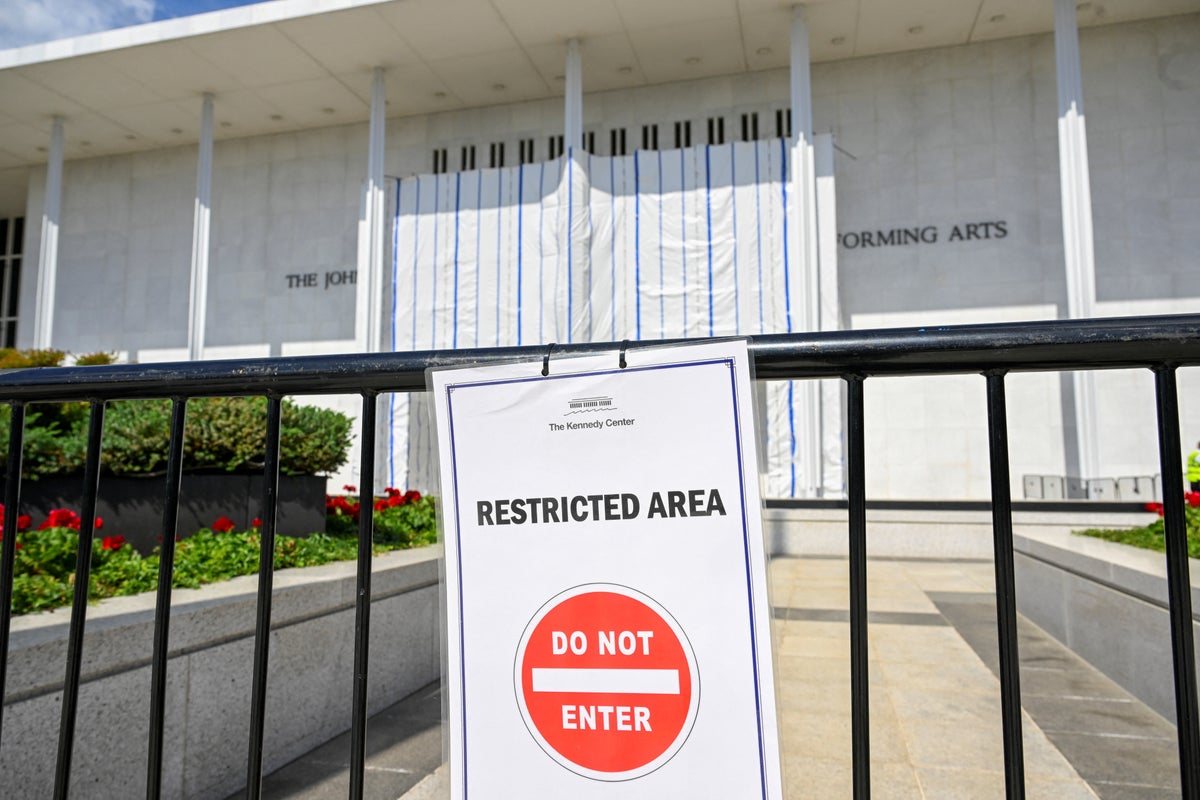
The marble of the John F. Kennedy Center for the Performing Arts was never meant to shout. When Edward Durell Stone designed the building in the late 1960s, he chose white Carrara marble—a gift from Italy—to capture a specific post-war American ideal. It was clean, bright, and monumental, yet intentionally understated. It was a physical manifestation of a young president’s belief that art and democracy should walk hand in hand, unburdened by the heavy, gold-flecked ornamentation of European monarchies.
For decades, the building stood as a temple to that quiet restraint. Don't forget to check out our previous article on this related article.
Then came the rush.
Deep within the restricted corridors of the presidential suite, far from the eyes of the patrons buying tickets for the evening opera, the quiet was replaced by the frantic screech of power saws and the chemical tang of quick-drying adhesive. An arbitrary deadline was ticking down. The calendar was screaming toward January 2021, and a specific aesthetic vision—one of heavy drapery, deep golds, and neoclassical opulence favored by the outgoing administration—had to be realized. To read more about the background of this, The Washington Post provides an informative breakdown.
The cost of that rush, however, would not be measured in dollars alone. It would be measured in cracked plaster, compromised fire barriers, and a betrayal of the very craftsmanship the building was built to celebrate.
The Illusion of Grandeur
Consider the perspective of an inspector walking into a newly renovated space. On paper, the project promised a majestic overhaul of the presidential box and its lounge, bringing back what proponents called a classic, dignified architecture.
But step closer.
Under the glare of a work light, the illusion crumbles. What looks like solid, historic molding is actually cheap, pre-fabricated polyurethane, slapped onto the walls with construction adhesive. The joints do not align. A gap wide enough to slip a coin through is filled with a hasty bead of caulk, already shrinking and yellowing under the heat of the lights.
In the rush to drape the walls in thick, heavy fabrics that evoked an idealized past, basic safety protocols were treated as mere suggestions. Inspectors later discovered that flame-retardant barriers behind the walls had been breached or omitted entirely to run wiring quickly. The very materials meant to protect dignitaries and artists from a catastrophic fire were cut away to make room for decorative trim.
It was a theater of safety masking a stage of high risk.
The workers on the ground knew it. Several of them, speaking through whistleblower reports, described an environment of intense, top-down pressure where speed was prioritized over structural integrity. To understand their frustration, one must understand the pride of a true tradesperson. A master plasterer or a finish carpenter does not want to leave behind a legacy of crumbling joints. They were forced to choose between their paychecks and their standards.
When Speed Suffocates Skill
The pressure to complete the renovation before the presidential transition created a frantic, 24-hour cycle of corner-cutting.
To visualize the chaos, imagine a painter being told to apply a fresh coat of oil-based enamel over a wall that is still damp from fresh plaster. The physical laws of construction do not bend for political timelines. The moisture must go somewhere. Within weeks, the paint began to bubble. It blistered, then peeled away in graying ribbons, revealing the damp, chalky failure beneath.
- The fire doors: Heavy wood doors, designed to swing shut automatically and seal off oxygen in the event of an emergency, were planed down and misaligned to accommodate thick, plush carpeting that had been laid down without measuring the clearances.
- The wiring: Electrical conduits were left exposed in ceiling plenums, snaking over metal ducts in direct violation of local building codes.
- The structural support: Heavy ornamental fixtures, including mirrors and light sconces weighing dozens of pounds, were anchored directly into drywall rather than the metal studs behind them.
One sudden jar, one slamming door, and the heavy glass could come crashing down.
This was not a renovation. It was a stage set. It was designed to look magnificent for a single photograph, after which the actors would exit stage left, leaving the stagehands to figure out how to keep the walls from collapsing.
The True Cost of a Veneer
The tragedy of the rushed renovation is that the Kennedy Center is not a temporary installation. It is a living monument.
When public officials treat a national cultural center as a personal canvas to be quickly redrawn before the moving trucks arrive, the taxpayer ultimately foots the bill for the correction. The cost to repair the shoddy workmanship—tearing out the bubbling plaster, re-hanging the fire doors, tracing the faulty wiring—often doubles the original budget.
But the deeper damage is symbolic.
The Kennedy Center was built to show the world that a free society could produce art and architecture that would stand the test of time. It was an investment in permanence. When we replace that permanence with hasty, gold-painted plastic, we confess a quiet belief that appearance is more important than substance. We admit that we care more about how things look on a screen than how they hold up under the weight of reality.
Somewhere in the quiet hours after the performances end, when the crowds have gone and the stage lights are down, the building settles. In the presidential suite, behind the heavy, light-blocking curtains, a tiny flake of gold paint drifts silently to the floor, landing on a carpet that was never supposed to be there.