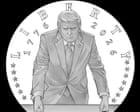
In a quiet room tucked away from the roar of the 24-hour news cycle, a group of people sat around a table to decide how history should feel in the palm of your hand. They weren't looking at policy papers or polling data. They were looking at sketches. Lines of graphite and ink that would soon be struck into 24-karat gold.
The Citizens Coinage Advisory Committee and the Commission of Fine Arts recently gave their nod to a design that is far more than a piece of currency. It is a commemorative coin honoring the 45th President of the United States, Donald J. Trump. To some, it is a shimmering badge of a movement. To others, it is a lightning rod for the complex anxieties of a divided era. But for the engravers and the officials, it is a technical challenge of immense proportions: how do you trap a personality that large in a circle of precious metal?
Gold is a strange, stubborn medium. It doesn't forgive a weak design. It carries a weight that paper money can never replicate. When you hold a one-ounce gold coin, you aren't just holding $2,500 or more in market value; you are holding a physical manifestation of permanence.
The Weight of the Image
Imagine a hypothetical collector named Elias. He lives in a small town in Ohio and has spent thirty years working in a machine shop. For Elias, this coin isn't about "macroeconomics" or "political discourse." It’s about the tangible. He remembers a time when things were made of steel and grit, and he sees this gold coin as a way to anchor his savings to something that won't vanish in a digital cloud.
When he looks at the approved design, he isn't just seeing a portrait. He is seeking a reflection of his own beliefs about strength and American identity. The appointees who cleared the design had to balance this emotional demand with the rigid traditions of the United States Mint. They had to ensure that the profile—the tilt of the head, the set of the jaw—conveyed the specific "tenacity" that defined the Trump presidency.
Designing a coin for a living person is always a tightrope walk. Most American currency features leaders long since passed into the hazy glow of myth. Their flaws have been sanded down by time. But with a figure as contemporary and polarizing as Trump, the metal becomes a battlefield. Every line etched into the die is a choice. Does the artist emphasize the populist fire or the executive stature?
The technical reality is that the U.S. Mint uses some of the most sophisticated technology on the planet to ensure these coins are "proof" quality. This means they have a mirror-like background and frosted foreground details. It creates a 3D effect that makes the portrait seem to float within the gold. To achieve this, the dies are polished by hand using diamond paste. It is a slow, methodical process that stands in stark contrast to the rapid-fire nature of the political world the coin represents.
Beyond the Bullion
There is a hidden friction in the world of numismatics. Coins are supposed to be universal, yet they are inherently exclusionary. A 24-karat gold coin is not something the average American uses to buy bread. It is a store of value. It is a legacy.
Consider the "invisible stakes" of this approval. By authorizing a gold commemorative for a recent president, the government is engaging in a form of official storytelling. They are saying: This mattered. This is a milestone worth preserving in the most indestructible element we have.
But there is a human cost to this obsession with gold. For every collector like Elias who feels validated by the coin, there is someone else who views the glint of that 24-karat surface as a symbol of a gilded age they feel left behind by. The coin becomes a mirror. What you see in it depends entirely on where you stand when the light hits it.
The market for these coins is driven by more than just the spot price of gold. It is driven by "perceived scarcity" and "historical resonance." When the Treasury appointees approve a design, they are essentially minting a piece of the American psyche. They are betting that decades from now, someone will pull this coin out of a velvet box and feel a rush of what it was like to live through these years.
The Alchemy of Memory
Gold doesn't tarnish. It doesn't rust. It doesn't decay. That is why we use it to remember.
But history is rarely as clean as a freshly minted coin. The real story of the Trump presidency—the rallies, the courtroom dramas, the legislative battles, and the cultural shifts—is messy, loud, and often painful. The coin attempts to distill all of that noise into a single, silent image.
It is an act of alchemy. We take the leaden weight of our political arguments and try to turn them into something beautiful and valuable. We want to believe that if we can just get the design right—if the gold is pure enough and the strike is deep enough—we can find a sense of closure or celebration that eludes us in the real world.
The appointees who sat in that room and looked at the sketches were performing a ritual as old as empire. From the gold staters of Alexander the Great to the sovereigns of Queen Victoria, leaders have always used the mint to assert their place in the timeline of humanity.
The real test of this coin isn't the approval of a committee or the purity of the metal. The test happens twenty years from now.
It happens when a grandchild finds the coin in a drawer and asks what it was for. In that moment, the gold won't speak. It won't argue. It will just sit there, heavy and cold, reflecting whatever light is left in the room.
The design is approved. The dies are being cut. The gold is being melted. But the meaning of the coin is still being written by the people who will never get to hold it, and by those who will hold it so tight their palms begin to ache.
The minting process is a violent one. Thousands of pounds of pressure slamming into a blank disc to force the metal into the shape of a man's face. It is a fitting metaphor for the era. We are all being pressed. We are all being shaped by forces larger than ourselves.
When the first of these 24-karat coins finally rolls off the press, it will be perfect. It will be flawless. It will be exactly what the committee envisioned.
Outside the mint, the world will remain as fractured and complicated as ever, oblivious to the fact that someone has finally managed to make a part of it stay still.