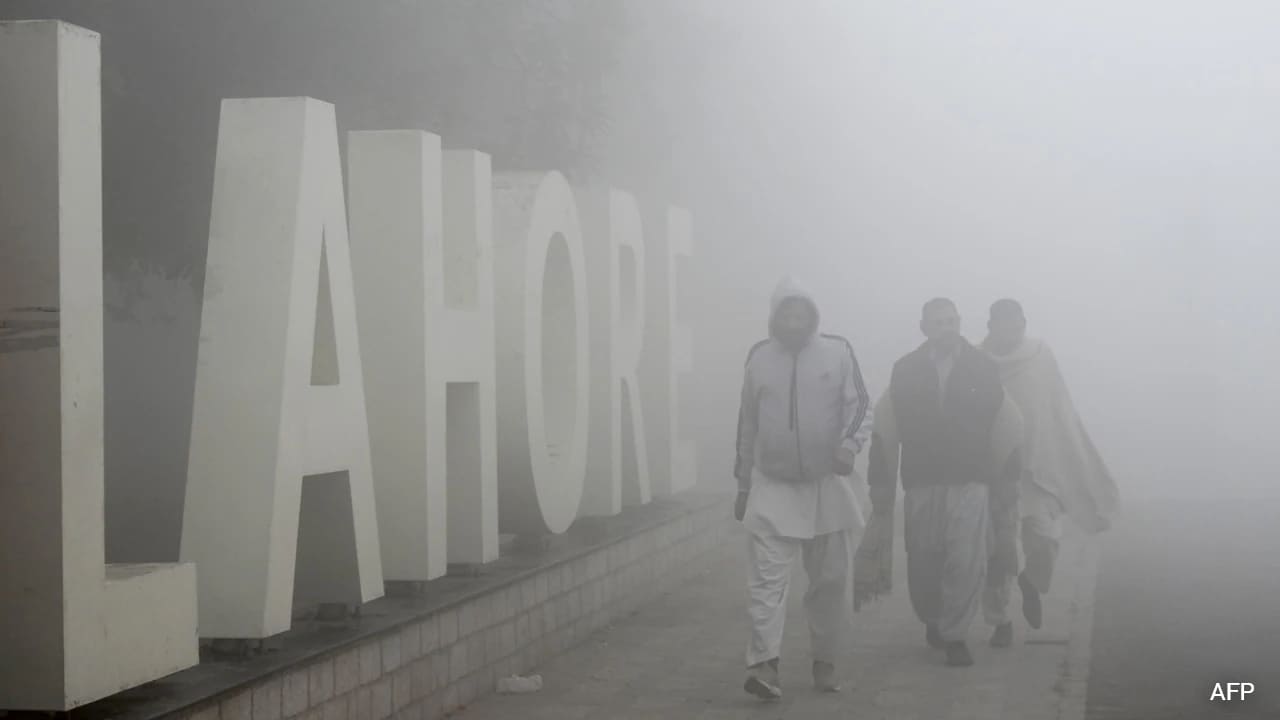
November in Lahore no longer arrives with the crisp, woodsmoke sweetness of old songs. It arrives like a wet wool blanket pressed over your face.
You wake up at six in the morning with the taste of copper pennies on your tongue and a dull, grinding ache behind your eyes. Outside the bedroom window, the neem tree twenty feet away has vanished into a bruise-colored soup. Your lungs do not expand so much as they negotiate, taking shallow, suspicious sips of an atmosphere that feels thick enough to chew. By midday, the sun is a pale, sickly coin floating in a grey void, casting no shadows on the asphalt below.
For years, whenever this annual suffocation descended upon Punjab, the official script was as predictable as the changing of the season. Someone in a crisp suit behind a mahogany desk would point a finger eastward, across the Wagah border toward India. The culprit, we were told with righteous certainty, was Diwali. Fireworks in Amritsar and Delhi, combined with crop stubble burning across Indian Punjab, had supposedly created a toxic cloud that drifted west to poison Pakistani lungs.
It was a convenient story. It turned an environmental catastrophe into a geopolitical grievance, shifting anger away from local failures and onto an old rival.
Then, the data refused to play along.
The Numbers That Refused to Salute
To understand how completely that narrative collapsed, consider a hypothetical morning in the life of Tariq, a composite character representing thousands of pulmonologists working in Lahore's overcrowded emergency rooms every winter.
Imagine Tariq standing at the triage desk at 3:00 AM. The Air Quality Index on his phone screen has just ticked past 600—a number so far beyond the World Health Organization’s safe threshold that international scales literally run out of colors to describe it. Anything above 300 is labeled hazardous. At 600, the air outside is an active biological assault. Around him, the waiting room echoes with the dry, barking coughs of toddlers clutching nebulizer masks and elderly men wheezing as if breathing through a pinched straw.
If Tariq turned on the television in that waiting room, he would hear commentators blaming festival sparks from across the border. Yet, when the Environment Protection Department of Punjab—Pakistan’s own provincial environmental agency—finally analyzed the wind patterns, satellite imagery, and particulate composition during peak smog spikes, the official excuse disintegrated.
The agency’s own findings revealed an uncomfortable truth. During the worst surges, when the Air Quality Index shattered records in Lahore and Multan, the prevailing winds were not even blowing consistently from the east. More damning still, the chemical fingerprint of the air told a story that had nothing to do with festive gunpowder across a border.
What Smoke Actually Remembers
Smoke has a memory. Every source of combustion leaves behind a distinct molecular signature, much like a fingerprint left on a glass.
When fireworks explode, they release brief, sharp spikes of heavy metals like barium, strontium, and copper—chemicals used to paint the night sky red, green, and blue. Those spikes are intense, localized, and short-lived. They flare up for a night or two and then dissipate as particles settle or disperse.
Lahore’s choking fog does not flare and fade. It sits. It stews. It builds week after week from October into January.
When scientists examined the fine particulate matter—microscopic specks known as PM2.5, which are thirty times narrower than a human hair—they found the overwhelming bulk of the poison was homegrown. It was the residue of low-grade diesel fuel burning in millions of poorly maintained motorcycles, rickshaws, and trucks idling in gridlock. It was the soot from thousands of traditional brick kilns ringing the city, belching black plumes day and night. It was the smoke from local crop residue burned by farmers on the Pakistani side of the border, clearing fields quickly and cheaply for the winter wheat sowing. And it was the industrial exhaust from factories operating without scrubbers or filtration.
Think of Lahore in winter as a bowl with a lid slammed onto it.
During the warmer months, the sun heats the ground, creating rising currents of warm air that carry pollution high into the atmosphere where winds sweep it away. Come November, the ground cools rapidly at night. A layer of cold, dense air gets trapped near the surface beneath a ceiling of warmer air above. Meteorologists call this a thermal inversion. In plain terms, the sky stops ventilating. Everything a city of fourteen million people burns, drives, cooks, and manufactures stays trapped at street level, circulating right back into the noses and throats of the people who produced it.
Blaming fireworks hundreds of miles away for a thermal inversion over Lahore is like locking yourself inside a garage with a running car engine and blaming your neighbor’s barbecue for the carbon monoxide.
The Anatomy of an Invisible Poison
Why does a number like 600 on the Air Quality Index matter soviscerally? Because PM2.5 is small enough to bypass every natural defense your body spent millions of years evolving.
Nose hairs trap dust. Mucus catches pollen. Your throat coughs up ash. Fine particulate matter laughs at all of it. Slipping effortlessly past the bronchial tubes, these microscopic daggers lodge deep inside the alveoli—the delicate, grape-like air sacs where oxygen crosses into your bloodstream. Once there, they do not simply sit inertly. They cross directly into your blood, triggering systemic inflammation that travels to your heart, your brain, and your kidneys.
Breathing air with an AQI over 600 for a single day carries a physiological toll roughly equivalent to smoking more than a pack of cigarettes. Except nobody asks an infant in a crib in Gulberg or a street vendor in Anarkali if they would like a cigarette. They are forced to chain-smoke the city simply by staying alive.
Medical researchers tracking South Asian air quality have documented what this silent siege does over time. Life expectancy in Lahore drops by more than seven years due to air pollution alone. Seven years stolen from every life—not by a sudden war or a dramatic plague, but by the slow, cumulative wear of dirty air thickening blood vessels and scarring lung tissue.
I remember walking through Liberty Market during one of those peak red-alert afternoons a couple of winters ago. The air smelled faintly of burnt rubber and wet ash. What struck me most was not the coughing, though you could hear it every ten paces. It was the strange, eerie quietness of the streets. Children were not playing cricket in the alleys. Schools had been ordered shut in a desperate emergency measure. People hurried from doorways to cars with scarves wrapped tightly over their mouths, eyes watering, moving with the hunched shoulders of people bracing against a cold rain that never fell.
You start to doubt your own senses in weather like that. You wonder if the headache is from lack of sleep, if the scratch in your throat is a mild cold, if the fatigue dragging at your limbs is just stress. That is the insidious nature of slow-motion disasters. When poison becomes the baseline, people adapt their expectations downward until struggling to breathe feels like just another Tuesday.
Why the Myth Survived So Long
If the science was always clear, why did the Diwali narrative hold sway for so many years?
Because accountability is expensive, and nationalism is free.
Fixing Lahore’s air requires confronting powerful, entrenched interests at home. It means enforcing fuel quality standards on refineries that produce dirty diesel with sulfur levels dozens of times higher than European norms. It means forcing thousands of brick kiln owners to convert to cleaner zig-zag technology—and actually inspecting them to ensure they do not revert to burning old tires and industrial waste when inspectors look away. It means giving smallholder farmers affordable machinery like Happy Seeders so they can mulch rice stubble into the soil instead of setting fire to their fields because they cannot afford any other option before planting wheat.
It also requires honest regional diplomacy. Crop burning happens on both sides of the Radcliffe Line. Smoke does not carry a passport, and winds do not stop at border checkpoints. When weather systems do carry agricultural smoke across Punjab, it is a shared airshed problem that demands joint monitoring, shared agricultural subsidies, and cross-border cooperation between Indian Punjab and Pakistani Punjab.
Pointing at a religious festival across the border accomplished the exact opposite. It gave officials a headline that required zero domestic reform. Better yet, it tapped into decades of historical friction, inviting citizens to direct their frustration outward rather than asking why their own municipalities had failed to regulate industrial emissions or build functional public transit.
When Pakistan’s own environmental agency dismantled that scapegoat—acknowledging that local vehicular emissions, industrial smoke, and domestic agricultural burning were the primary engines driving the crisis—it was a rare moment of institutional candor. It stripped away the comforting illusion that Lahore’s misery was imported.
The Cost of Looking Away
Confusion is easy to forgive; willful blindness is not. For years, ordinary families in Lahore bought expensive HEPA air purifiers—those who could afford them, anyway—while millions of working-class laborers, traffic wardens, rickshaw drivers, and construction workers stood unprotected in the grey haze for twelve hours a day.
Consider what happens when a society finally loses its favorite excuse.
At first, there is anger. When the scapegoat disappears, the mirror appears in its place. Citizens look at the unchecked sprawl of concrete eating up greenbelts, the lack of reliable buses forcing millions onto two-stroke motorbikes, and the factories running unmonitored through the night.
Yet, there is a strange relief in truth, even brutal truth. If a problem comes entirely from somewhere else, you are helpless—a passive victim waiting for someone beyond your reach to change their behavior. If the poison is coming from your own tailpipes, your own kilns, and your own fields, then the power to clear the sky lies within your own borders.
Cities have choked before and recovered. London in December 1952 suffered a five-day "Great Smog" so thick that buses had to be led through the streets by men carrying lanterns on foot; it killed thousands before Parliament passed the Clean Air Act and banned coal burning in urban zones. Beijing, once synonymous with apocalyptic gray skies and surgical masks, cut its fine particulate pollution by more than forty percent over a single decade by shutting down coal plants, restricting dirty vehicles, and enforcing ruthless industrial compliance.
Neither London nor Beijing cleared its sky by blaming the neighbors. They cleared it by measuring the smoke honestly, naming the sources without flinching, and paying the political price to clean them up.
Morning in the Grey
Back in Lahore, the air purifiers hum in the bedrooms of the fortunate, their tiny digital displays glowing red as they strain to scrub the invisible grit from indoor air. Outside, down in the servant quarters and along the canal roads where day laborers sleep under thin blankets, there are no filters. There is only the cold, heavy air, settling deeper into the lungs with every breath taken in sleep.
Tomorrow morning, the sun will rise behind a wall of gray, invisible until noon. Millions of engines will turn over, millions of lungs will tighten against the burn, and the sky over Punjab will keep its own honest ledger—recording every drop of dirty fuel, every uninspected smokestack, and every year we spent arguing about fireworks while the house filled with smoke.


