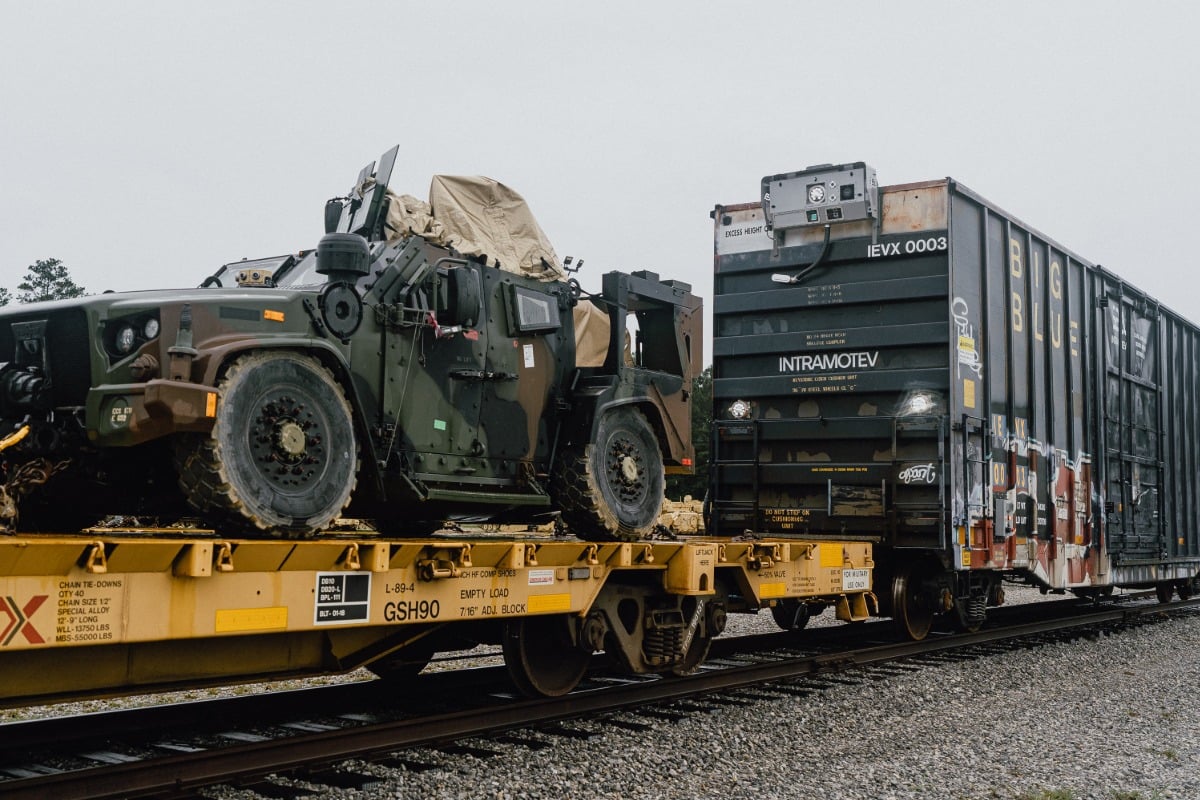
The wind across the tracks at the Curtis Bay Military Ocean Terminal carries the scent of salt, rust, and old diesel. If you stand near the switching yard long enough, the silence becomes heavy. For decades, this silence was shattered by the rhythmic, mechanical heartbeat of military logistics: the groan of steel wheels, the hiss of pneumatic brakes, and the shouting of crews working under the unforgiving glare of floodlights to move thousands of tons of ammunition, vehicles, and supplies.
Now, a different kind of quiet is taking over.
A lone railcar sits on the tracks. It looks ordinary from a distance, just another weathered boxcar or flatbed waiting to be coupled to a multi-engine train. But there is no locomotive attached to it. There is no engineer sitting in a high cab looking out over the tracks, coffee mug in hand. Instead, a faint electronic hum vibrates through the steel chassis. The railcar begins to move entirely on its own. It glides forward, shifts smoothly across a web of track switches, and halts precisely where it needs to be loaded.
This is the U.S. Army’s new experiment with autonomous rail technology. To the spreadsheet analysts in Washington, it represents an optimization strategy, a line item designed to streamline supply chains and reduce overhead. But to anyone who has ever spent a night in a switching yard or watched a supply convoy crawl through a hostile corridor, this driverless platform represents something far deeper. It is a fundamental shift in how we protect human life at the bleeding edge of global logistics.
The Invisible Weight of the Supply Chain
Imagine a young logistics specialist. Let us call him Specialist Miller. He is twenty-one years old, fueled by energy drinks and a sense of duty, tasked with moving heavy armor and artillery shells across vast, unpredictable distances. In the traditional theater of operations, moving cargo is an exercise in vulnerability. You need a locomotive, an entire crew, a security detail, and a predictable path.
When a supply line stretches across hundreds of miles, every mile is a gamble. Locomotives are massive, loud, and high-value targets. If a single engine is disabled, the entire supply chain grinds to a halt, leaving the men and women down the line waiting for the tools they need to survive. Miller knows that behind every crate of medical supplies or armored plating is a human vulnerability. The traditional rail network requires constant human touchpoints—coupling, uncoupling, switching tracks manually in hazardous environments, and sitting in exposed cabs for hours on end.
The Army's recent testing of these robotic railcars attempts to remove that vulnerability from the equation. By transforming individual railcars into self-propelled, intelligent units, the military is attempting to break the traditional, rigid structure of the train itself.
Consider how conventional rail logistics works. You aggregate dozens of cars, attach them to a massive locomotive, and move them all at once. It is efficient for commercial shipping, but rigid for military operations. If you only need to move three cars of critical equipment to an isolated outpost, you still need the entire apparatus of a train.
The autonomous railcar changes the geometry of the tracks. Operating on its own onboard propulsion system and guided by a suite of sensors, cameras, and localized computing power, a single car can detach itself from a larger group, navigate a complex rail yard, and travel down a branch line entirely unaided.
Breaking the Iron Chain
The technology relies on a combination of propulsion modules integrated directly into the railcar's bogies—the wheel assemblies beneath the carriage—and an array of automated control software. Instead of relying on a central locomotive to pull the weight, the car distributes its own power.
During the initial testing phases, engineers watched as these automated platforms communicated with track infrastructure, reading signals and responding to obstacles on the rails with a precision that human operators find both impressive and unsettling.
There is an inherent anxiety in watching a sixty-ton piece of steel move without a human hand at the throttle. Rail yards are notoriously dangerous places. The pinch points between cars can crush a human body in a split second. The momentum of rolling stock is unforgiving. Yet, the sensors on these robotic cars do not get tired. They do not lose focus during a blinding rainstorm or at three o'clock in the morning after a twelve-hour shift. They map the environment continuously, calculating stopping distances based on weight, speed, and track conditions.
But the real problem lies elsewhere, far from the controlled environment of a domestic testing facility.
What happens when the system encounters the chaos of an active deployment? A rail line in a conflict zone is not a pristine laboratory. Tracks warp under extreme heat. Debris blocks the path. Sabotage is a constant threat.
The true test of this technology is not whether a robot car can trundle down a straight track in Maryland, but whether it can make critical, split-second decisions when the world around it is falling apart. If an autonomous railcar detects an obstruction on the tracks in a hostile environment, it cannot simply stop and wait for a maintenance crew. It must possess the operational intelligence to assess the threat, communicate with the wider network, and potentially reverse its course to find an alternative route through the rail web.
The Human Cost of Efficiency
We often talk about automation as a means to cut costs, but in a military context, the currency being saved is blood. Every autonomous system deployed on a logistics route is a human being kept out of harm's way.
Think back to the supply convoys of the early 2000s. Thousands of soldiers drove unarmored or lightly armored trucks through territory littered with improvised explosive devices because the front lines needed water, ammunition, and fuel. Logistics was one of the most dangerous jobs in the entire theater. Rail transportation is inherently safer and more efficient than road convoys, but it has always remained bottlenecked by the need for massive, centralized infrastructure.
By decentralizing the rail network into individual, autonomous nodes, the target profile changes completely. A convoy of fifty trucks or a massive train stretching a mile long is impossible to hide. A single, silent, self-propelled railcar moving under the cover of darkness along an existing track is a ghost.
If an adversary manages to disrupt or destroy one autonomous car, the loss is purely material. The network adapts. The remaining cars reroute themselves, distributing the cargo across the available lines like data packets moving through the internet. The supply chain becomes resilient because it is no longer dependent on a single, fragile spine.
Yet, this transition brings an emotional weight for the people who have built their lives around the rail industry and military transport. There is a deep, historic romance tied to the sound of a train horn echoing across the countryside. It is a symbol of industrial might, human ingenuity, and collective effort. Replacing the human crew with a silent array of LiDAR sensors and electric motors feels like stripping the soul out of the machinery.
Veterans of the Transportation Corps look at these developments with a mixture of pride and melancholy. They recognize the undeniable utility of keeping soldiers out of the line of fire, but they also wonder what happens to the camaraderie forged in the grease and noise of the traditional yards.
The Unseen Network
The broader implications stretch far beyond the military. The technologies tested by the Army often find their way into the civilian world, where commercial rail networks face their own crises of efficiency, safety, and labor shortages.
Imagine a future where short-line railroads, long abandoned because they were economically unfeasible for massive locomotive-pulled trains, are revitalized by single, autonomous cargo units. Small towns could see goods delivered directly to local distribution hubs without the need for massive freight yards. The environmental impact of moving freight could drop drastically as these self-contained units utilize highly efficient electric or hybrid drivetrains, pulling power precisely when needed rather than idling a massive multi-thousand-horsepower diesel engine for hours.
But that future depends entirely on the lessons being learned right now on the testing tracks. Engineers are currently wrestling with the immense friction of the real world. Software updates must be pushed to ensure the cars can detect everything from a fallen tree branch to an intentional barricade. The communication protocols must be hardened against cyberattacks, ensuring that an adversary cannot simply hack the logistics network and redirect an entire shipment of military hardware to a different destination.
The work is slow, tedious, and largely invisible to the public. It takes place in dusty yards, on monitors filled with lines of code, and during endless test runs that involve moving a single car back and forth over the same stretch of track for days on end.
The sun begins to set over the testing grounds, casting long shadows across the ties and ballast. The autonomous railcar completes its loop, slowing to a gentle, perfectly judged stop inches from the bumper block. There is no triumphant shout from a crew, no whistle blow. Just the quiet click of a relay shutting down and the cooling hum of an electric motor.
The machine sits in the twilight, waiting for the next command from a server miles away, an unblinking sentinel in the evolution of how we move the things that sustain us.