The sound of an Israeli airstrike does not just rattle the windows in southern Lebanon; it tears the social fabric clean in half. When the sirens wail and the sky turns the color of bruised iron, survival reduces life to a simple, brutal math. How many seconds do we have? Who can fit in the car? What do we leave behind?
Too often, the answer to that last question is living, breathing, and terrified.
In the village of Kfaroue, tucked away near Nabatiyeh, the human population has largely vanished. They fled the escalating Israel-Hezbollah war, escaping to the relative safety of Beirut or northern camps. Some didn’t make it out in time; their stories ended abruptly in the rubble of targeted strikes. Left behind in the empty, dust-choked streets is a shadow population. Puppies huddled under collapsed porches. House cats pacing empty balconies, waiting for a key to turn in a lock that no longer exists. Livestock chained in stalls, watching the horizon with wide, unblinking eyes.
Then there is Hussein Hamza.
He did not run. Instead, he stayed behind to run an makeshift sanctuary that feels less like a traditional shelter and more like an ark built on dry, burning land.
The Arithmetic of Mercy
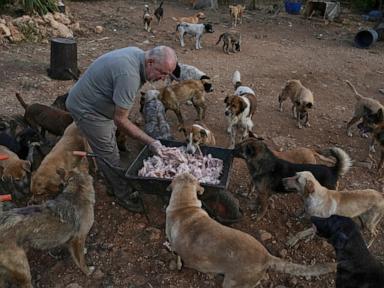
Every morning, Hamza steps out into an environment of extreme precarity. The air frequently vibrates with distant artillery. His operation is expensive, chaotic, and entirely unsustainable by any conventional economic metric. He burns through $400 to $500 a day. In a country experiencing severe economic friction, that sum is a small fortune. The money goes toward meat, kibble, basic antibiotics, and patching up fences shattered by concussive shockwaves.
Consider what happens when a community evacuates in panic. A family intends to return in two days, so they leave a bowl of water and lock the door. Two days turn into two weeks. Two weeks turn into two months. The water dries up. The silence turns heavy.
Hamza’s days are spent breaking into this silence. He coaxes terrified German Shepherds out of cratered living rooms. He treats a dog missing a limb—a casualty of shrapnel—bandaging the stump with steady, practiced hands. He even tends to a stray camel that wandered into the fray, its massive, prehistoric presence a bizarre monument to the absurdity of war.
The math is simple but devastating: more animals arrive every single week, but the resources to feed them are dwindling.
The Children of the Ark
The burden is heavy, but Hamza is not entirely alone. Ten-year-old Bashar Hilal moves among the pens with the easy confidence of someone who has forgotten how to be afraid.
While other children his age are learning to navigate the digital world or playing sports in safer climates, Bashar spends his afternoons cradling abandoned golden retriever puppies. A mixed-breed dog named Lucy, left behind when her owners fled the initial bombardment, routinely leaps up to lick the dust from the boy's face.
It is a striking juxtaposition. Around them, the infrastructure of the old world is splintering. Yet inside the wire fences of the Kfaroue shelter, a different kind of normalcy is forged. The dogs do not know about geopolitical borders, airstrikes, or ceasefires. They only understand hunger, pain, and the sudden, miraculous relief of a human hand offering a bowl of clean water.
For Bashar, the animals are a shield against the psychological toll of the conflict. You cannot easily succumb to panic when thirty dogs are demanding their evening meal.
The Invisible Cost of Survival
It is easy to look at animal rescue in a war zone as a secondary concern—a luxury for times of peace. Human lives, understandably, take precedence in the triage of global sympathy. But this perspective misses the deeper, systemic truth of what an animal represents to a community.
To a farmer in southern Lebanon, a goat or a dairy cow is not just property; it is a multi-generational livelihood, an insurance policy, and the difference between poverty and starvation when the guns finally fall silent. To an elderly widow who refused to leave her village until the final moment, a pet is the last remaining anchor to a life that has been completely erased.
When Hamza saves a dog, he is often keeping a placeholder for a human being’s future. Take Abbas Shoeib, a local man who recently arrived at the shelter. He wasn't there to abandon a pet; he was there to adopt a dog whose original family had been wiped out by an airstrike.
The adoption was a quiet, solemn transaction. There were no adoption fees or vetting processes. Just two survivors recognizing each other in the smoke.
The Horizon
The conflict shows no signs of slowing down, and the psychological weight of the situation is shifting. Early on, there was a trickle of hope that adoptions might keep pace with the influx of abandoned animals. A few dogs found homes further north. But as the threat of a wider regional escalation looms, potential adopters are freezing. People are hesitant to take on another mouth to feed when they don't know if they will have a roof over their own heads next month.
The shelter is filling up, the walls are closing in, and the daily bills keep mounting. Yet Hamza continues his rounds, hauling heavy sacks of feed through the midday heat, checking the water troughs, and speaking softly to creatures that have no understanding of why their world fell apart.
The true horror of war isn't just the destruction of concrete and steel; it is the total evacuation of tenderness from a landscape. In the dust of Kfaroue, a lone man and a ten-year-old boy are refusing to let that happen, one meal at a time.